
Securing New Zealand’s Future: Join the National Conversation on Critical Infrastructure Resilience

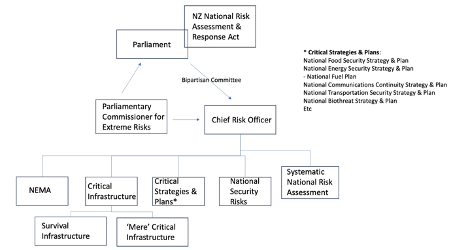
Enhancing the resilience of critical infrastructure needs to be part of a systematic and comprehensive approach to national risk (Figure: Adapt Research Ltd)

The NZCat Team has a vision for a secure New Zealand, resilient to large scale global disruptions and catastrophic risks. We’ve been researching anticipatory governance of risk, the process of effective national risk assessment, and we’ve published peer-reviewed research on specific risks such as pandemics, nuclear war, massive volcanic eruption, and risks from artificial intelligence.

Most recently we developed a NZ Hazard Profile for nuclear war, and conducted a cross-sector survey of this hazard, its likely impacts and mitigation strategies. We are now undertaking an in-depth interview study to consolidate this information before we publish our global catastrophes policy agenda in late 2023.

This background meant that we were very interested when the Department of Prime Minister and Cabinet called for submissions on their “Strengthening the resilience of Aotearoa New Zealand’s critical infrastructure system” Discussion Document.

The Discussion Document asks whether and how NZ’s critical infrastructure systems ought to be regulated to ensure resilience in the face of hazards, threats, and megatrends.

We have now made a detailed submission on this document noting that regulation is only one aspect of the systematic development of resilience, and arguing the need for better definitions, a wider net, a more systematic approach to national risk, and more focus on potential global catastrophes.

We encourage anyone else who thinks New Zealand needs to improve resilience to hazards and threats, across sectors such as food, energy, transport, and communications to make your own submission here.

You can read our full submission.

Or you can read the Executive Summary of our submission as follows…

Submission to the New Zealand Government: Strengthening the resilience of Aotearoa New Zealand’s critical infrastructure system

Executive Summary

We applaud the initiative to enhance the resilience of New Zealand’s critical infrastructure. In response to the Discussion Document, we make the following key points (explained in more detail in the full submission below).

  1. A distinction needs to be made between ensuring existing critical infrastructure is resilient and investing in infrastructure needed for resilience. NZ needs more of the latter (we give examples below) and this should be legislated.
  2. A further distinction needs to be made between infrastructure needed for survival (eg water, agriculture, food transport, heating, etc) and merely critical infrastructure. The current Emergency Management Bill does not yet achieve this.
  3. Regulation of survival and critical infrastructures should not stop at requirements for currently existing infrastructure. There are resilience infrastructures NZ currently lacks that would be critical to survival in certain catastrophe situations (eg, domestic biofuel production capacity, coastal shipping, seed stockpiles, etc). New Zealand must foster ‘resilient’ infrastructure and develop ‘resilience’ infrastructure.
  4. Any regulatory approach to critical national infrastructure needs to be informed by a properly resourced, systematic, public, and transparent National Risk Assessment that addresses all hazards and all threats to help prioritise risk mitigation activity.
  5. All hazards and all threats must mean exactly that (not just familiar or recent hazards such as flooding, earthquakes, or Covid-19) and explicitly include the global catastrophic risks that likely contain most of the risk to NZ. The risks should include catastrophic trade isolation and its impact on critical infrastructure.
  6. New Zealand could replicate something like the US Global Catastrophic Risk Management Act 2022 that defines and lists such risks and defines ‘basic needs’.
  7. If not the above detailed US-style legislation, there could be a NZ National Risk Assessment and Response Act, requiring government to conduct a regular comprehensive, publicly facing, systematic assessment of national risks, including cross-border global catastrophic risks, and to engage with the public, experts, and other stakeholders, including Australia, on these risks and possible solutions.
  8. The National Risk Assessment could be coordinated by a Chief Risk Officer or Parliamentary Commissioner for Extreme Risks tasked with overseeing and advising on the systematic national approach to risk, including regulation (see Figure above).
  9. There should be a public discussion, including government, media, and crowdsourcing of possible solutions, that explicitly addresses the trade-off between standard of living and security in the face of catastrophic risk, with clear options on the table for addressing resilience, and funding these investments.
  10. People today and in the future deserve equitable protection from risks, so investment in resilience should occur immediately, financed by borrowing, and paid for across the lifetime of the resilient infrastructure by all of those who benefit.
  11. The distinction made between ‘survival infrastructure’ and ‘merely critical infrastructure’, should leave government responsible for investing in, and maintaining survival infrastructure where it is not economic for the market to do so.
  12. Any ‘minimum standards’ should be informed by analysis of second (and higher) order impacts, for example using a NZ digital twin for plausible risks and using downward counterfactual analysis of previous events.
  13. We need to better understand the risks before contemplating minimum standards in the face of those risk conditions. However, minimum standards should include mandatory cooperation among providers/sectors/government and pre-catastrophe simulation/scenario exercises.
  14. The Government should be transparently clear with the public about the overarching framework for systematically approaching national risk, and employ a legislative and governance structure that does not omit key risks (ie includes clear responsibilities for addressing such risks as Northern Hemisphere nuclear war, bioweapon pandemic, climate altering volcanic eruption, severe solar storm, and other similar risks, all of which originate overseas, and none of which is a ‘malicious threat to NZ’).

You can read our full submission here.

Ready or Not? New research on the Global Health Security Index and implications for pandemic preparedness

Matt Boyd, Nick Wilson

Figure reproduced from Ledesma et al 2023

Summary/TLDR

  • The world remains vulnerable to the persisting risk of pandemics and other biological threats.
  • One tool for informing pandemic preparedness is the Global Health Security (GHS) Index, which was created in 2019 to benchmark countries.
  • However, analysis early in the Covid-19 pandemic did not show the expected correlation between GHS Index scores and Covid-19 outcomes.
  • Just published research now demonstrates that countries’ GHS Index scores do predict Covid-19 outcomes.
  • In particular, the GHS Index scores for the ‘risk environment’ category were most predictive, yet this category is not included in other preparedness tools such as the WHO’s Joint External Evaluation.
  • Governments can have some confidence in using the GHS Index to help guide pandemic preparedness efforts.
  • Governments can also learn from international exemplars such as the UK’s just-released comprehensive Biological Security Strategy

The world continues to face biological threats

Major health crises beyond the Covid-19 pandemic are almost certain in the future. The risks include pandemic influenza or a new infectious disease, as well as deliberate biological attacks or accidental release of agents used in biodefence research.  

The world may have learned some lessons from Covid-19, but a recent international scenario exercise indicated there is still work to do. In the fictional scenario, a state-sponsored agricultural attack led to a human pandemic because ongoing cyberattacks undermined the accuracy of data about the outbreak. This interplay between advancing technology and biothreats is concerning. Participants in this exercise agreed that current systems for assessing biological events of unknown origin are not up to the task. Compounding this is the risk that the new WHO treaty on future pandemics is being watered down and the design of future bioweapons could be informed by artificial intelligence.

The Global Health Security Index

The GHS Index is a comprehensive, criteria-based assessment of health security capabilities across 195 countries. It encompasses six categories relevant to health security and biological threats: Prevent, Detect, Respond, Health System, International Commitments, and Risk Environment.

However, during the early stages of the Covid-19 pandemic, research indicated that countries with the highest preparedness capacities paradoxically experienced the greatest levels of Covid-19 burden.1 For example, one study suggested that the higher the GHS Index score, the worse the impact of Covid-19 (see Figure).2

Aitken et al 2020

This finding was surprising given that analyses of pre-Covid-19 communicable disease data had found that the GHS Index was a valid predictor of mortality. For example, our own independent validation analysis of the GHS Index 2019, found that the proportion of deaths from communicable diseases decreased 4.8% for each 10-point rise in GHS Index.3

One possible reason for the perplexing GHS Index vs Covid-19 findings could be that more developed countries with high GHS Index values had provided better quality data, which biased analysis.4

New research on the GHS Index

A paper just published in the journal BMJ Global Health, presents an updated analysis of Covid-19 mortality for 183 countries, against GHS Index scores.5 Importantly, this analysis used data accounting for excess deaths (not just those formally attributed to Covid-19), throughout the pandemic (not just at the beginning) and accounted for the different age structures of countries’ populations. The analysis used data from the Institute for Health Metrics and Evaluation (IHME) modelling database and compared it to results derived from data that relied more heavily on country-reported deaths.

Results from this new analysis showed that country GHS Index scores were negatively associated with excess Covid-19 deaths (or more precisely age-specific cumulative mortality ratios) meaning that better preparedness predicted fewer deaths (see Figure, from Ledemsa et al5).

In particular, the ‘Response’ score and ‘Risk environment’ score appear to have the greatest correlation with reduced Covid-19 mortality (see the Table below and also Figure 2, from Ledemsa et al5).

This finding is counter to earlier claims that better GHS Index scores correlated with worse Covid-19 outcomes and provides some additional support for the use of the GHS Index as a metric of pandemic preparedness.

Of note were the strong results for the ‘Risk environment’ category, which assesses the socioeconomic, political, regulatory, and ecological factors that increase vulnerability to outbreaks. Notably this score includes government effectiveness and public confidence in government, as well as the level of inequality and social exclusion.

In the new analysis by Ledesma et al, ‘Health system’ score was the only category that was not clearly correlated with reduced excess mortality. However, when the authors adjusted for countries’ income and Covid-19 mitigation strategies (using the Oxford Stringency Index) the expected relationship was found.

‘Commitments to international norms’ and the ‘Risk environment’ are factors not considered by many other measures of pandemic preparedness (such as the WHO’s Joint External Evaluation process), yet both correlated with excess Covid-19 deaths.

The results using the IHME database were not replicated using WHO and The Economist excess mortality models (except for the ‘Risk environment’ category). The authors hypothesise that this is because the WHO and Economist models have a higher correlation with reported Covid-19 mortality and are not fully accounting for excess deaths. Underreporting of Covid-19 deaths is a particular problem, with surveillance studies suggesting actual Covid-19 deaths are ten times greater in some regions.6

What this means for NZ

We have previously described our country’s (NZ’s) rather suboptimal GHS Index score prior to the Covid-19 pandemic.7 8 We also described how this score had improved in the 2021 version of the GHS Index, with NZ lifting its ranking to become 13th in the world at 62.5/100, thanks to many of the capabilities developed during the pandemic.9

NZ should continue to optimise government effectiveness, strive to achieve equitable approaches with strong Māori leadership, and address sociological factors important in pandemic outcomes. This new research emphasises the need for central planning, effective decision-making mechanisms, and continued focus on issues of social cohesion and trust. Trust and cohesion are already looming vulnerabilities for NZ and in a pandemic context they are life and death.

The NZ Government should also advocate for newly recommended international approaches such as a UN Joint Assessment Mechanism for outbreaks of unknown origin, as well as a Response Coordination Unit. It should also identify and develop solutions to the highest priority cyber-biosecurity vulnerabilities and invest in stronger biothreat intelligence capabilities.

The latter feature strongly in the UK’s new Biological Threat Strategy, which includes a responsible Minister, a ‘Biothreats radar’, a 100-days vaccine action plan, and a Biological Security Task Force (responsible for exercising capabilities). 

Understanding the drivers of future biological harms can help us take effective actions to both prevent future pandemics and minimise harms if they cannot be avoided.

References

  1. Haider N, Yavlinsky A, Chang YM, et al. The Global Health Security index and Joint External Evaluation score for health preparedness are not correlated with countries’ COVID-19 detection response time and mortality outcome. Epidemiol Infect 2020;148:e210. doi: 10.1017/s0950268820002046 [published Online First: 2020/09/08]
  2. Aitken T, Chin KL, Liew D, et al. Rethinking pandemic preparation: Global Health Security Index (GHSI) is predictive of COVID-19 burden, but in the opposite direction. J Infect 2020;81(2):318-56. doi: 10.1016/j.jinf.2020.05.001 [published Online First: 2020/05/22]
  3. Boyd M, Wilson N, Nelson C. Validation analysis of global health security index (GHSI) scores 2019. BMJ Glob Health 2020;5:e003276.
  4. Markovic S, Salom I, Rodic A, et al. Analyzing the GHSI puzzle of whether highly developed countries fared worse in COVID-19. Scientific Reports 2022;12(1):17711. doi: 10.1038/s41598-022-22578-2
  5. Ledesma JR, Isaac CR, Dowell SF, et al. Evaluation of the Global Health Security Index as a predictor of COVID-19 excess mortality standardised for under-reporting and age structure. BMJ Global Health 2023;8(7):e012203. doi: 10.1136/bmjgh-2023-012203
  6. Gill CJ, Mwananyanda L, MacLeod WB, et al. What is the prevalence of COVID-19 detection by PCR among deceased individuals in Lusaka, Zambia? A postmortem surveillance study. BMJ Open 2022;12(12):e066763. doi: 10.1136/bmjopen-2022-066763
  7. Boyd M, Baker M, Wilson N. New Zealand’s poor pandemic preparedness according to the Global Health Security Index. Public Health Expert (Blog) 2019;(10 November). https://www.phcc.org.nz/briefing/new-zealands-poor-pandemic-preparedness-according-global-health-security-index
  8. Boyd M, Baker MG, Nelson C, et al. The 2019 Global Health Security Index (GHSI) and its implications for New Zealand and Pacific regional health security. New Zealand Medical Journal 2020(1516):83-6.
  9. Boyd M, Baker MG, Nelson C, et al. The 2021 Global Health Security (GHS) Index: Aotearoa New Zealand’s improving capacity to manage biological threats must now be consolidated. New Zealand Medical Journal 2022;135(1560):89-98.