Majority public support for government action on catastrophic risks

By John Kerr, Matt Boyd, & Nick Wilson (Blog crossposted from PHCC ‘the Briefing‘)

TLDR/Summary:

There is increasing concern over catastrophic threats such as nuclear conflict, engineered pandemics, and emerging technologies including artificial intelligence. Our just published survey research shows New Zealanders want their government to take these risks seriously. Majority public support for planning and strategy on risks underscores the need to move beyond analysis and invest in practical preparedness. Yet Aotearoa New Zealand remains underprepared, with vulnerabilities in areas such as energy security and industrial inputs needed for food production.

Building resilience will require more than technical planning: trusted communication, cross-sector leadership, and public engagement are vital to maintain legitimacy and consensus. The findings highlight a need for policymakers to align with public expectations by developing a national strategy, strengthening institutions, and broadening the voices involved in planning for worst-case scenarios.

Introduction

Aotearoa New Zealand (NZ), like all nations, faces the possibility of extreme events that could cause global or civilisation-level disruption. These global catastrophic risks include nuclear conflict, bioengineered pandemics, major volcanic eruptions, severe space weather, and potentially runaway artificial intelligence (AI). While the probability of any one event is low in a given year, the potential consequences are so severe that preventive efforts and proactive planning are essential.1, 2

Our survey of more than 1,000 New Zealanders provides evidence on how the public views government responsibility for these risks (Figure 1). The results, published in the journal Risk Analysis, show majority support for greater action – but also raise questions about gaps in trust, communication, and institutional readiness.3
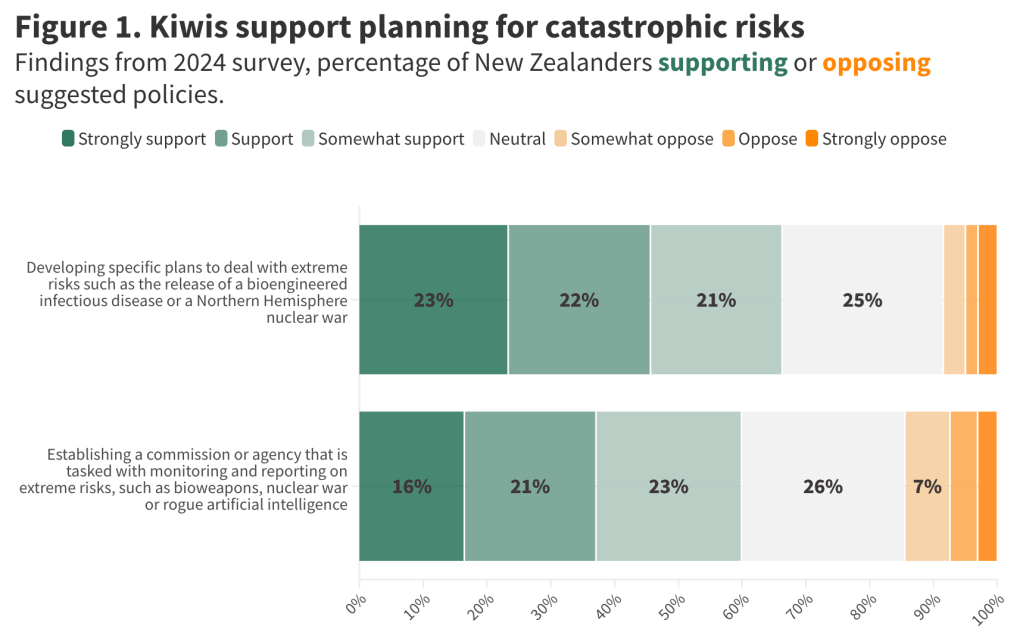
Source: Kerr, Boyd & Wilson, 2025; Based on sample of 1,012 NZ adults, collected in 2024. Weighted to match NZ population on age, gender, education and ethnicity.

Key Findings from the Survey

  • Two-thirds of New Zealanders (66%) support government developing specific plans for catastrophic risks such as nuclear war or engineered pandemics.
  • A clear majority (60%) also back establishing a dedicated commission or agency to monitor and report on these risks.
  • Outright opposition is small (8–15%), but about a quarter of respondents are neutral or unsure, suggesting limited awareness or competing priorities.
  • Support for government planning increases with age, education, income, and trust in scientists.
  • Unlike many public health issues, there were no major differences in policy support across political orientation, gender, or ethnicity.

Overall, this suggests majority support across the political spectrum for government leadership on catastrophic risks. Trust in science stands out as the strongest predictor of support, highlighting both an opportunity and a vulnerability for building consensus.

Why this Matters Now

Although NZ has previously examined catastrophic risks – for instance, through work in the 1980s on nuclear war4, 5 – resilience has waned. Recent expert reviews conclude that Aotearoa remains poorly equipped to cope with global shocks, despite being relatively well placed geographically to weather them.6, 7

The contrast between strong public support and limited government preparedness is striking. In a 2021 review, Sir Peter Gluckman and Dr Anne Bardsley highlighted major gaps in national planning for high-impact risks.8 More recent work has shown vulnerabilities such as reliance on imported fuel for food production, despite NZ’s apparent self-sufficiency in food supply.6, 9

This new survey reinforces earlier evidence. The Department of the Prime Minister and Cabinet’s 2024 National Risks Public Survey found overwhelming support for government responsibility in managing threats from emerging technologies and critical infrastructure disruption.10 Our findings extend this picture, showing that the public also endorse forward planning for the very worst-case scenarios.

Understanding Ambivalence and Opposition

A significant minority of New Zealanders remain neutral or opposed to stronger government action. Possible reasons11 include:

  • Low awareness of catastrophic risks and their likelihood.
  • Fatalism – a belief that little can be done to prepare.
  • Distrust in government or science as credible actors.
  • Competing priorities, with attention focused on more immediate social and economic concerns.

This points to the need for broader engagement beyond surveys. Deliberative methods such as citizens’ assemblies, public forums, and focus groups could help unpack how people weigh catastrophic risk planning against other policy demands, and identify framings that resonate across diverse groups.

Trust as a Foundation

The finding that trust in scientists is the single most consistent predictor of support is particularly important. While scientists are central to identifying and communicating extreme risks, they are not always the most effective messengers. For people with low trust in science, other credible voices – such as iwi leaders, community representatives, or political figures across the spectrum – may be more effective in building support.

This echoes lessons from public health communication during the Covid-19 pandemic, where trust was both an asset and a fault line. Building a coalition of trusted messengers will be vital for gaining broad consensus on preparedness.

Policy Implications

The survey adds to mounting evidence that NZ needs to go beyond the hazards it currently plans for (earthquakes, volcanic eruptions and severe space weather) to address all major  catastrophic risks. Several policy options merit urgent consideration:

  1. Develop a national strategy for global catastrophic risks – building on the National Risk Framework but extending it to worst-case scenarios.8
  2. Establish a dedicated agency or commission, either domestic or in partnership with Australia12, to monitor, assess, and coordinate responses to these risks.
  3. Invest in resilience measures that reduce vulnerabilities exposed in recent studies, such as energy security for ensuring food production.9, 13
  4. Engage the public through deliberative processes to deepen understanding of trade-offs and maintain legitimacy.
  5. Broaden communication approaches, pairing scientific expertise with trusted community and political voices.14, 15

Moving from Analysis to Action

As we noted in an earlier PHCC briefing on the NZ Government’s work on hazards16, progress has been made in recognising some major threats, but important gaps remain. 

NZ’s geographic position makes it one of the countries most likely to endure in certain global catastrophes. But survival advantage will only matter if we have invested in resilience and governance structures in advance. Public opinion is clear: most citizens want government to prepare for the unimaginable, before it is too late.

What is New in this Briefing?

  • Risk scholars and other experts are increasingly concerned about the high-impact threats of global catastrophic risks such as severe engineered pandemics, nuclear war and rogue AI.
  • The majority of New Zealanders support broad Government action to plan for global catastrophic risks.
  • Few New Zealanders are actively opposed to policies addressing catastrophic risks, however a quarter (~25%) are unsure or ambivalent. 

Implications for Policy and Practice

  • More in-depth research is desirable to understand why some people are unsure or opposed to Government action.
  • Nevertheless, it is now over to policymakers to respond to the majority public support for better Government planning and infrastructure to identify and prepare for global catastrophic risks.

References

  1. Mecklin J. (2025). Closer than ever: It is now 89 seconds to midnight – 2025 Doomsday Clock Statement. Bulletin of the Atomic Scientistshttps://thebulletin.org/doomsday-clock/2025-statement/
  2. World Economic Forum. (2025). The Global Risks Report 2025https://www.weforum.org/publications/global-risks-report-2025/
  3. Kerr J, Boyd M, & Wilson N. (2025). Public Attitudes to Responding to Global Catastrophic Risks: A New Zealand Case Study. Risk Analysishttps://doi.org/10.1111/risa.70096
  4. Preddey G, Wilkins P, Wilson N, Kjellstrom T, & Williamson B. (1982). Nuclear Disaster: A Report to the Commission for the Futurehttps://www.mcguinnessinstitute.org/wp-content/uploads/2016/11/CFTF-March-1982-Future-Contingencies-4-Nuclear-Disaster-FULL.pdf
  5. Green W, Cairns T, & Wright J. (1987). New Zealand After Nuclear War. New Zealand Planning Council.
  6. Boyd M, Payne B, Ragnarsson S, & Wilson N. (2023). Aotearoa NZ, Global Catastrophe, and Resilience Options: Overcoming Vulnerability to Nuclear War and other Extreme Risks: Report by the Aotearoa NZ. Catastrophe Resilience Project (NZCat) [Report]. Reefton: Adapt Research Ltd. https://adaptresearchwriting.com/wp-content/uploads/2023/11/231117-v1-nzcat-resilience-nuclear-gcrs-1.pdf
  7. Boyd M, & Wilson N. (2021). Anticipatory Governance for Preventing and Mitigating Catastrophic and Existential Risks. Policy Quarterly, 17(4), 20-31.
  8. Gluckman P, & Bardsley A. (2021). Uncertain but inevitable: The expert-policy-political nexus and high-impact risks. https://informedfutures.org/high-impact-risks/
  9. Wilson N, Prickett M, & Boyd M. (2023). Food security during nuclear winter: A preliminary agricultural sector analysis for Aotearoa New Zealand. The New Zealand Medical Journal (Online), 136(1574), 65-81.
  10. Ipsos. (2024). National risks public survey: All threats and hazards (Commissioned by the Department of the Prime Minister and Cabinet)https://www.dpmc.govt.nz/our-programmes/risk-and-resilience/national-risk-framework/2024-national-risks-public-survey-report
  11. Wiener JB. (2016). The Tragedy of the Uncommons: On the Politics of Apocalypse. Global Policy, 7(S1), 67-80. https://doi.org/10.1111/1758-5899.12319
  12. Wilson N, Boyd M, Potter J, Mansoor O, Kvalsvig A, & Baker M. (2024). The case for a NZ-Australia Pandemic Cooperation Agreement. Public Health Expert Briefinghttps://www.phcc.org.nz/briefing/case-nz-australia-pandemic-cooperation-agreement.
  13. Boyd M, Ragnarsson S, Terry S, Payne B, & Wilson N. (2024). Mitigating imported fuel dependency in agricultural production: Case study of an island nation’s vulnerability to global catastrophic risks. Risk Analysis https://doi.org/10.1111/risa.14297.
  14. Johns Hopkins University. (2019). Risk Communication Strategies for the Very Worst of Caseshttps://centerforhealthsecurity.org/sites/default/files/2022-12/190304-risk-comm-strategies.pdf
  15. Balog‐Way D, Mccomas K, & Besley J. (2020). The Evolving Field of Risk Communication. Risk Analysis, 40(S1), 2240-2262. https://doi.org/10.1111/risa.13615
  16. Wilson N, Kerr J, & Boyd M. (2025). New government document on hazards: Good progress but gaps remain. Public Health Expert Briefinghttps://www.phcc.org.nz/briefing/new-government-document-hazards-good-progress-gaps-remain 
Food Security and Global Catastrophic Risk – presentation to Environment Canterbury 10 Sept 2025

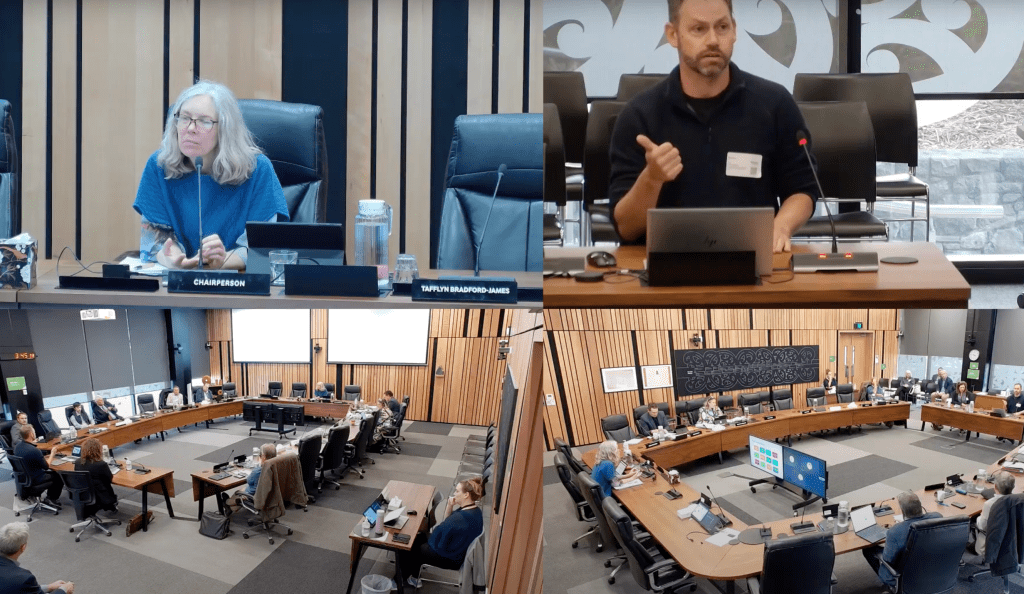
Matt Boyd presenting to Environment Canterbury on 10 Sept 2025 – View the recording here

The following is a transcript of our invited presentation to the Environment Canterbury regional council on 10 Sept 2025 as part of Council’s external speaker series and in support of a food resilience strategy.

You can click to watch the recorded version which is followed by Q&A with the councillors.

You can also access slides from a similar presentation Nick Wilson gave at the International Conference on Urban Health (Wellington, 18 Nov, 2025).

Introductory Remarks

Thank you for the opportunity to speak today.

I’m Matt Boyd, Executive Director of Islands for the Future of Humanity, a non-partisan NZ charity disseminating risk information. And I’d like to acknowledge the logos on this slide representing the contributions of various other people to our work.

Slides are as they appeared at the presentation

This talk is about 16min and covers food system resilience.

In my work, that means ensuring the local population can eat enough to survive indefinitely, no matter what the circumstances.

First, I’d like to describe some relevant context, then we can address what can be done.

What is the Risk Context?

Disaster Risk Reduction efforts have advanced a lot.1 However, these efforts focus almost exclusively on climate change and natural hazard risks.

Missing from disaster risk reduction frameworks are Global Catastrophic Risks—often overlooked because many of them are human-caused or because they originate elsewhere (probably outside NZ) and spread, through cascading impacts, to severely affect the entire world, beyond a point where response systems can cope.

Examples include:

With such events, outside help may be unavailable. Critical systems could face destruction, not just disruption, preventing rapid recovery.

While unlikely in any given year, some of these risks are uncertain but inevitable.

We insure our houses against worst possible risks, despite low likelihood, because the harm would be unbearable. We need to apply this thinking to societal resilience.

But there’s more. Global human systems face failures because they are stressed by at least 14 rising global stresses: climate change is one, but there is also biodiversity loss, demographic changes, concentration of industrial food production, emerging AI risks, etc. We need to consider this portfolio.

Basically, we have stresses elevating all kinds of global systems into a precarious state, such that major triggers (eg global hazards, wars, policy changes) could tip stressed systems into crisis. The stress-trigger-crisis model,2 represents this situation and provides tools for thinking about it.

Furthermore, our systems—food, energy, transport, communications—are densely interconnected, with stress in one causing feedback, potential amplification of problems, contagion across systems and cascading effects.

This creates continuous crisis—polycrisis—difficult to escape without addressing root causes:

  • such as rivalry, inequality, exponential change, and unfettered resource extraction.

In the face of this, organisations like the ASRA network (whose symposium I was at in Paris in June) are developing tools that decision makers can use to apply systemic risk thinking to their risk management.

Why should NZ care about this?

Given this documented global context, NZ should be worried.

We need resilience to absorb these problems and public institutions play a critical role.

But NZ is also relatively well-placed to weather this storm.

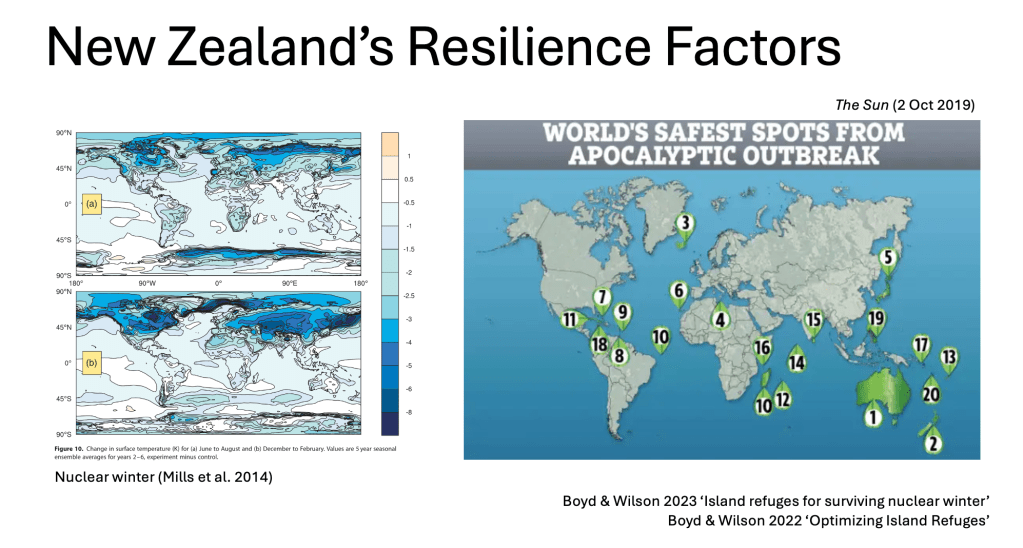
For example, the figure on the left shows the expected global cooling following a regional nuclear war between India and Pakistan,3 you see agriculture would collapse in the Northern Hemisphere, but that islands suffer less. The same is true for global winter caused by very large volcanoes.

Additionally, islands with potential for strict border control are less susceptible to health effects of pandemics.

We have studied these various island resilience factors;4 The UK newspaper The Sun reports our work in the right figure – NZ could be one of the most resilient places given our geography, resources, and our social systems.

But islands like NZ need to organise themselves and actually harness their natural advantages, and this only works if we are smart about resilience to global risks and play a careful long game.

NZ is not most at risk from the Alpine Fault (though this is a severe problem)

NZ is most at risk from trade and supply collapse—a downstream consequence of basically all the global risks I’ve mentioned so far.

  • A major volcanic eruption in Indonesia could blanket Asian ports with metres of ash.
  • Catastrophic electricity loss or cyber-attack could disable GPS and shipping portside operations.
  • Nuclear war over Taiwan would cause far more supply harm than one stuck ship in the Suez canal.

NZCat

Our multidisciplinary NZCat research project studied these problems through 2023.5

We created hazard profiles, conducted workshops, a survey, interview study, document reviews, technical research, and hosted a webinar. We spelled out these risks and identified resilience options.

This included food.

We found that our food system’s operation depends on the world. Without imported liquid fuel, fertiliser, agrichemicals, seed, expertise, machinery, spare parts, functioning electricity and internet, NZ’s food production, processing and distribution grinds to halt in its current state.

It is even worse if yields are reduced due to smoke in the atmosphere in a nuclear or volcanic winter.

This is bad for NZers and bad for export recipients depending on NZ food.

It is worst for economically disadvantaged people unable to afford scarcity pricing or source alternatives.

Good risk governance and risk management is key.

Risks need to be visible to the community and discussed.

Sometimes we think we’re already resilient, but local research shows many cases of supposedly redundant NZ systems susceptible to the same risks as primary systems. For example: parallel buried gas pipelines in Taranaki often run through the same topographic corridors being vulnerable to the same volcanic lahars.

For a full presentation of the NZCat project work you can watch the Korero on Catastrophe we held with diverse experts in 2023.

Turning to Food Security: What can be done?

I’ve deliberately spent half this talk NOT discussing food because the context I’ve just outlined needs to be better understood by the public and decision-makers.

This context of: Ordinary disaster risk, global catastrophic risk, global systemic risk, polycrisis, and dependence on trade and supply, is critical to food security.

Export foods, crop choices & liquid fuel

Growers require industrial inputs, crops must thrive despite climate, food must be transported to processing and consumption, sustainably, at levels feeding the local population indefinitely.

So, we need systems in place that can easily pivot export food to the local market if needed.

Some have already argued for a two-track New Zealand food system, with product from the farmgate going directly to the local market as well as to export processing.

We may need frost-resilient crops like wheat and carrots to sustain yields in potential volcanic or nuclear winter.

Most importantly: we need to ensure supply of inputs like liquid fuel.

MBIE has raised this issue with a Draft NZ Fuel Plan proposing increased tankerage, domestic fuel storage, and small-scale refining options.

Our research shows how much difference crop choices can make and how much locally produced liquid biofuel might be needed in a trade collapse. Let’s take a look:

For a detailed explanation of this figure see here

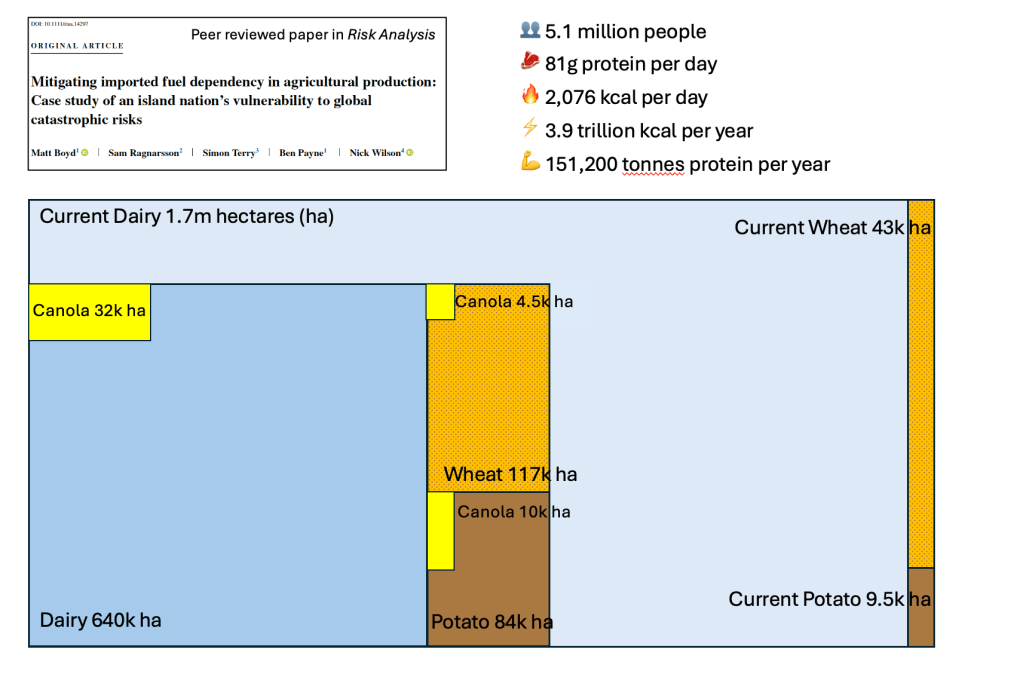
In our paper on mitigating imported fuel dependency,6 we noted that New Zealanders collectively need 4 trillion kcal per year and 150,000 tonnes of protein. So what does that look like?

This square represents the entire scope of NZ land used for dairy farming (1.7 million hectares). This is how much wheat we grow, and this is potatoes.

If you wanted to supply all that protein and food energy using just dairy, you’d need a supply of industrial inputs to farm this much land (640k ha in the figure). If you grew only wheat, this much (117k ha), and only potatoes, this much (84k ha).

Now if you needed to produce liquid fuel locally for the machinery, you’d need 32,000 ha of a feedstock like canola seed to do the dairy farming. You’d need 10,000 ha for potatoes, and only 4.5k hectares for wheat.

The choice of what is produced has massive implications for inputs like fuel. Any resilience programme should consider these factors.

We can drive home the point on this next slide:

This shows how much liquid fuel is needed to conduct the agriculture to feed NZ depending on whether we do dairy, grow potatoes, or wheat, and whether produce is transported 20, 50, or 100km. And whether the skies are darkened by nuclear or volcanic winter or not. You can see it makes a huge difference to certain logistics.

Let’s look at urban agriculture.

Urban and near-urban agriculture

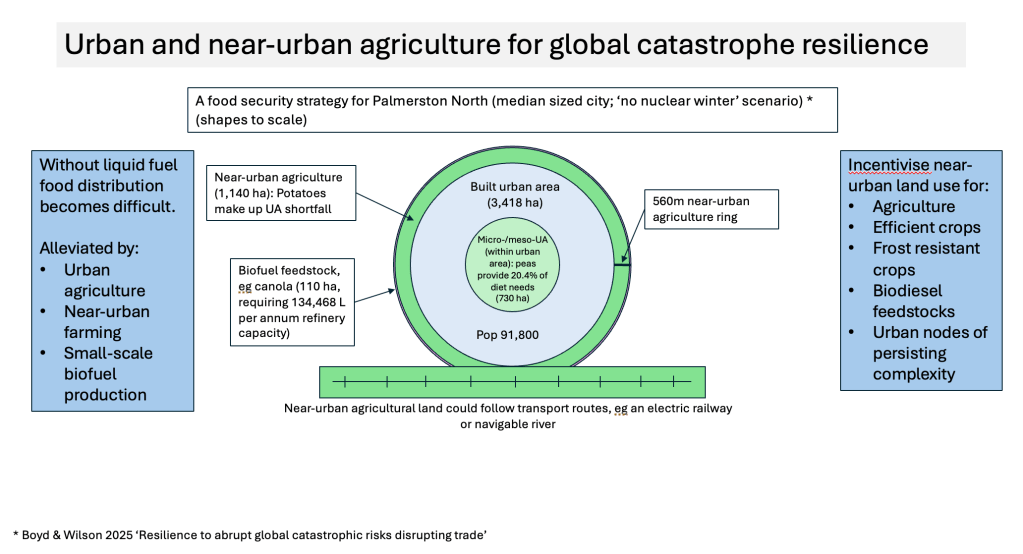
Urban agriculture brings production near to the population, eliminating transport fuel, and some off-road fuel. We analysed Palmerston North (chosen as a median sized city)7 and I’ll talk you through that:

This blue circle represents the built urban area, to scale, at 3400 hectares. If you planted every available green space, parks, gardens, golf courses, for urban agriculture (730 ha) with highest yield crops, you can meet the full food needs of up to 20% of the city.

But you only need a relatively small amount, about 1000 hectares in the case of Palmerston North, of city adjacent land, with high yield industrial cultivation (eg potatoes, wheat) to make up the shortfall.

And a relatively small 100 hectares of a biofuel feedstock could provide the liquid fuel needed. The near urban growing could follow a transport route such as an electric railway.

The main point is this: feeding a city or region doesn’t require much land or fuel if done cleverly. But each region needs to understand its minimum needs and secure this minimum before any catastrophes, assuming no imports.

Of course, urban and near-urban agriculture raise land use and zoning issues.

Urban and near-urban agriculture also require productive soils, which could be prepared in anticipation through green waste to compost schemes.

What can ECan do?

ECan could commission a formal study mapping these problems and generating local resilience options, including analysis of who would be worst affected.

This could form the basis for serious public consultation on options and trade-offs via citizen’s assemblies/citizen juries.

For context, our Palmerston North analysis cost ~NZ$30k—not bank-breaking stuff when it can spark such important conversations.

Our national NZCat analysis included a suggested national Food Security Plan for nuclear war/winter. Here’s some key points:

For full details see the NZCat Main Report

Ideally, resilient food production could occur throughout a weeks- or months-long electricity loss (a possible consequence of solar storms flagged by NEMA in their new Space Weather Plan). We have provided a free webinar, expert interview, and panel discussion on Managing the Risk of Catastrophic Electricity Loss.

Watch the webinar here

But overall, to help ensure basic food needs can be met, no matter what happens, ECan could champion something like this 12-point plan:

  • Include global catastrophic risks in local risk planning and governance
  • Advocate for central government responsibility for basic needs during catastrophes
  • Facilitate public discussion on catastrophic risks and resilience
  • Promote 10-day household food storage (vs. current 3-day standard)
  • Convene cross-sector working groups for contingency planning
  • Plan low-fuel food production with frost-resistant crops post-catastrophe
  • Protect near-urban land for high-yield crop production
  • Support urban agriculture and community food knowledge
  • Prepare to redirect export food to domestic markets
  • Plan food transport without liquid fuels through electrification
  • Develop compost from urban waste for soil improvement
  • Incentivize high-yield farming near cities over energy-intensive production

Food Resilience

So the objective is: everyone eats, no matter what

The strategy is: increase food system resilience to GCR

And the tactics are: near-urban agriculture, crop selection, local fuel supply…

I’m very happy to take questions and point you to websites with all the research work I have talked about.

Thank you again for this opportunity to speak.

References

  1. UN Office for Disaster Risk Reduction. (2025). Global Assessment Report 2025: Resilience Pays: Investing and financing for our future. United Nations. https://www.undrr.org/gar/gar2025
  2. Lawrence M, Homer-Dixon T, Janzwood S, Rockstöm J, Renn O, Donges JF. Global polycrisis: the causal mechanisms of crisis entanglement. Global Sustainability. 2024;7:e6. doi:10.1017/sus.2024.1
  3. Mills, M. J., O. B. Toon, J. Lee-Taylor, and A. Robock (2014), Multidecadal global cooling and unprecedented ozone loss following a regional nuclear conflict, Earth’s Future, 2, doi:10.1002/2013EF000205.
  4. Boyd, M., & Wilson, N. (2023). Island refuges for surviving nuclear winter and other abrupt sunlight-reducing catastrophes. Risk Analysis, 43, 1824–1842. https://doi.org/10.1111/risa.14072
  5. Boyd M, Payne B, Ragnarsson S, Wilson N. (2023). Aotearoa NZ, Global Catastrophe, and Resilience Options: Overcoming Vulnerability to Nuclear War and other Extreme Risks: Report by the Aotearoa NZ Catastrophe Resilience Project (NZCat). Reefton: Adapt Research Ltd
  6. Boyd, M., Ragnarsson, S., Terry, S., Payne, B., & Wilson, N. (2024). Mitigating imported fuel dependency in agricultural production: Case study of an island nation’s vulnerability to global catastrophic risks. Risk Analysis, 44, 2360–2376. https://doi.org/10.1111/risa.14297
  7. Boyd M, Wilson N (2025) Resilience to abrupt global catastrophic risks disrupting trade: Combining urban and near-urban agriculture in a quantified case study of a globally median-sized city. PLoS One 20(5): e0321203. https://doi.org/10.1371/journal. pone.0321203