
Mapping Pathways Through the Polycrisis: The Cascade Institute’s New Model for Navigating Global Systemic Risk

An in-depth read, ~15 min

TLDR/Summary

  • Global systems theorist Thomas Homer-Dixon gave a webinar on Nov 6, 2025 in which he described the Cascade Institute’s breakthrough approach to modelling global systemic risk. You can watch the full video of his presentation on the ASRA YouTube channel.
  • The Polycrisis Core Model (PCM) is a sophisticated analytical tool that not only maps the complex interactions driving today’s global crises but could help identify concrete pathways toward more hopeful futures.
  • Moving beyond speculation: Previously, ideas about achieving positive global transformation were largely speculative. Now, based on 1,800 expert judgments and rigorous mathematical modelling, there’s a grounded, evidence-based approach to understanding how we might navigate out of today’s entangled crises.
  • The PCM uses Cross Impact Balance (CIB) analysis to model 11 global subsystems (covering everything from economy and climate to food and governance), each with multiple possible states, generating over 4 million potential future scenarios for humanity by 2040.
  • Only 11 scenarios are truly stable: Out of 4 million possibilities, the mathematics reveals just 11 “consistent” scenarios, or attractors in an 11-dimensional state space. Three major attractors emerge: Illiberal Decline, Mad Max, and Hope.
  • The Hope attractor exists but is narrow: The good news is that a positive future is mathematically possible. The challenging news is that Hope attracts only about 100,000 scenarios compared to Mad Max’s 500,000, and it remains climatically “Hot” (high degrees of global warming), these facts mean resilience work against collapse remains a critical hedge.
  • Democracy appears non-negotiable: The analysis reveals clear policy targets which most notably include maintaining democracy, this appears essential for any pathway to Hope. Without democratic systems, initial modelling suggests no viable route to positive outcomes.
  • The work is actionable, not academic: The model identifies specific leverage points for interventions and provides a framework for understanding which policy moves might push us toward the edge of Hope’s basin of attraction, where natural system dynamics would pull us in to a positive future.

Introduction: Can We Model Our Way to Hope?

Thomas Homer-Dixon gives a webinar on the Polycrisis Core Model (Nov 6, 2025)

On November 6, 2025, Thomas Homer-Dixon presented findings from the Cascade Institute’s Polycrisis Core Model to a webinar hosted by the Accelerator for System Risk Assessment (ASRA). The presentation offered something rare in discussions of global catastrophic risk: not just a diagnosis of our predicament, but the potential for a mathematically grounded pathway through it.

This matters because, as Homer-Dixon emphasised, previously speculative ideas about reaching hopeful futures are now grounded in modelling and evidence. Based on approximately 1,800 expert judgments, the work demonstrates a concrete way to navigate toward hope, or at least to understand the terrain we must cross.

The timing is significant. As I reported in my recent blog on the ASRA Symposium, humanity faces accelerating, amplifying, and interacting crises across interconnected global systems. This polycrisis isn’t theoretical it is the world’s lived reality of pandemics, climate change, geopolitical conflict, economic instability, and democratic backsliding all reinforcing one another. For a New Zealand perspective on this see our recent paper on long-term resilience to global risk.

What the Cascade Institute’s new Polycrisis Core Model (PCM) offers is the potential for a way to move from acknowledging this complexity to actively navigating it.

The Cascade Institute’s Approach

The Cascade Institute has focused its work on identifying high-leverage interventions in global systemic risk. Their CORE initiative examines what pathways exist toward better futures through rigorous systems analysis.

The PCM represents the latest evolution of this work. As Homer-Dixon explained in the webinar linked above, it builds on the legacy of the “Limits to Growth” report (which Homer-Dixon called “the granddaddy of world models”) but employs more sophisticated methods suited to understanding social and political systems where relationships are inherently fuzzier than in physical or ecological models.

The CORE Model’s ambition is substantial: to create a “global system-of-systems” analysis projecting to 2040, capable of mapping millions of possible futures and identifying which are self-reinforcing (and therefore stable) and which policy interventions might shift humanity’s trajectory away from worse world states and into more hopeful ones.

Crucially, this isn’t just descriptive work. The model aims to identify plausible pathways to positive transformation, or what Homer-Dixon called finding the “self-reinforcing virtuous processes” that could move us toward flourishing world states rather than collapse.

The Technical Architecture: How the Model Works

For those comfortable with complexity science, the PCM employs Cross Impact Balance analysis (see below). But Homer-Dixon’s presentation makes the core methodology accessible to non-specialists.

The Building Blocks: 11 Subsystems, 45 States

The model divides global systems into 11 subsystems, split between social and material domains. Each descriptor can exist in one of 3-5 possible states across time. This creates the model’s vast scenario space:

Social subsystems (5):

  • Economy (states: laissez-faire growth, guided growth, low growth, managed economic contraction, unmanaged economic failure)
  • Polity Type (states: strong democracy, illiberal democracy, strong autocracy, weak autocracy, nonocracy)
  • World Order (states: international fragmentation, multipolarity, consolidated blocs, multilateral rules-based order, thick global governance)
  • Inequality (states: various combinations of low/high international and domestic inequality)
  • Conflict & Security (states: low violence, widespread non-state violence, civil/proxy war, international war, great power war)

Material subsystems (6):

  • Energy (states: fossil-fuel dependence, peak oil and gas, green-tech breakthrough, low-carbon energy contraction)
  • Climate (states: increased global heating of <2.5°C in 2100, 2.5-4°C, >4°C)
  • Health (states: high/medium/low burden of disease)
  • Food (states: status-quo global industrial production, agri-tech breakthrough, agro-ecological production, variable regional production, failed global industrial production)
  • Transportation (states: fit for the future, fit for now, fragmented and failing)
  • Information technology (states: limited rollout, managed rollout, unmanaged rollout)

The Method: Cross Impact Balance Analysis

Cross Impact Balance (CIB) analysis was developed by Wolfgang Weimer-Jehle in a 2006 paper. This method is particularly powerful for social systems because it can integrate different types of data and expert judgment about fuzzy relationships.

The core of the approach involves creating a judgment matrix showing all descriptors (ie all global subsystems and their possible states) and their relationships to each other, including:

  • Whether relationships are promoting or inhibiting
  • The strength and confidence level of each relationship

A crucial methodological constraint disciplines the analysis: scores within each judgment group must sum to zero. This “balancing constraint” prevents arbitrary or unconstrained assessments and forces careful consideration of trade-offs.

The model required 110 separate judgment sections (eg, “effect of world order on economy”), resulting in approximately 1,800 individual expert judgments (across the 45 different states). These judgments are supported by 200 pages of research and rationale, allowing independent assessment of their validity. The judgment model and it’s calculation matrix, are completely transparent.

The Mathematical Core: Finding Consistency

With 45 possible states across 11 descriptors, the model theoretically encompasses 4,050,000 possible scenarios or “futures.”

The CIB mathematical framework determines which scenarios are “consistent”, which means they are self-reinforcing. A consistent scenario is one where the various system states mutually support each other, creating a stable configuration.

Think of it like this: some combinations of system states reinforce each other (eg, strong democracy + multilateral cooperation + managed technology rollout), while others create contradictions that make them unstable (eg, authoritarian regimes + thick global governance).

The Findings: Three Attractors and a Narrow Path to Hope

The mathematics reveals that out of 4 million possible states, only 11 are fully consistent. These function as attractors in the 11-dimensional state space. Attractors are stable configurations toward which the global system naturally tends.

Stable attractors in the Polycrisis CORE Model. Source: T. Homer-Dixon webinar Nov 2025

Three Major Attractors Emerge

Simplifying these results, Cascade Institute researchers identified three main types of attractors:

  1. The Illiberal Democracy Attractor: A world of democratic backsliding and constrained freedoms
  2. The Mad Max Attractor: Characterised by state failure, widespread violence, and collapsed governance, Homer-Dixon referenced Haiti as a current example
  3. The Hope Attractor: A positive future with improved human wellbeing
Simplified categories of stable attractors in the Polycrisis CORE Model. Source: T. Homer-Dixon webinar Nov 2025

The relative size of these attractors matters enormously:

  • Mad Max is big: Attracting approximately 500,000 of the 4 million scenarios, this represents the largest basin of attraction. It appears frighteningly easy for the global system to slide into this catastrophic state.
  • Illiberal Democracy and Autocracy: Significant individual attractors exist in this space as well, though collectively they appear to absorb more scenarios than Mad Max.
  • Hope is narrow: Drawing in only about 100,000 scenarios, Hope has the smallest basin of attraction among the major outcomes

However, there’s important nuance here. Later analytical runs showed that Hope is a “relatively deep attractor”, meaning that once in its basin, the world systems tend to stay there. It’s a harder equilibrium to reach but stable once achieved.

Succession Analysis

Further research by the CORE Model team will employ a method known as succession analysis (which tracks how inconsistent scenarios migrate through state space toward the consistent scenarios), to deduce the lowest barrier pathways through the model from the world’s present system states to the nearest edge of the hope attractor. This approach leverages the idea of a kind of reverse tipping point, high leverage policy/intervention points that could set off a cascade of transformation into the hope attractor, the system’s natural dynamics would pull us in.
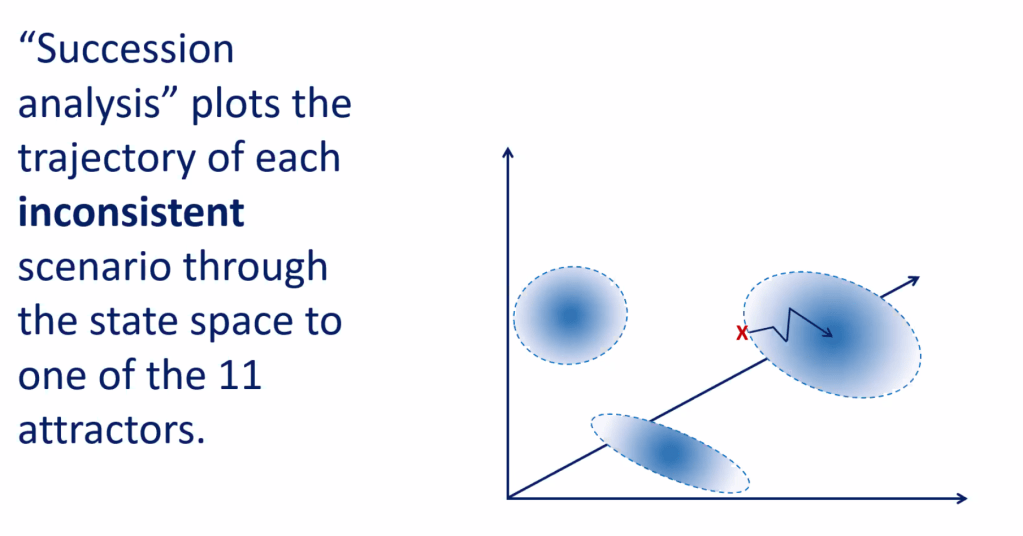
Source: T. Homer-Dixon webinar Nov 2025

The temporal aspects of the model are complex. Succession analysis functions as “an analogue of time” rather than explicit temporal modelling. The model is essentially “instantaneous” (showing stable states) rather than fully dynamic (showing detailed trajectories through time).

This is both a limitation and a practical necessity as fully modelling the temporal dynamics of 11 coupled systems risks being computationally intractable and would require even more uncertain judgments about rates of change.

The real value of this work emerges in its policy implications. The model isn’t just descriptive, rather it’s designed to identify intervention points.

Hope’s Limitations

However, even the Hope attractor isn’t utopian. As Homer-Dixon emphasised, “Hope is still Hot”, by which he meant that even this positive scenario involves significant climate heating and its associated challenges. The model doesn’t promise a return to pre-industrial conditions or easy solutions, just significantly better outcomes than the alternatives.

Critical Policy Target: Democracy

The analysis has already revealed very clear policy targets. Most notably, according to Homer-Dixon, maintaining democracy appears essential, as without democratic governance, “there appears no way there”, ie, no viable pathway to the Hope attractor emerges in the model.

This finding aligns with the Cascade Institute’s broader work on global systemic stresses, which identifies ideological fragmentation, polarisation, and political-institutional decay as critical stressors undermining humanity’s capacity to respond to other challenges.

Methodological Considerations and Ongoing Work

Homer-Dixon was refreshingly candid about the model’s current status and limitations. He acknowledged the model is “somewhat crude” but argued it provides a foundation for mapping paths toward transformation. This honesty is important, the model isn’t claiming perfect foresight but offering structured insight into complex dynamics. Furthermore, it is fully transparent, so users could adjust the settings according to new evidence. The CORE Model lends itself to modelling interventions that change the present state of world subsystems and deducing likely future states.

Sensitivity Analysis and Refinement

The research team is conducting extensive sensitivity analysis and converging on the “right” approach through iterative refinement. The rules used for succession analysis, Homer-Dixon noted, are “very important and make a difference to outcomes.”

This ongoing refinement is crucial. Early versions of complex models often reveal more about the modellers’ assumptions than about reality. But through systematic testing and adjustment, such models can become increasingly useful.

The forthcoming release of 200 pages of research and rationale supporting the 1,800 expert judgments will provide important grounding. This documentation will allow others to assess the judgments’ correctness and validity.

Next Steps and Using This Work

Homer-Dixon indicated the work is being prepared for publication in Nature, suggesting it will soon face rigorous peer review. He also noted that slide decks, mathematical details, and video recordings will be made available through ASRA’s YouTube channel.

We note that for researchers, policymakers, and organisations working on global catastrophic risk, several opportunities emerge:

For Researchers

  • Examine the detailed methodology when published
  • Apply similar CIB approaches to regional or sectoral polycrises
  • Contribute to refining the expert judgments as new evidence emerges
  • Extend the model to explore specific intervention scenarios

For Policymakers

  • Use the framework to identify high-leverage intervention points
  • Prioritise policies that maintain democracy and international cooperation
  • Assess whether current policies push toward Hope or away from it
  • Design policies with an understanding of system-level interactions

For Organisations

  • Apply polycrisis thinking to strategic planning
  • Identify how organisational actions contribute to global system stresses or resilience
  • Engage with the Cascade Institute’s broader work on global systemic stresses

Finally, such approaches and tools are exactly the kind of frameworks that we have previously argued are missing from a lot of national risk assessment, so there is much potential to incorporate these methods when addressing global catastrophic risk, see our call for more focus on these issues in our recent peer-reviewed paper on New Zealand’s long-term resilience to global risks.

Conclusion

What makes the Polycrisis Core Model significant isn’t that it predicts the future because it doesn’t and it can’t. What it does is transform our understanding of possibility space.

Before this work, discussions about achieving positive global transformation were largely speculative. We could point to things that needed to change such as carbon emissions, inequality, authoritarian governance, but we lacked a systematic understanding of how these elements interact and which changes might trigger virtuous rather than vicious cycles.

Now, based on the CORE Model’s 1,800 expert judgments and rigorous mathematical analysis, we have something more concrete. The model demonstrates that Hope is possible but narrow, that certain policy targets (especially democracy) appear non-negotiable, and that we need to find ways to push the global system toward that Hope attractor’s basin.

The work is also a further wake up call. Mad Max attracts far more scenarios than Hope. Our default trajectory, absent deliberate intervention, trends toward collapse not transformation. This is something we have also detailed when describing the ‘hard landing ahead’ in previous blogs. This likelihood also means that investment in resilience (to Mad Max) remains a critical hedge for decision-makers (for examples of resilience options see our previous “NZCat” work).

But unlike in previous work, and thanks to the Cascade Institute’s work, we now have tools to map this terrain. We can identify leverage points, evaluate interventions, and design policies with an understanding of system-level consequences. The question isn’t whether transformation is possible, the model shows it is. The question is whether we’ll implement the changes necessary to reach it.

As Ben Okri challenged myself and other attendees at the recent ASRA Symposium: “We have to find better alternatives to the current direction of history.” The Polycrisis Core Model provides not just warning but a roadmap for doing exactly that.

Whether we follow it remains to be seen.

Further Resources:

The webinar recording and slide deck are available on ASRA’s YouTube channel.

Beyond Local Hazards: Why New Zealand’s Resilience Thinking Must Expand to Global Catastrophic Risk

New Zealand has a geographic advantage that could be a strategic liability. Our isolation protects us from many regional and global threats, but makes us uniquely vulnerable to the one consequence nearly all global catastrophes share: the collapse of international trade and supply chains.

This paradox sits at the heart of our new paper in peer-reviewed journal Policy Quarterly, which examines how New Zealand’s current approach to long-term resilience, while commendable in many ways, exemplifies broader blind spots that could leave this island country dangerously unprepared for 21st century risks. In this post we summarise the key points and recommendations from our research.

Photo by Micaela Parente on Unsplash

TLDR/Summary

  • The DPMC’s 2025 draft long-term insights briefing on hazard resilience represents a welcome shift toward anticipatory governance and long-term thinking
  • However, current publicly facing frameworks tend to focus on familiar local natural hazards while systematically excluding global catastrophic risks like nuclear war, bioengineered pandemics, extreme volcanic eruptions, severe solar storms, and catastrophic AI failures
  • For an island nation dependent on global trade, supply chain collapse represents our primary threat vector regardless of what triggers it
  • Understanding global systemic risk and “polycrisis”, manifested through at least 14 global systemic stresses that interact to create cascading failures, is essential for effective resilience planning
  • Moving forward requires transparent public engagement with comprehensive risk information, not technocratic approaches that limit disclosure for fear of “scaring the public”
  • NZ needs publicly facing risk assessment work that facilitates informed democratic dialogue about resilience options and their costs – enabling citizens to make collective choices about investing in our shared future

Strengths and limitations of current thinking

We previously noted that discussion documents like the Department of the Prime Minister and Cabinet’s draft Long-Term Insights Briefing deserve credit for several important advances. Such work explicitly connects resilience with long-term prosperity, rejecting the false economy of austerity followed by repeated disaster-rebuild cycles. It acknowledges that hazards may have catastrophic consequences and that abrupt crises can occur. And crucially, it represents a fundamental shift from reactive emergency response toward proactive resilience-building.

These are genuine achievements that move New Zealand’s risk discourse in the right direction.

But the briefing, and much public sector risk thinking, remains trapped within frameworks addressing symptoms rather than systemic forces, focusing primarily on familiar natural hazards and incremental climate risks while missing an entire category of global catastrophic risks that could trigger the isolation and supply chain collapse we’re most vulnerable to.

Consider what’s systematically excluded from many current resilience frameworks:

  • Nuclear war and electromagnetic pulse attacks causing global agricultural failures and cascading infrastructure collapse
  • Bioengineered pandemics potentially far more severe than Covid-19
  • Large volcanic eruptions comparable to Tambora 1815, particularly those affecting critical global supply chain pinch points or altering the climate
  • Severe solar storms capable of disabling electrical grids for weeks or months across regions of the world
  • Catastrophic AI failures in interconnected infrastructure
  • Global food system failures from synchronous breadbasket failures severely impacting food supply and trade relations

These risks share critical characteristics that distinguish them from conventional hazards: they typically originate elsewhere yet spread via cascading impacts to cause global catastrophe; external assistance may be unavailable when needed most; and they could threaten global critical infrastructure destruction rather than mere disruption.

While individually unlikely in any given year, collectively these risks represent high-probability problems over decades, with some, like severe solar storms and large volcanic eruptions, being practically inevitable.

Understanding the polycrisis

Beyond discrete catastrophic events lies an even more fundamental challenge: the world faces rising systemic risk driven by interconnected global stresses.

Working with frameworks developed by institutions like the Cascade Institute, we identify at least 14 major chronic systemic stresses simultaneously pushing human systems toward dangerous disequilibrium. These range from great-power hegemonic transition and climate heating to ideological fragmentation, concentrated industrial food production, and the propagation of artificial intelligence.

These stresses interact through what researchers term the “stress-trigger-crisis” model. Any major trigger event – whether a volcanic eruption blanketing Southeast Asian ports with ash, catastrophic electricity loss disabling GPS and shipping, or nuclear conflict over Taiwan – could tip already-stressed global systems into cascading failure.

Our new peer reviewed paper illustrates how each of these global stresses creates specific vulnerabilities for New Zealand, from liquid fuel import disruption to digital payment system collapse to synchronous failure of global breadbaskets.

For New Zealand, this creates a stark reality: while our geography, natural resources and social systems position us relatively well to weather various global storms (think Covid-19), our greatest vulnerability lies precisely in trade and supply chain collapse – the downstream consequence of virtually all global catastrophic risk.

Breakdown in the supply of goods and services is both the cause and consequence of virtually all past civilisation collapse.

Need for improved risk and resilience tools

New Zealand’s approach to national risk assessment lacks analytical outputs that have become standard practice among comparable nations grappling with complex risk landscapes.

The United Kingdom maintains a detailed, publicly accessible National Risk Register, alongside comprehensive chronic risks analysis, substantial parliamentary inquiry reports, and a National Resilience Action Plan. The United States has commissioned RAND Corporation assessments of global catastrophic risks, enacted the Global Catastrophic Risk Management Act 2022, and established dedicated institutional frameworks for extreme risks.

Even when such comprehensive approaches exist, significant methodological problems persist. But at minimum, these nations have recognised that transparent, systematic assessment of the full spectrum of risks – including low-probability, high-impact events – represents a fundamental democratic necessity.

New Zealand’s current approach (both nationally and regionally) not only lacks this scope and transparency, but also exhibits the methodological shortcomings we identified in previous research including: insufficient justification of foundational assumptions, systematic omission of largest-scale risks, and limited stakeholder engagement to legitimise key choices.

The democratic imperative for transparency

This brings us to one of the most critical gaps: the absence of transparent, detailed, publicly-facing risk assessment that enables and can be used to stimulate informed democratic dialogue.

The 2021 UK House of Lords’ report on extreme risks included a presumption toward publication of security information, stating that “only through transparency and a healthy culture of challenge can we provide society with a reliable foundation to respond to emerging risks.”

The institutional aversion to “scaring the public” must be overcome. Citizens require access to comprehensive risk information spanning the full spectrum from conventional hazards to global catastrophic and systemic threats, supported by government-facilitated forums enabling structured public deliberation.

But more importantly, information sharing needs to be solutions-focused, including transparent information about resilience investment options, their costs, benefits and trade-offs across different time frames and scenarios.

This approach empowers rather than alarms populations. It enables discourse over the “tough decisions” the draft briefing acknowledges while ensuring democratic legitimacy for long-term resilience investments. And it recognizes that New Zealanders are adults capable of engaging with difficult realities and making informed choices about their collective future.

New Zealand’s strategic position

Here’s the opportunity: New Zealand possesses substantial advantages that current frameworks underutilise.

Our geographic isolation, low urban density, plentiful food production capacity, abundant renewable energy potential, relatively strong democratic institutions, and established social capital position us uniquely well – if properly leveraged through anticipatory planning.

Regional cooperation with Australia and Pacific neighbours offers additional strategic opportunities. Initiatives like shared vaccine manufacturing capacity, cooperation on shipping resilience, and coordinated resilience planning could strengthen collective preparedness for global catastrophic risks that are inherently cross-border in nature.

Research shows that egalitarian institutions and transparent governance structures demonstrate superior adaptive capacity compared with hierarchical alternatives. This suggests that democratic deepening through citizens’ assemblies and deliberative forums represents both a values commitment and a pragmatic resilience strategy.

Pathways forward

Our new paper outlines several concrete recommendations:

Expand hazard coverage to include global catastrophic risks that traditional frameworks systematically exclude. International precedents demonstrate this is slowly becoming standard practice among comparable nations.

Adopt systemic analytical frameworks that recognise interdependencies, cascade pathways, and stress-trigger-crisis dynamics rather than treating hazards as discrete events.

Strengthen resilience factors such as geographical advantages, institutions, and social capital through deliberate cultivation rather than focusing exclusively on risk drivers.

Implement institutional reforms including dedicated risk officers or a parliamentary commissioner for catastrophic risks, cross-sector collaboration mandates, and three-lines-of-defence approaches.

Ensure basic needs continuity through both strengthened existing systems and alternative “Plan B” infrastructure capable of functioning at a minimum when primary systems fail.

Finance using intergenerationally fair methods through approaches that avoid disadvantaging current populations while preventing unfair burden-shifting to future generations.

Our recent research found majority public support (56-63%) across the political spectrum for institutional reforms to manage global catastrophic risk. New Zealanders are ready for this conversation.

Conclusion: An opportunity for leadership

Our critique extends far beyond the DPMC briefing toward establishing principles applicable across all public sector risk and resilience thinking.

By embedding systemic thinking, expanding considered hazards, ensuring transparency, and implementing institutional reforms oriented toward anticipatory governance, New Zealand can establish itself as a global leader in building resilience to 21st-century challenges through genuine democratic engagement.

The alternative of continuing reactive approaches that address symptoms while global stresses accumulate will ensure that risks will continue emerging faster than interventions can manage them.

The result of getting this right would benefit not just New Zealanders, but populations depending on our food exports and humanity generally, should catastrophe ever threaten global collapse. Our isolation could become our greatest strategic asset but only if we invest in resilience with eyes wide open to the full spectrum of threats we face.

The choice is ours: genuine anticipatory governance through transparent democratic engagement, or reactive crisis management that addresses symptoms while root causes remain unchanged.

***

Read the full paper: Boyd, M. and Wilson, N. (2025) “From Disaster Response to Anticipatory Governance: why Aotearoa New Zealand’s long-term resilience thinking must address global catastrophic risk and systemic vulnerabilities,” Policy Quarterly, 21(4), pp.61-71.

Read our original submission: Response to DPMC Draft Long-term Insights Briefing (PDF, 12 pages)

Consider donating

If you support our work providing non-partisan evidence-based information to support resilience to global catastrophic risks, please consider donating to help our charity Islands for the Future of Humanity.

Your support allows us to continue producing risk information and resilience options that could benefit New Zealand and the world.

NZ faces medicines shortage if global trade cut off

Photo by Christine Sandu on Unsplash

The following is a media release by the University of Otago about our latest research paper, which determined that New Zealand would likely struggle to supply most of the commonly prescribed medicines used in acute care if a global catastrophe seriously reduced global trade.

New Zealanders could lose access to life-saving medicines in a trade-ending global catastrophe because imported ingredients are needed to locally manufacture commonly used medicines, research led by the University of Otago, Wellington shows.

The researchers say events such as a Northern Hemisphere nuclear war, a volcanic winter, a bioengineered pandemic, or a major solar storm, could all contribute to a collapse in international trade which would lead to critical shortages of imported medicines.

The research is published in the New Zealand Medical Journal.

The senior researcher, Professor Nick Wilson, from the Faculty of Medicine’s Department of Public Health at the University of Otago, Wellington, says the research shows none of the most widely prescribed 10 medicines for acute conditions, including pain relievers and medicines for treating infections, are able to be made in New Zealand. This is because of a lack of access to the key ingredients, many of which require petrochemical refining which the country no longer has.

Professor Wilson says global manufacturing of medicines has become dependent on just a few countries, with Europe, for example, obtaining 60-80 per cent of its ingredients for generic medicine manufacture from China.

The medicines examined in the study are: the popular pain reliever paracetamol; omeprazole used for acute gastritis and treating gastric ulcers; the antibiotic amoxicillin, used to treat severe bacterial pneumonia; the anti-inflammatory ibuprofen, used for acute pain relief; aspirin, used to manage strokes and heart attacks; the blood pressure medication metoprolol; salbutamol, used for acute asthma attacks; prednisone, a steroid used for severe allergic reactions; the antihistamine cetirizine; and the calcium channel blocker amlodipine, used to manage angina.

Professor Wilson says not only is modern pharmaceutical manufacturing highly dependent on ingredients from petrochemical refining, but New Zealand lacks many other necessary ingredients for the 10 medicines – and the complex industrial infrastructure to synthesise modern medicines at scale.

“The country’s current pharmaceutical industry is focused on secondary manufacturing and formulation, the packaging of imported active ingredients and quality control and testing.

“So once stocks of imported medicines had been exhausted in a post-catastrophe situation, there would likely be increased deaths from infections, heart disease, stroke and asthma.

“New Zealand could potentially build new infrastructure to produce some of the ingredients needed for medicines production by modifying the wood pyrolysis plant in Timaru to produce phenols and furans, or the Glenbrook steel plant to produce benzene/phenol from coke gas. A micro-refinery could also be built for oil extracted in Taranaki or from coal tar from West Coast coal mines.

“But all of these options would be expensive and challenging to undertake in a crisis situation.”

Another of the study authors, independent researcher Dr Matt Boyd, says New Zealand could also consider producing natural alternatives to some medicines, for instance by using salicylic acid from the bark of willow trees as an alternative to aspirin, growing opium poppies to make morphine and codeine, or by using hormones derived from livestock to produce insulin.

But he says, one of the most sensible approaches would be for the New Zealand and Australian Governments to come up with a joint plan to produce and trade key pharmaceuticals.

“Australia still has petrochemical refining, produces some of its own medicines, and is a major global producer of legal morphine from opium poppies. The New Zealand Government could contribute funding towards medicines production in Australia, but it could also help ensure the viability of post-catastrophe Trans-Tasman trade by using locally produced biofuel to keep cargo ships running.”

The research paper, ‘Capacity to manufacture key pharmaceuticals in Aotearoa New Zealand after a global catastrophe’ is authored by Professor Nick Wilson, Peter Wood and Dr Matt Boyd and is published in the New Zealand Medical Journal.