I recently presented our new research on Covid-19 outcomes (watch the recording embedded above – 37min, moderately technical), revisiting what analysts got wrong about pandemic preparedness and why.
Pandemics remain a major global risk, and emerging AIxBio threats make it critical we understand what actually drives good pandemic outcomes.
Early Covid-19 analyses were misleading due to flawed data (especially underreporting of deaths) and poor statistical methods.
Our new, more robust analyses show that pandemic preparedness, measured by the Global Health Security (GHS) Index, does predict lower excess mortality, especially in non-island countries.
Islands had fundamentally different pandemic experiences, with lower mortality driven by geography and border control strategies, so they must be analysed separately.
Key structural factors differ by context: democracy mattered more in islands, while low inequality was more important for non-islands, highlighting that preparedness interacts with broader social conditions.
The video above explains the technical details of all of this.
Many thanks to my collaborators on this Covid-19 work: Nick Wilson, Michael G Baker, & Amanda Kvalsvig
Pandemics are still a major global threat
Pandemics remain one of the most significant global catastrophic risks. Covid-19 demonstrated not only the scale of harm that infectious disease can cause, but also how deeply uncertain our understanding of pandemic performance can be.
Looking forward, emerging risks at the intersection of artificial intelligence and biotechnology (AIxBio) could further amplify these threats. It is critical that the world correctly understands what determines good pandemic outcomes.
Much analysis on pandemic preparedness is flawed
A key debate during Covid-19 was whether traditional measures of pandemic preparedness actually mattered. Early in the pandemic, many analyses suggested that they did not.
The Global Health Security (GHS) Index, which purported to assess countries’ pandemic preparedness, appeared to have little or no explanatory power for Covid-19 outcomes. Some studies even found that higher-scoring countries performed worse.
These findings fed into a broader narrative: that “soft” factors such as trust, social cohesion, and low corruption mattered more than formal preparedness; that authoritarian regimes may have had an advantage; and that wealthier countries fared worse than expected.
However, these conclusions were based on early pandemic data and that data turned out to be deeply flawed.
As demonstrated in the presentation above, Covid-19 mortality reporting varied systematically across countries. Countries with stronger institutions, often those with higher GHS Index scores, were better at detecting and reporting deaths. Conversely, some countries with apparently “good” outcomes were simply undercounting mortality. When analyses relied on reported cases or deaths, they risked measuring data quality rather than pandemic performance. Similar confounding occurred due to the different age-structures of populations.
In addition, early studies often failed to account for key statistical issues. Variables such as GDP and mortality were highly skewed, yet were frequently analysed without transformation. As illustrated in the presentation above, applying appropriate transformations can substantially change results, sometimes eliminating spurious relationships altogether.
The key lesson is this: when analyses produce results that fly in the face of our a priori evidence-based hypotheses and expectations, we shouldn’t accept results uncritically. We must ask, why did the expected result not appear, what might be wrong with the data or our analysis?
Pandemic preparedness saves lives
More recent work, including our own research on the Covid-19 pandemic, using improved data and methods, tells a very different story. In the video above, I explain the technical details of why this occurred.
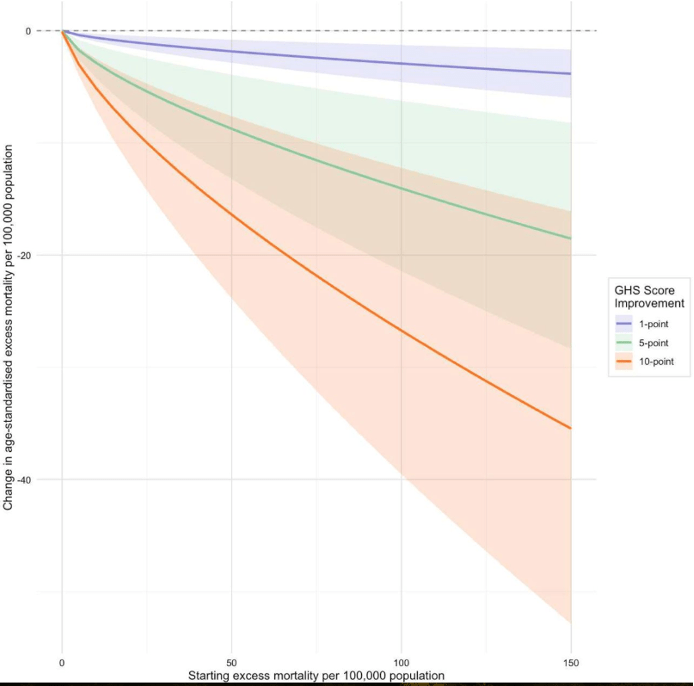
When excess mortality is used (rather than reported deaths), when age structure is accounted for, and when appropriate statistical transformations are applied, the GHS Index does in fact predict pandemic outcomes. For example, analyses such as that of Ledesma et al. (2023) showed a clear negative relationship between preparedness and mortality once some of these corrections are made.
In our own work, which carefully addressed additional critiques of the Ledesma et al. study, we find similar patterns: higher GHS scores are associated with lower excess mortality, particularly in non-island countries.
Predicted reduction in age-standardised cumulative pandemic excess mortality (2020-2021), based on Covid-19 data, for a given increase in preparedness (GHS Index score)
This reversal highlights a critical lesson: data quality and analytical choices matter enormously. Early pandemic narratives, while understandable given the urgency of the moment, were often based on incomplete or misleading evidence (as explained in the presentation above).
As better data has become available, some widely repeated claims now need to be reconsidered or reversed. Unfortunately some of the slogans emerging from these early analyses, and widely shared, have now established themselves as dis-informative slogans.
Islands experienced the pandemic very differently
Another key insight from our analysis is that not all countries should be treated as a single group. Islands, in particular, had a fundamentally different pandemic experience.
Historically, islands have had distinct advantages in infectious disease control, and Covid-19 was no exception. Island jurisdictions experienced dramatically lower excess mortality on average than non-islands. This reflects both geography and strategy: islands can more effectively implement border controls, and many pursued elimination strategies that were simply not available, or not chosen, elsewhere.
Because of these differences, combining islands and non-islands in a single analysis can obscure important relationships. When we separate them, clearer patterns emerge.
In non-island countries, preparedness, as captured by the GHS Index, strongly predicts outcomes. In islands, however, geography and border strategy play a much larger role, and preparedness metrics may behave differently. Many islands succeeded during Covid-19 despite their poor pandemic preparedness. But this pattern does not generalise to the non-island jurisdictions of the world.
Enhancing democracy and reducing inequality matter
The impact of structural factors also vary between these groups. Our results suggest that, among islands, democratic governance is associated with better outcomes, likely reflecting the importance of public consent and compliance in border-based strategies and elimination of local outbreaks.
In contrast, among non-islands, lower inequality appears to be a key determinant, perhaps because more equitable societies are better able to sustain collective action and protect vulnerable populations.
These findings help reconcile some of the apparent contradictions in early pandemic analyses. It is not that preparedness “doesn’t matter”, but rather that its effects interact with geography, strategy, and social structure in complex ways. The impact of preparedness, democracy’s crisis advantage, and inequality, are conditional on the context, and mutually reinforcing.
Islands should leverage their advantages
Finally, there may be broader lessons from island epidemiology. Islands have long been sites of successful infectious disease control, including the elimination of zoonotic diseases such as hydatid disease and brucellosis in some settings, and strong biosecurity responses to threats like avian influenza, which remains absent from New Zealand, Australia, and many Pacific Islands as at the time of writing. Their geographic isolation can enable tighter control over animal and human movement, reducing opportunities for pathogen introduction and spread.
This raises an intriguing possibility: that the advantages islands demonstrate in pandemic control may generalise to other infectious disease risks, particularly those involving zoonotic spillover. If so, understanding how island systems manage biosecurity could offer valuable insights for strengthening global preparedness, especially in an era of increasing biological risk.
As we prepare for future pandemics, the lesson is clear. Preparedness does matter, but only if we measure it properly, analyse it carefully, and understand the contexts in which it operates.
While our organisation, Islands for the Future of Humanity (IFH), has largely focused on Aotearoa New Zealand (NZ) to date, there are many lessons for island resiliency from other island jurisdictions. These are the focus of this Blog.
Food production resiliency is particularly shown for Australia, Ireland and NZ with large excesses in production, but innovations are also present in Iceland (greenhouse use) and Singapore (factory food).
Island jurisdictions are increasing their energy resiliency, particularly Australia as a world leader in rooftop solar. There is also domestic production of geothermal energy (Iceland, NZ),liquid biofuels (Australia), and wind energy (Ireland, Great Britain).
Advanced deliberative democracy mechanisms are present in Ireland (citizens’ assemblies), and Taiwan(digital tools).
High scores on the “Global Innovation Index” are seen for Singapore, Great Britain and Japan.
Particularly strong public health responses to the Covid pandemic with relatively low burden of deaths resulting, were shown by Australia, New Zealand (NZ), Singapore and Taiwan.
Island nations with histories of their societies surviving past disasters include: Iceland (volcanic-related famine); Great Britain (World War II); and Japan (famines, earthquakes and WWII).
Other notable resiliency measures include: manufacturing capacity (Japan, Great Britain); domestic production of medicines and vaccines (Australia); building electric-powered shipping (Australia); and indigenous knowledge and activities that build resilience (NZ).
In summary, island jurisdictions provide multiple examples of resiliency to potential catastrophic risks, some of which are world leading. Island jurisdictions should do more to research their true level of resiliency (eg, when considering all imports) and share this knowledge with each other.
[To receive more updates like this blog, and invitations to our all-comers calls, complete the Islands for the Future of Humanitywebform.]
Introduction
While much of the focus of Islands for the Future of Humanity (IFH) has centred on Aotearoa New Zealand – we are also concerned with island nations more broadly. So in this Blog we explore examples of resilience, focusing in this initial case on selected high-income democratic island states (future work will expand on this grouping). We particularly highlight illustrative strengths across five domains relevant to global catastrophic risk:
Food security and production capacity
Energy independence and diversity
Democratic robustness and governance innovation
Innovation and manufacturing capacity
Historical experience of surviving major shocks
While the geographic boundedness of islands can create vulnerabilities (eg, trade dependency and supply-chain fragility) this can also confer strategic advantages. These can include the potential for relative isolation during global disruptions, better defined borders (eg, tighter border control in severe pandemics), and the potential for good governance.
The examples below demonstrate how some island jurisdictions are building resilience in such domains as food security, energy security, and adaptive governance. We also show how some have strengths in innovation and manufacturing capacity and have historical experience with navigating severe external shocks.
Notes on selected examples of resiliency measures
Australia
Overall resiliency: In an analysis of 38 island nations, Australia scored the best across aggregated metrics of resilience to abrupt sunlight reduction scenarios (eg, nuclear winter or volcanic winter) [1]. It had the largest excess food production under simulated nuclear winter scenarios. It also has “good-quality infrastructure, vast energy surplus” and “the second highest health security in the world”. Australia also scored the highest in another analysis of island nations as potential refuges for ensuring long-term human survival in the face of catastrophic pandemics (or other relevant existential threats) [2].
Energy (solar): Australia has become the world leader in residential solar panel uptake. Around 4.3 million homes (around a third of all Australian households) had solar panels installed by early 2026 [3]. Government subsidies have facilitated this growth in solar panel and home battery uptake.
Energy (liquid biofuels): Australia has a number of biofuel plants, mainly focused on ethanol and biodiesel. The ethanol plants use the feedstocks of sorghum, waste starch and molasses. The biodiesel plants use the feedstocks of tallow, used cooking oil, and canola oil. Two Australian states have mandates for bioethanol.
Electric-powered shipping: Australia has recently built the world’s largest battery-electric ship [4].
Medicines/vaccines: Australia has a pharmaceutical industry that produces some vaccines and generic medicines [5]. In particular, it grows opium poppies which are the source of 37% of the world’s licit morphine supply [6]. It is also progressing mRNA vaccine development [7]. Australia produces a range of chemical feedstocks and catalysts that could be used for pharmaceutical production after a trade-ending catastrophe (as detailed in a study of its neighbour, NZ [8]).
Strong Covid pandemic response: Australia was one of the few jurisdictions that effectively applied an explicit exclusion/elimination strategy and which achieved a relatively low burden of deaths (in an analysis of 193 nations [9]). It used a state-of-the-art quarantine facility (Howard Springs in the Northern Territory) which had a notable record of zero quarantine failures [10].
Great Britain
Large manufacturing sector: Great Britain has a large manufacturing sector, albeit it is fairly trade-dependent for material inputs (a dependency which lowers its resilience to catastrophes).
Wind and solar energy: In 2025, wind generated nearly 30% and solar over 6% of Great Britain’s electricity [11]. The year 2025 was a record year for growth of solar panels on rooftops (with around 250,000 new small-scale installations).
High innovation: According to “Global Innovation Index” the United Kingdom (ie, Great Britain and Northern Ireland together) ranked sixth in the world in innovation in 2025 [12]. This is the second highest ranking amongst all island nations (after Singapore).
History of surviving national threats: Britain successfully survived multiple severe stressors during World War II. These included trade restrictions (requiring a rapid and major upscaling of domestic food production), deaths and damage from aerial bombing, and devoting a high allocation of GDP towards the war effort.
Iceland
Overall resiliency: In an analysis of 38 island jurisdictions, Iceland was one of the top scoring ones in terms of resilience to abrupt sunlight reduction scenarios [1]. “Modeling of nuclear winter indicates that Iceland may suffer less climate impact than continental Europe” and “the Icelandic population is well educated, there are abundant fish resources, and most electricity generation is hydroelectric.” Iceland also scored third highest in another analysis of island nations as potential refuges for ensuring long-term human survival in the face of catastrophic pandemics (or other relevant existential threats) [2].
Local food production (greenhouses and fisheries): Iceland has successfully used its geothermal energy and greenhouses to boost local food production [13]. This production has improved food security and “locally grown food is also a source of national pride” [13]. Iceland also has a science-based “individual transferable quota” fisheries management system which has meant that “most fish stocks are sustainably managed” [14].
Near-total renewable electricity: A mix of hydro and geothermal energy mean that the electricity generation in Iceland is ~100% renewable. Furthermore, geothermal energy is used in district heating systems to heat over 90% of homes.
History of surviving disasters: Icelandic society has a long history of surviving volcanic disasters, including the 1783–1784 Laki eruption which caused a major famine [15]. The country also constantly deals with relatively severe climatic conditions given its proximity to the Arctic Circle.
Innovation in risk management: Iceland has constructed large-scale lava diversion barriers and earthworks to protect the town of Grindavík and the Svartsengi geothermal plant during recent volcanic eruptions. It also maintains one of the most advanced integrated volcanic and seismic monitoring systems globally (combining real-time geophysical data with rapid public communication through its Meteorological Office).
Ireland
Food exporter: Ireland is a major exporter of meat and dairy products and is approximately self-sufficient in potatoes. However, it does require some food imports (eg, of cereals, fruit and other vegetables), and the high livestock production is partly dependent on imports of soy meal and maize.
Investment in wind energy: Ireland has dramatically increased renewable electricity generation, particularly from wind. The latter accounted for 34% of electricity production in 2023 [16].
Strong deliberative democracy: Ireland has effectively used citizens’ assemblies (panels of randomly selected citizens tasked to make recommendations about public policies). “It held four consecutive randomly selected citizens’ assemblies” and “some of those processes produced major political outcomes through three successful referendums; no other country shows such as record” [17].
History of surviving disasters: As with Iceland (above), Ireland has a long history of surviving famines, particularly the “Irish potato famine” from 1845 to 1852. This involved around one million deaths (from starvation and disease) and over one million people left the country.
Japan
Large manufacturing sector: Japan has a large manufacturing sector, although this sector is very trade-dependent for both material and energy inputs. To some extent, the nuclear energy sector could continue electricity production if fossil fuel imports ceased in a catastrophe (ie, if stockpiles of imported uranium were sufficient).
High innovation: According to “Global Innovation Index” Japan ranked 12th in the world in innovation in 2025 [12]. This is the third highest ranking amongst all island nations.
History of surviving disasters: Japanese society has survived such disasters as famines [18], severe earthquakes and tsunamis, and devastation associated with World War II. The country also used some successful approaches in its response to the Covid-19 pandemic [19].
New Zealand
Overall resiliency: In an analysis of 38 island jurisdictions, NZ was one of the top scoring ones in terms of resilience to abrupt sunlight reduction scenarios [1]. In particular, it is has a large excess in food production (which it mainly exports). NZ also scored the second highest (after Australia) in another analysis of island nations as potential refuges for ensuring long-term human survival in the face of catastrophic pandemics (or other relevant existential threats) [2].
Renewable energy: A majority of NZ’s electricity generation is renewable (especially hydro, geothermal and wind). While the country’s agricultural production is extremely dependent on imported diesel [20], there is at least one food oil production facility (using locally-grown canola), that could potentially be converted to biodiesel production after a catastrophe.
Indigenous population knowledge and activities: Māori have a strong tradition of intergenerational stewardship (kaitiakitanga) that aligns with anticipatory governance. Furthermore, marae and tribal authorities provide for additional governance resiliency. Māori are also involved in the growth of “tribal economies” [21], local food sovereignty [22], and local renewable energy production [23].
Close links with Australia: NZ has relatively strong cultural, trading and defence links with Australia. This is a form of resiliency that might help with post-catastrophe supplies to NZ of medicines [8], liquid fuels, minerals, and key manufactured goods.
Covid pandemic response: NZ was one of the few jurisdictions that effectively applied an explicit exclusion/elimination strategy and which achieved a relatively low burden of deaths (in an analysis of 193 nations [9]). In a comparison of OECD island nations, it also had the best health outcomes, the lowest median stringency level of response, and ranked third best for macroeconomic outcomes [24].
Singapore
Advanced agricultural technologies: Singapore is a small island city-state with a food resilience strategy involving vertical farms and food factories using automation, AI and alternative protein solutions. The Government is leading with the goal of increased food self-sufficiency and with a “state-driven model for clustering” of food production hubs [25].
Covid pandemic response: Singapore was one of the few jurisdictions that effectively applied an explicit exclusion/elimination strategy and which achieved a relatively low excess mortality [9].
High innovation: According to “Global Innovation Index” Singapore ranked fifth in the world in innovation in 2025 [12]. This is the highest ranking amongst all island nations.
Taiwan
Deliberative democracy tools: Taiwan is using digital processes to improve public engagement in decision-making. Specifically, “vTaiwan is an open consultation process that brings Taiwan citizens and government together in online and offline spaces, to deliberate and reach rough consensus on national issues, and to craft national digital legislation” [26].
Covid pandemic response: Taiwan was one of the few jurisdictions that effectively applied an explicit exclusion/elimination strategy and which achieved a relatively low burden of deaths [9]. It used many effective interventions (eg, very strong border control, digital technologies, and rapid mask production) and was able to avoid a national lockdown [27].
Discussion
Based on the research for this Blog, it is clear that these eight island jurisdictions provide multiple examples of resiliency to potential catastrophic risks. Some of these are world leading, such as for Australia with residential solar uptake and electric shipbuilding. Three of these jurisdictions (Australia, Ireland and NZ) are also major food exporters and so could potentially help out other nations after a catastrophe. Nevertheless, some of these identified resiliency measures may be somewhat superficial when considering dependence on imports. For example, NZ’s food production is highly dependent on the supply of diesel [20], 100% of which is imported. NZ agriculture also uses imported: seeds, fertiliser, agricultural chemicals and farm machinery. Similarly, the strong manufacturing sectors of Japan and Great Britain are largely dependent on imported energy and materials. Such dependencies highlight the need for in-depth local research that determines the true level of resiliency for critical systems such as food, energy, communications and governance. Sharing such research could help build resiliency across all island jurisdictions. So could pre-catastrophe cooperation between these islands in terms of research, security arrangements, and trade.
References
1. Boyd M, Wilson N. Island refuges for surviving nuclear winter and other abrupt sunlight‐reducing catastrophes. Risk Analysis.2023;43(9):1824-1842.
2. Boyd M, Wilson N. The prioritization of island nations as refuges from extreme pandemics. Risk Analysis. 2020;40(2):227-239.
6. McAlister S, Ou Y, NeffE, Hapgood K, Story D, Mealey P, McGain F. The Environmental footprint of morphine: a life cycle assessment from opium poppy farming to the packaged drug. BMJ Open. 2016;6(10):e013302.
8. Wilson N, Wood P, Boyd M.Capacity to manufacture key pharmaceuticals in New Zealand after a global catastrophe. The New Zealand Medical Journal (Online). 2025;138(1625):44-58.
9. Boyd M, Baker MG, Kvalsvig A, Wilson N. Impact of Covid-19 control strategies on health and GDP growth outcomes in 193 sovereign jurisdictions. PLOS Global Public Health.2025;5(10):e0004554.
10. Grout L, Katar A, Ait Ouakrim D, Summers JA, Kvalsvig A, Baker MG, Blakely T, Wilson N. Failures of quarantine systems for preventing COVID‐19 outbreaks in Australia and New Zealand. Medical Journal of Australia. 2021;215(7):320-324.
13. Butrico GM, Kaplan DH. Greenhouse agriculture in the Icelandic food system. European Countryside.2018;10(4):711-724.
14. Gunnlaugsson SB, Valtysson H. Sustainability and wealth creation, but no consensus: Recent decades in Iceland’s ITQ-managed fisheries. Marine Policy. 2022;135:104836.
15. Wieners CE. Haze, hunger, hesitation: Disaster aid after the 1783 Laki eruption. Journal of Volcanology and Geothermal Research. 2020;406:107080.
17. Courant D. Citizens’ Assemblies for Referendums and Constitutional Reforms: Is There an “Irish Model” for Deliberative Democracy? Frontiers in Political Science.2021;2:591983.
18. Jannetta AB. Famine mortality in nineteenth-century Japan: the evidence from a temple death register. Population Studies. 1992;46(3):427-443.
19. Tashiro A, Shaw R.COVID-19 pandemic response in Japan: What is behind the initial flattening of the curve? Sustainability. 2020;12(13):5250.
20. Boyd M, Ragnarsson S, Terry S, Payne B, Wilson N. Mitigating imported fuel dependency in agricultural production: Case study of an island nation’s vulnerability to global catastrophic risks. Risk Analysis. 2024;44(10):2360-2376.
22. Wehi PM, Cox MP, Whaanga H, Roa T. Tradition and change: Celebrating food systems resilience at two Indigenous Māori community events. Ecology and Society. 2023;28(1).
23. Ellis M. ‘If the stars align, boom!’: Ngā Wairiki-Ngāti Apa bets on green energy. Radio NZ 2026;(20February).
24. Summers JA, Kerr J, GroutL, Kvalsvig A, Baker MG, Wilson N. A proactive Covid-19 response associated with better health and economic outcomes for OECD High-Income Island Countries. SSM-Population Health. 2025;31:101827.
26. Hsiao Y-T, Lin S-Y, Tang A, Narayanan D, Sarahe C. vTaiwan: An empirical study of open consultation process in Taiwan. SocArXiv. 2018;4.
27. Summers J, Cheng H-Y, Lin H-H, Barnard LT, Kvalsvig A, Wilson N, Baker MG. Potential lessons from the Taiwan and New Zealand health responses to the COVID-19 pandemic. The Lancet Regional Health–Western Pacific. 2020;4.
A short link-post today, so you can listen to my interview (15min) with Emile Donovan on Radio New Zealand about trade and supply risks.
With the strait of Hormuz under threat due to Israel and the US’s attacks on Iran, trade and supply will be strained. There is risk of conflict spreading (Suez, Yemen), and this context means any synchronous crisis would massively amplify the problem (think of a major volcano near the Strait of Malacca, or an opportunistic China blockade of Taiwan).
NZ has been described as the ‘last bus stop on the planet‘ and its greatest risk is supply collapse impacting fuel, fertiliser, and replacement parts, resulting in inexorable degradation of critical functions. If not now, then at some point in the future given the reality of more than a dozen rising and interacting global stresses (climate, demography, ideological fragmentation, zoonotic disease, AI, geopolitical tension, etc).
Our 2023 NZCat Project Report analysed these Global Catastrophic Risks, and recommended:
An independent Parliamentary Commissioner for Catastrophic Risk
A National Food Security Plan
Local biodiesel production at a minimum level to sustain minimal agriculture
Distributed and islanded electricity generation systems including solar and geothermal
Local digital technology for government services, payments, and communication
Improved coastal shipping assets, electric rail, and urban design
A publicly facing National Risk Register and deliberative democracy on resilience options
Cooperation with Australia on global risk resilience
And many other recommendations…
Which political party will run with a vision for NZ’s resilience to global reality in the 2026 election?
 Adapt Research Ltd