From Technocracy to Democracy: What NZ’s National Risk Register Should Actually Do

By Matt Boyd & Nick Wilson
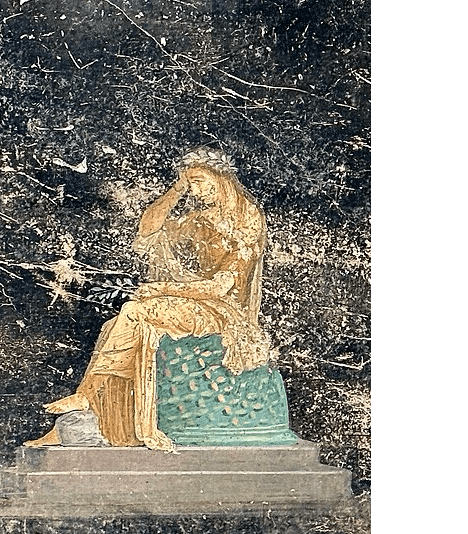
Image credit: Cropped Fresco of Cassandra and Apollo, focusing on Cassandra, found in Pompeii’s black room, excavated in 2024; Chappsnet, CC BY-SA 4.0, Wikimedia Commons

TLDR/Summary

  • The 2026 fuel crisis was not a surprise. New Zealand’s (NZ) extreme liquid fuel vulnerability was identified years ago, yet the country still lacked onshore resilience measures, pre-agreed rationing frameworks, prioritisation among critical consumers, or decision thresholds when Hormuz closed.
  • As with Covid-19, the risk was known. The failure was institutional: no living public risk register, no ready-to-deploy clear decision frameworks, no democratic authorisation of the assumptions behind preparedness measures.
  • But fuel and Covid are not the story. They are symptoms. NZ faces a wide portfolio of national risks: supply chain disruption, satellite and communications failure, food shocks from sunlight reduction (e.g. nuclear or volcanic winter), fertiliser shortage, pandemics, cyberattack, and more. Each has a catastrophic scenario, yet there is no unified, public-facing system for assessing these risks together.
  • Our research identified three core failures in national risk assessment: systematic exclusion of global catastrophic risks; opaque assumptions that lack public authorisation; and a failure to ever ask how things could have been worse – the downward counterfactual discipline essential for calibrating how far short of adequate our current preparations actually are.
  • “National risk register” is an outdated frame in a world of interdependent global stresses. What NZ needs is a hazard-agnostic National Vulnerability Register, focused on what our critical systems are actually exposed to across all hazards, paired with a costed National Mitigation Register of options to address those exposures.
  • This cannot remain a technocratic exercise. Advancing technology makes genuine two-way public engagement feasible, enabling crowd-sourced analyses, and worked resilience options, from civil society, NGOs, and researchers to surface and feed into real deliberation. Democracy has a measurable protective effect in crises; that advantage must be actively cultivated, not squandered.
  • All of this requires independent institutional stewardship: a Parliamentary Commissioner for Catastrophic Risk, charged with ongoing oversight of whether NZ is actually prepared, not just whether it coped with the last crisis.

A crisis that was never a surprise

On 28 February 2026, coordinated US and Israeli strikes on Iran triggered a conflict that rapidly closed the Strait of Hormuz. Within days, petrol hit NZ$3 per litre and stations began running dry. There is now legitimate concern about the ongoing security of NZ’s liquid fuel supply.

None of this is a surprise. NZ imports essentially all of its refined liquid fuel from South Korea and Singapore, refineries sourcing crude oil via tankers through the Strait of Hormuz. MFAT modelled this scenario explicitly in July 2025. Our own 2023 research identified liquid fuel as NZ’s most critical strategic vulnerability in major global conflict, and our Beyond 90 Days analysis of the Government-commissioned 2025 Fuel Security Study estimated that under catastrophic disruption, onshore stocks could last approximately 160 days with severe rationing for essential services only, a finding the Study itself obscured. The first step towards a solution, the NZ Fuel Security Plan, was published only in November 2025, too late to substantially affect preventive and planning action for the current fuel crisis.

The question is not whether anyone saw this coming. Many did. The question is why, when the risk was known, NZ lacked a credible public risk register, naming this vulnerability, quantifying it, listing resilience and mitigation options, and enabling a mature public conversation about where to invest resources in anticipation. Four things the government has done since the start of the crisis could and should have been done before the crisis materialised:

  1. Quantification (eg of fuel volumes and usage rates, for essential services, etc)
  2. Stratification and prioritisation (across the ‘critical users’ listed in the NZ Fuel Plan)
  3. Informing the Public (about the risk, the plans, the quantification and stratification, and importantly, what vulnerabilities yet remained)
  4. A call for research, analysis, and considered solutions (as with the new ‘tip line’ for letting decision makers know where the obstacles are to an efficient fuel crisis response)

We need to learn from this crisis and generalise these four steps, in anticipation, across all of NZ’s major vulnerabilities.

We have been here before. Coronavirus pandemics were identified as a ticking time bomb after the SARS pandemic in 2003. Before Covid-19, we published work on the benefits of border closure for island nations, not with all the answers, but as a framework for thinking through what was measurable, what was uncertain, and when action thresholds might be triggered. That work proved useful when the pandemic hit. But even when relevant research exists, if it is not embedded in a living, publicly accessible register connected to government decision-making, it remains on the margins.

Broaden the debate

There is now enormous public discussion about the immediate fuel response: rationing tiers, critical consumer lists, stock levels, tanker movements. This is necessary. But it is not sufficient, and it risks repeating the Covid trap of obsessing over the specifics of the last crisis while the next one loads.

NZ is exposed to a wide portfolio of risks beyond complete dependence on liquid fuel imports. Disruption to global shipping affects far more than petrol, diesel and jet fuel. There could be attacks, or natural hazards, causing damage to undersea communications cables or satellite infrastructure which would cripple financial systems, supply chains, and emergency coordination simultaneously. Abrupt sunlight reduction, from a major volcanic eruption or nuclear war, would devastate food yields regardless of fuel supplies. Fertiliser shocks, extreme pandemics, grid-disabling cyberattacks or geomagnetic storms, and cascading financial instability are all plausible within planning horizons. Our 2023 NZCat report was built around three realities that are now visibly materialising:

  1. The most dangerous risks originate elsewhere (outside NZ) and spread to affect the entire world;
  2. We face potential destruction, not just disruption, of critical global infrastructure;
  3. War is the defining feature of human history, not an aberration to be planned around.

The Hormuz crisis should not simply provoke a fuel plan. It should provoke a national conversation about risk and vulnerability in general, one that is systematic, comprehensive, and democratic.

Three failures in how NZ society assesses national risk

Our peer-reviewed research identified two core and recurring deficiencies in national risk assessments. We now add a third.

  • First, national risk assessments systematically exclude global catastrophic risks, high-consequence events most likely to cause civilisation-scale harm. The Hormuz crisis is a partial example; scenarios involving nuclear war, extreme pandemics, or major volcanic eruptions at global logistics pinch points, are more severe still, and increasingly plausible.
  • Second, national risk assessments lack public authorisation of their underlying assumptions. Scenario choice matters enormously: a 10% fuel disruption for six months is a fundamentally different problem from a 100% supply shock lasting a year, with radically different implications for what mitigation looks rational. Time horizons, discount rates, decision rules, and what is actually most valued by citizens, all shape conclusions. When assumptions are opaque, the public cannot evaluate the risk picture, contribute knowledge that might improve it, or express informed preferences about how to best invest public resources in resilience.
  • Third, and currently absent from the national conversation, risk assessments never ask how things could have been worse. Governments tend to evaluate a response by whether it held, then tick the box and move on. But the right question is: what would it have taken to overwhelm this response? What if Covid-19 had been far more lethal? What if most of the oil infrastructure in the Middle East had been destroyed? What if nuclear weapons had been used in the current conflict, or Hormuz had closed for two years rather than months? This downward counterfactual discipline is essential for calibrating how far short of adequate our current preparations actually are. A government that only asks “did we cope?”, will typically conclude it “did the best that could have been expected”.

These three societal failures reflect a shared institutional pathology: risk assessment is treated as a technocratic exercise rather than a democratic one, producing documents that circulate among officials rather than living tools that connect citizens to the realities of the world and the choices their government faces on their behalf.

From risk register, to vulnerability register, to mitigation register

It is worth being precise about what we actually need, because “national risk register”, typically presented as a list of hazards, is an outdated frame.

Many different hazards, including trade disruption, tariffs, electromagnetic pulse, geomagnetic storm, war, pandemic, can all produce the same outcome: a catastrophic reduction in liquid fuel available to NZ. The common factor is not the hazard but the vulnerability: NZ’s near-total dependence on imported liquid fuel for almost everything.

What we need is a National Vulnerability Register, that is hazard-agnostic (though extracted in part from a detailed study of hazards) and focused on what our critical systems are actually exposed to.

Then this should be paired with a National Mitigation Register: ideally costed, a comparable menu of options that could patch those vulnerabilities, or at least take the edge off anticipated impacts, so that basic needs such as food, water, communication, and critical goods transport, can still be met for all citizens.

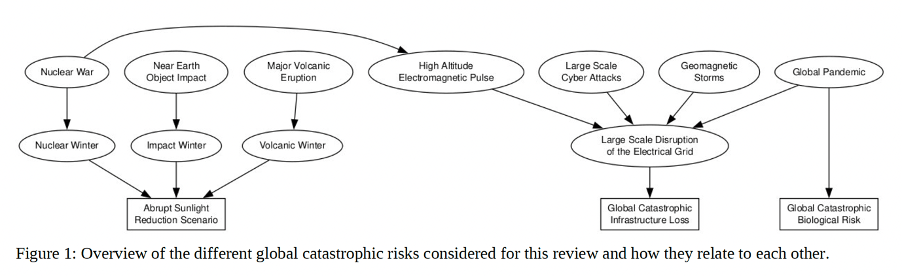
Our peer-reviewed 2025 Policy Quarterly paper argued for moving beyond a hazard-by-hazard approach entirely, adopting a systems and complexity lens that accounts for cascade dynamics, interdependencies, and the polycrisis nature of global risks. This matters because the truly catastrophic scenarios, should they ever occur, and whatever their origin, tend to cause harm through one of three common pathways (see Figure below):

  • Global catastrophic infrastructure loss (eg, electricity, liquid fuel, internet, shipping, etc);
  • Abrupt sunlight reduction (eg, nuclear winter, volcanic winter);
  • Pandemic disease.
Figure credit: Jehn et al. (2026)

A register organised around vulnerabilities and common pathways, such as these, is far more meaningful and useful than one organised around individual hazards assessed in isolation. Furthermore, cost-benefit is more properly understood when all possible causes of some harm are collapsed into one aggregate likelihood.

Although a classified NZ national risk assessment exists, the publicly facing material is woefully inadequate (eg, see the annex in DPMC/MfE’s 2025 long-term insights briefing on resilience to hazards). Liquid fuel supply merits a single phrase under ‘Significant disruption or failure of critical infrastructure.’ There are no detailed scenarios, no cascade consequences, no mitigation options, no indication of what preparations are still absent. This is not just a transparency problem, it is a democratic deficit.

The two-way tool we need, and can now build

In our 2023 paper we argued for a two-way engagement mechanism: not just broadcasting risk information downward (in highly redacted form), but actively developing the risk picture through structured public input. That argument is now more achievable than ever.

Advancing technology, including the capacity of large language models to consume, synthesise, and be trained on domain-specific material, means that contributions from businesses, community organisations, academics, researchers, NGOs, and individual citizens can be collated and synthesised into a structured set of options without requiring officials to read every submission individually. The specific platform architecture matters less than the principle: there are multiple ways to instantiate this effectively, and the design should be decided through consultation. What matters is that such a system is produced, is genuinely open, and generates outputs that informs meaningful deliberation and real decisions.

This is effectively the fuel crisis ‘tip line’ writ large, formalised, and generalised across all risks, including global catastrophic risks.

This is not just about information quality. It is about whose voice gets heard. A government-only process will reflect government-of-the-day priorities, official assumptions, and industry-captured analysis (it is frequently infrastructure lobbyists who make the most detailed submissions on resilience consultations).

A properly designed public engagement process would inform the public with details, and surface what NGOs like Wise Response, EatNZ, and the NZCat project have already developed: costed analyses of food security, biodiesel production capacity, essential service fuel allocation, and more. Pooling such analyses creates a genuine, comparable menu for informed and democratic decision-making. It also means that when deliberation occurs, citizens are not dependent on information filtered by any ideologically trapped government-of-the-day, or the ‘usual consultants’. The needed imagination can be expressed.

From risk catalogue to democratic decision

The deeper purpose is not transparency for its own sake. It is to enable a deliberative democratic process for directing resilience investments and building social licence for the outputs. Increasing the variety of problem-solving frames and ideas across society is grounded in evidence in the polycrisis literature, and there is democratic advantage in crises.

NZ is not short of known risks (we compiled a list of the global catastrophe hazards in our 2023 NZCat report, see p.101–3). What NZ lacks is a structured, publicly accountable process for deciding which to mitigate, how, at what cost, and to what agreed level.

A critical shortcoming of most risk registers is that they stop at listing risks, effectively declaring “we’ve got this covered.” They rarely detail what more is needed, or desired, that is not already in place, what it would cost, or what benefits would follow. Connecting a vulnerability assessment to a costed action menu is precisely the step that turns a register into improved outcomes with societal acceptability.

That menu must feed into a process of genuine democratic deliberation. Our analysis of Covid-19 outcomes showed clearly that democracy, particularly in island nations, strongly predicted fewer deaths (the Figure below shows the modelled reduction in excess deaths for a given increase in democracy score, based on Covid-19 outcome data).
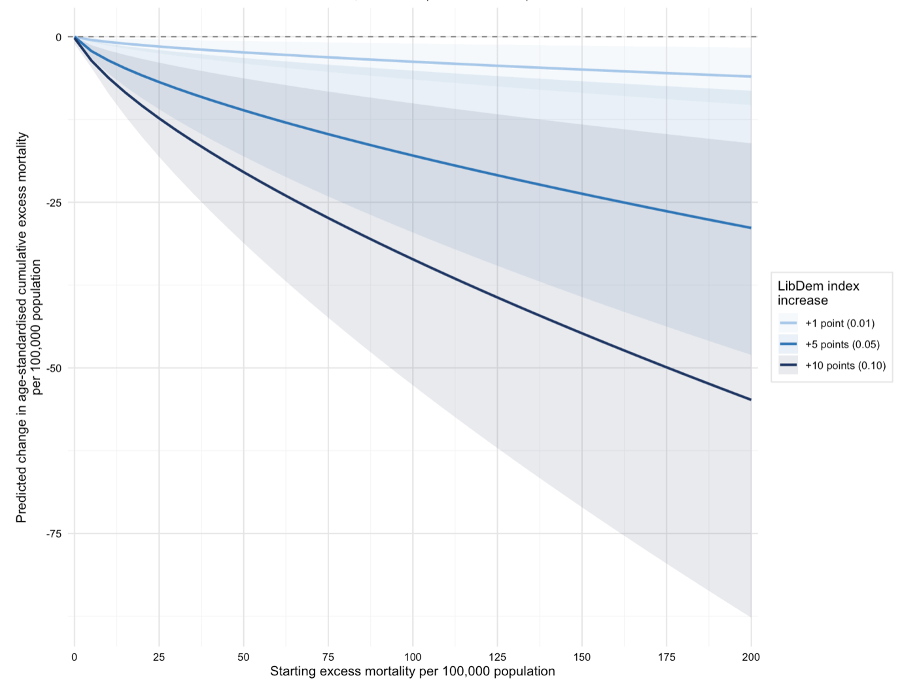
Figure credit: Boyd & Wilson (2026)

The democratic advantage is real. And yet trust in government institutions is eroding across democracies. Rather than accepting this, the NZ Government should actively counter it: publishing assumption-transparent risk and vulnerability assessments, supporting citizens’ assemblies where the assumptions, and resilience trade-offs can be debated in depth by informed, representative groups, and empowering those groups to reach conclusions that carry democratic weight.

This is not naïve idealism. It is what properly functioning democracy looks like when facing hard choices, in a complex world, with real costs and trade-offs. Citizens need the tools to decide collectively how to manage this transition.

That is precisely what a National Vulnerability Register, connected to a National Mitigation Register and genuine public deliberation, makes possible.

A Parliamentary Commissioner for Catastrophic Risk

All of this requires independent institutional stewardship. We renew our recommendation from the NZCat report: NZ should establish a Parliamentary Commissioner for Catastrophic Risk (PCCR), an independent officer of Parliament charged with overseeing the national risk and vulnerability assessment process, scrutinising its assumptions, ensuring global catastrophic risks are included, and assessing whether public engagement mechanisms are genuinely democratic and effective.

The PCCR would provide what no current NZ institution does: ongoing, independent, publicly accountable oversight of whether NZ is actually prepared, not just whether it coped with the last crisis. In an election year, this is a concrete institutional reform worth demanding.

Building resilience for a world of iterated shocks and polycrisis

We need to be clear-eyed about the broader context. The Global Shield risk policy initiative has noted that the world appears to have entered a new risk paradigm in the late 2010s and early 2020s, and that core assumptions of 20th-century governing, long planning horizons, slow policy processes, siloed expertise, implicit institutional trust, fiscal capacity to recover, may simply be inadequate for the decades ahead.

This is in a context where increasing and inexorable stress across a wide-range of global systems raises the possibility of systemic risk or critical system collapse, this trajectory is likely to be punctuated at abrupt points by the kinds of catastrophes discussed above. However many resilience decisions and investments will benefit both chronic break-down and sudden crisis scenarios.

NZ cannot put its faith in restoring pre-Covid growth trajectories or consuming the same volumes of imported energy we have relied on. What is needed is the opposite of fragile complexity: modularity, redundancy, diversity, decentralisation, and simplification of our critical systems. Shorter supply chains, local production capacity for essentials (eg, at least one biofuel refinery), redundant infrastructure, closer cooperation with Australia and Pacific neighbours (eg on vaccine manufacturing and sovereign shipping assets), and distributed decision-making. Building this kind of generalised resilience, which defends against many risks simultaneously, requires democratic buy-in, because it involves real trade-offs and real costs. But the upshot is that New Zealanders will suffer less anxiety and harm whenever global catastrophe strikes – they might even keep thriving.

We cannot achieve this through ad hoc action, trying to put out one fire at a time, especially when our vulnerabilities are correlated: a single geopolitical rupture can simultaneously threaten fuel, food, communications, and financial stability. A systematic approach, drawing on the research and ideas already distributed across NZ’s research community, civil society, and private sector, is the only answer.

The Hormuz crisis will likely eventually resolve. But the next systemic shock will come, be it a pandemic, nuclear event, volcanic eruption, technological catastrophe, or another geopolitical rupture. The time to build the vulnerability register, the mitigation menu, the deliberative tools, and the resilience NZ actually needs is now, before the next crisis reminds us, once more, that we already knew… or even prevents NZ achieving the resilience it needs.
“We Are F#*king F#*ked!” – Popular Music on Global Catastrophic Risk

(15 min long-read)

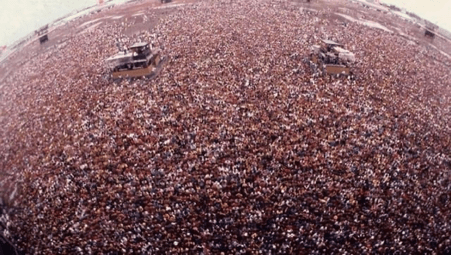
Metallica plays to a crowd of 1.6 million in Moscow (1991)

TLDR/Summary

  • Analysis of ten songs spanning six decades illustrates popular music’s sustained and often prescient engagement with global catastrophic risk (GCR), frequently anticipating threats before policy communities formally named them.
  • Risk domains covered include nuclear war (accidental and intentional), biotechnology trajectory risk, AI alignment, epistemic collapse, Moloch-style coordination failure, environmental catastrophe, polycrisis, and civilisational decline.
  • Where cinema functions as a sentinel, watching and occasionally warning in specific terms, popular music acts as a barometer, registering shifts in collective mood from fear to anger to resignation, often ahead of public or policy discourse.
  • A clear tonal trajectory emerges across the collection: from Bob Dylan’s moral urgency in 1962, through Cold War alarm, to the compounding resignation of the 2020s, a drift that is not merely artistic, but empirically measurable across millions of songs.
  • Key GCR lessons recur across the collection: catastrophe typically arises from misalignment and accident rather than intent; early warning is consistently present and consistently ignored; and fatalism is not just a cultural mood but a risk multiplier.
  • Music’s historical capacity to build new constituencies for action, exemplified by Nena’s near-universal 1983 reach with “99 Luftballons,” has weakened as algorithmic fragmentation means protest music now energises the already-convinced rather than crossing the gap to those who are not.
  • The mismatch between rising catastrophic risk and fragmenting cultural coordination mechanisms may itself be a key dimension of the problem of global risk.

Introduction

In 2025, I examined what 12 critically acclaimed films could teach us about global catastrophic risks. Cinema, it turned out, had a great deal to say. WarGames and The Day After were even credited with influencing Reagan-era arms control policy.

But music touches similar themes, and often more viscerally. Where film requires a two-hour investment and a darkened room, a three-minute song can lodge itself in collective consciousness for decades.

Here I take the same approach as the cinema piece: a curated list of songs, an attempt to extract GCR-relevant lessons from each work, and some reflection on what the collection as a whole reveals.

The selection is necessarily subjective. The dominance of rock and art-rock may itself say something about which musical subcultures have engaged most explicitly with existential themes. The picture that emerges is striking, and rather bleak.

The Songs

Bob Dylan: “A Hard Rain’s A-Gonna Fall” (1962) | Generalised collapse

Written in the shadow of the Cuban Missile Crisis, Dylan gives us early warning of global catastrophe and our moral obligation to prevent it. “Hard rain” with its surreal catalogue of poisoned waters, dead forests, and suffering humanity functions as a broad-spectrum warning about civilisational recklessness and the multi-domain impact of global catastrophe. The song has much in common with the film The Road in last year’s films blog, with its nameless threat and cascading consequences.

Though clearly written in the nuclear shadow, “hard rain” does not have to be read as a single event but an accumulation, a reckoning that follows from moral failure across many domains simultaneously. The song is a pessimistic bearing witness of human trajectories but insistent on the moral duty of testimony. Someone has seen the consequences; someone must speak.

In GCR terms, this maps onto the challenge of communicating low-probability, high-impact risks to the public and policymakers. Dylan’s imagery, “the executioner’s face is always well hidden” anticipates how catastrophic risk is often driven by opaque incentives and dark structural forces rather than visible villains.

Zager and Evans: “In the Year 2525” (1969) | Biotechnology and trajectory risk

Both a major number one hit, and a remarkably prescient survey of where biotechnology, automation, and genetic enhancement might lead over time, with each verse advancing the degree of human self-modification until nothing recognisably human remains, “your legs got nothing to do, some machine’s doing that for you.”

More than 35 years before Ray Kurzweil’s “singularity”, this song sits squarely in the long-termism and transhumanist camps of global catastrophic and existential risk studies. The listener appreciates the inter-generational risk horizon stemming from unbridled technological advance.

The song evokes a degree of repulsion for the imagined future, and under present day interpretation sits as a criticism of the e/acc community and technological progress without ethical restraint.

The tone is deterministic in a way that contemporary biosafety researchers might find both familiar and uncomfortable, the trajectory all the way to, “now man’s reign is through” seems locked in from the start.

It is striking that three years before the seminal Limits to Growth study raised similar concerns about resource exploitation, Zager and Evans are singing about, “taking everything this old Earth can give.” A concern that is a very real and perhaps underappreciated potential handbrake on present technology build out.

The key insight is trajectory risk: unlike nuclear catastrophe, which has a clear failure point, some risks unfold too slowly or diffusely to trigger timely intervention. As a global number one hit, “2525” is a reminder that audiences were, even in 1969, receptive to dystopian long-termism when it was compellingly presented.

Nena: “99 Luftballons” (1983) | Accidental nuclear escalation

Another multi-country number one smash hit, this German language song portrays an accidental nuclear escalation due to radar error (balloons not missiles). This is eerily similar to what happened approximately six months after the song’s release when Stanislav Petrov, a Russian officer correctly identifying a satellite warning of incoming US missiles as a false alarm. He disobeyed protocols to report it, suspecting a malfunction, saving the world from a retaliatory strike, and the song’s “Neunundneunzig Jahre Krieg” (99-year war).

The song is a rare and elegant illustration of accidental nuclear escalation in popular music and captures the “false alarm” problem, that being the danger that systems optimised for speed and deterrence remove the human hesitation that might otherwise prevent catastrophe. The lesson is clear, that misaligned systems and poor communication can destroy the world even without malicious intent.

Sung in German, inescapable on radio across Europe, 99 Luftballons achieved something rare, near-universal exposure within societies, creating a shared emotional experience that politicians could not ignore. We return to this point below.

Iron Maiden: “2 Minutes to Midnight” (1984) | Intentional nuclear risk

Less philosophically subtle than Dylan, but considerably more fun, Iron Maiden directly reference the Bulletin of Atomic Scientists’ Doomsday Clock, sitting at “two minutes to midnight”. A clock which now in 2026 sits at 85 seconds to midnight, marking a significant deterioration in global catastrophic risk since the song was released.

The critique is directed squarely at the political and military-industrial incentives that normalise nuclear brinkmanship, “As the reasons for the carnage cut their meat, And lick the gravy.” As with Zager and Evans the intergenerational impact of disaster is clear, “To kill the unborn in the womb.” The tone is angry rather than resigned, catastrophe is avoidable, and the obstacle is human choice.

This is a meaningful distinction in GCR thinking, where some risks are structurally determined, others are politically constructed. Nuclear war risk sits firmly in the latter category, which is why governance reform, treaty frameworks, and command-and-control safeguards remain tractable interventions.

Radiohead: “2 + 2 = 5” (2003) | Epistemic collapse; mis- and dis-information

Beginning ethereally, Radiohead deliberately reference George Orwell’s 1984 and foreshadow the global risk of mis- and dis-information. In more frantic mid-song terms we are warned that we have not been “paying attention”, or perhaps it is those seeking conspiracy explanation that are telling us to “pay attention” – the song’s central repetitive refrain.

Either way, this song released amid the manufacture of consent for invasion of Iraq, clearly anticipates the attention economy, and presents epistemological risk to humanity, asking what happens when enforced falsehoods displace shared reality?

“2 + 2 = 5” feels, two decades on, more rather than less relevant. Epistemic collapse is now a recognised GCR-adjacent risk, increasingly associated with AI-generated misinformation and coordinated disinformation campaigns. The song’s lesson is foundational, namely if societies cannot agree on facts, coordinated responses to any other global risk become functionally impossible. Information integrity is not a soft issue, it is the substrate on which all other risk mitigation depends.

Nine Inch Nails: “The Great Destroyer” (2007) | Systemic collapse and ‘Moloch’ dynamics

Trent Reznor’s dystopian 2007 album Year Zero is immersive and explicitly systemic. There is authoritarian surveillance, societal breakdown, biological or terror threats weaponised to justify repression.

The track “The Great Destroyer” is open to interpretation, but on one reading, in the tradition of Alan Ginsberg’s 1956 poem “Howl”, personifies the mechanics of multi-polar coordination failures, game theoretic traps that lead humanity deeper into catastrophe by favouring choices that are individually rational but collectively destructive.

Ginsberg calls this invisible destructive dynamic “Moloch” after the god of sacrifice, “Moloch the incomprehensible prison… Moloch whose blood is running money.” While for the Nine Inch Nails this is “The Great Destroyer.”

The Great Destroyer/Moloch is not a villain, but a process: self-reinforcing system dynamics driven by misaligned incentives, producing runaway outcomes no individual intended or wanted, outpacing governance.

The track begins relatively contained, then fractures into chaotic distortion, sonically enacting loss of control. This is precisely how many modern catastrophic risks operate, not through deliberate malice, but through individually rational actions aggregating into collectively catastrophic outcomes. Collapse comes bit by bit, then all at once.

This theme also highlights a secondary risk that appears frequently in both music and film, namely that responses to crises, emergency powers, expansion of surveillance, can themselves become catastrophic when they erode democratic norms.

Gojira: “Global Warming” (2012) | Environmental catastrophe

Taking their band’s name from the Japanese word for “Godzilla”, the original metaphor for nuclear threat, Gojira presented 2012 audiences with metal, anger, and a genuine sense of climate action urgency, “A world is done, and none can rebuild it.”

“We will see our children crying” is not subtle, but subtlety was never the genre’s priority. What distinguishes Gojira from many environmental-risk songs is that the track is not entirely fatalistic, a thread of “new hope” runs through the distortion, although there is tension between the catastrophe and the sliver of potential for recovery.

The anger in “Global Warming” functions as motivation rather than resignation, which puts it in an increasingly rare category among the songs on this list, the outro, “We will see our children growing,” communicates the hope that persisted through the early 2010s.

Muse: “Algorithm” (2018) | AI alignment and automation risk

From Muse’s album Simulation Theory, “Algorithm” depicts a world where artificial intelligence shapes perception and decision-making in ways that feel both seductive and inescapable. Precise, repetitive and synthetic sound invokes a world of automation and technology. From the outset we (or AI?), “Burn like a slave.”

The AI does not oppress through force but through optimisation, desires shaped, agency quietly subsumed, humanity rendered obsolete not by hostility but by efficiency. “This means war with your creator” captures a key transition: from control to contestation, where systems we built no longer reliably serve us, “Algorithms evolve.”

This maps closely onto contemporary concerns about AI alignment, it is not that systems will necessarily act maliciously, but that optimisation for specified goals may override or erode human values or produce unanticipated and destructive outcomes.

There is a faint thread of resistance in the song, but it is unclear whether it succeeds. The lesson appears to be that ceding decision-making to opaque algorithmic systems without meaningful oversight risks an irreversible narrowing of human autonomy and irreversible loss of control.

Tool: “Descending” (2019) | Slow-moving civilisational decline

Where Muse and Gojira deal with identifiable hazards, Tool is diffuse, oceanic. “Descending” frames civilisational decline in sweeping, elegiac terms, humanity as a once-great tide now receding. The lyrical plea to “stay the reading of our swan song” is urgency wrapped in resignation.

This song is a 13-minute epic, almost cinematic, journey. As with so many songs by Tool it is a spiritual journey for atheists, a meditation on the potential decline of contemporary human civilisation. “This madness of our own making,” puts the blame squarely on humanity itself, but calls for the “dread alarm” to, “stir us from our, wanton slumber.”

Written before the Covid-19 pandemic, Russian invasion of Ukraine, release of ChatGPT, or any of the subsequent years’ accumulation of crises, the plea to stay execution now feels tinged with quixotic hope.

Tool’s vision is paradigmatic of slow-moving GCRs, where the signals are visible, the trajectory is clear, but coordinated action lags behind awareness and a psychology of denial. The song’s emotional register is grief rather than anger, which may be more honest about where sustained inaction leads. Recognising risk is not the same as responding to it, and elegy is what you get when warning goes unheeded.

Muse: “We Are F#*king F#*ked” (2022) | Polycrisis and the failure of optimism

The title alone earns its place. Closing the Will of the People album, this track, written at the height of the Covid-19 pandemic, contemporary with the energy crisis of 2022, is a study in late-stage pessimism. We hear systems spiralling, elites indifferent, collective agency exhausted. And yet with hindsight its commentary is situated pre-Trump v2.0, pre- global tariffs, pre-Israel/US war on Iran, pre-LLMs, if anything it should be read as hopeful!

“We’re at death’s door, another world war, Wildfires and earthquakes I foresaw, A life in crisis, a deadly virus, Tsunamis of hate are gonna find us.” The lyrics cover the spectrum of global catastrophe hazards, a true polycrisis with each amplifying the impact of the others.

What makes it analytically interesting is what it signals about Muse’s own trajectory. Their 2009 track “Uprising” was a call to arms, “we will be victorious!” By 2022, the same band was declaring the game over, with this titular resignation singing additionally, “it’s a losing game.”

This tracks a genuine shift in how many serious researchers view systemic and interacting risks: climate breakdown, governance failure, and technological disruption interacting in ways that overwhelm incremental solutions, with tail risk cases becoming most likely. The song echoes the spirit of Brad Werner’s famous paper at the American Geophysical Union, titled: “Is Earth F**ked?”, which asked, with deliberate provocativeness, whether systemic dynamics now preclude the changes needed to avert catastrophe. The lesson: delayed responses to accumulating risks eventually reach a tipping point where optimism itself becomes untenable.

What the Collection Tells Us

Considered as a whole, these ten songs have a structure that is worth naming. The nuclear entries (Nena and Iron Maiden) are the only ones in the collection where governance is presented as a tractable solution. This is not a coincidence. Nuclear risk genuinely did respond to political pressure: treaties were negotiated, hotlines established, launch protocols reformed. The enemy had a face, even if Dylan’s executioner kept his well-hidden.

The middle of the collection (Radiohead, Nine Inch Nails) operates differently. These songs address what might be called risk amplifiers. These are not threats or hazards imperilling human life directly, but undermine the preconditions for managing any risk at all. Epistemic collapse and coordination failure are upstream problems. If shared reality dissolves, or if Moloch dynamics mean that individually rational actors cannot help driving toward collectively catastrophic outcomes, then the tractability of any downstream risk deteriorates sharply.

This thought makes the middle cluster arguably the most strategically significant section of the list, even though it contains no images of mushroom clouds or dead oceans. The substrate on which all other risk mitigation depends is being quietly eroded, and these songs noticed. Humanity needed to act.

However, the later entries abandon solution-framing almost entirely. Tool offers elegy; Muse is a band travelling from defiant resistance to titular resignation. When the same creative community that once sang “we will be victorious” arrives at “it’s a losing game,” something has shifted in the ambient cultural temperature and it is worth asking what.

Several patterns recur across all ten songs with enough consistency to suggest they are capturing something real rather than reflecting the preoccupations of any single artist. Catastrophe, in this collection, is not always the result of a single cause or a single villain. From Dylan’s multi-domain collapse to Muse’s polycrisis, risk emerges from interacting systems, feedback loops, and the aggregated weight of small failures, it crosses institutional silos.

Misalignment, mistake, and accident feature far more prominently than malice. “99 Luftballons” and “2 Minutes to Midnight” make this point about nuclear risk; “Algorithm” makes it about AI; “The Great Destroyer” generalises it as a structural feature of complex systems. This convergence on accident-over-intent is striking, and consistent with how GCR researchers now understand the landscape, where “agents of doom” are just a subset of wider risk classification.

Perhaps the most persistent motif across all ten songs is the presence of visible warning that goes unheeded. From Dylan’s insistence on testimony to Radiohead’s accusation that “you have not been paying attention,” the collective argument of this music is not that catastrophe arrives without warning. It is that the warning is available, and something prevents it from being acted upon. That something, whether it be attention, will, institutional design, or the psychology of denial, is the real subject of the collection.

The shift in emotional register over six decades is measurable beyond this curated selection. Sentiment analysis of 6,150 Billboard Hot 100 songs from 1951 to 2016 found statistically significant movement toward the negative across the full period. The musicologist Ted Gioia, tracking key signatures, notes that the proportion of songs in minor keys has stabilised at a level dramatically higher than the 1970s and 1980s, with lyrics growing angrier in tandem. Slower, darker, angrier, these are independent signals pointing the same way.

The dominance of rock and art-rock in this blog’s selection is not accidental. These are the genres where the pessimistic turn was early and sharp, which may explain why they have engaged most explicitly with existential themes. The question, however, is whether the cultural drift these genres exemplify is a leading indicator of something broader, a reflection of accumulated real-world deterioration, or even the anticipation of decline.

Plato argued in The Republic that, “when the modes of music change, the fundamental laws of the State always change with them.” We seem to be seeing this.

Has Music Lost Its Leverage?

This brings us to an important implication. In 1983, “99 Luftballons” was a shared cultural object, inescapable across West Germany and much of Europe. This was not because an algorithm decided its listeners were already interested in nuclear anxiety, but because broadcast media delivered it to everyone. Politicians felt the weight of that consensus precisely because their constituents had all received the same message, through the same channels (eg radio), at the same time, and were talking about it in the same spaces.

Shared cultural objects create shared emotional states. Shared emotional states are what make collective political action possible. Soviet openness, the dissolution of the Soviet Union, and massive nuclear disarmament followed.

The infrastructure now exists for a song to quickly reach a billion people. But the conditions under which music once moved societies collectively do not. Algorithmic personalisation means that a contemporary protest song, however urgent, reaches the already-convinced. The song does not cross the gap. Reach is not the same as persuasion, and persuasion across existing divisions is precisely what changes policy. Kneecap raging at Coachella in 2025 probably felt incredibly subversive, but it probably had less real world impact than Nena’s broad-based success in the early 1980s. Spectacle has expanded. Leverage may have contracted.

Conclusion

If my 2025 GCR films analysis suggested that cinema can act as a sentinel for global catastrophic risk, watching, warning, occasionally influencing policy directly, then popular music might be better understood as a barometer, registering ambient pressures rather than pointing at specific threats, capturing shifts in collective mood from fear to anger to resignation, often before those shifts surface in policy or public debate.

The trajectory across these ten songs describes a gradual erosion of perceived collective agency. Whether that reflects actual changes in the risk landscape, changes in perception, or changes in the cultural machinery available for translating concern into action is difficult to untangle. Probably all three, interacting in ways that are themselves a kind of Moloch dynamic.

What is harder to dispute is the mismatch where global catastrophic risks are, on most measures, increasing, but the cultural mechanisms for building shared concern and translating it into collective action are fragmenting. The tools are becoming less effective precisely as the task becomes more demanding. This is the world’s metacrisis.

Artists have often perceived the shape of emerging risks before they were formally named. Less constrained by institutional caution, they can follow an anxiety wherever it leads. When the tenor of popular music shifts demonstrably toward collective pessimism, as the data confirms it has, across genres and decades, it is worth asking what that shift is registering.

Right now, the needle is pointing somewhere uncomfortable. The question is whether anyone with the ability to act is “paying attention”, or whether we are indeed “F#*king F#*ked”.

Substantial progress on national resilience briefing; Credit to government officials; Information gaps remain

By Matt Boyd & Nick Wilson

TLDR/Summary:

  • The New Zealand DPMC and Ministry for the Environment’s briefing on resilience to hazards was tabled in Parliament in February 2026.
  • We revisit this briefing amid the current global crisis arising from conflict in the Middle East.
  • The final document is a clear improvement over the earlier 2025 draft, and credit to government officials is due.
  • Though it still focuses on selected hazards, it better balances discussion of both risks and resilience, highlighting key resilience drivers like institutions, trust, and geography.
  • It strengthens focus on maintaining basic needs during crises (food, water, energy, shelter).
  • Public participation and deliberative democracy on risk and resilience are more clearly emphasised.
  • A National Risk Register is now included as an annex, improving transparency, but this list still very much lacks depth.
  • Disparate bodies of risk and resilience information now exist, but there is no one-stop shop for a comprehensive view of New Zealand’s national vulnerabilities and mitigation options.
  • Adding a national mitigation register and ‘wish list’ would let society deliberate on what to do.
  • Major gaps remain in public information on national risk, especially around global catastrophic risks (eg, wars impacting fuel supply, and worse).
  • Official work on the National Resilience System is welcome, but stronger governance arrangements could help (eg, an independent Parliamentary Commissioner for Catastrophic Risks / Chief Risk Officer).

DPMC’s/MfE’s briefing on long-term resilience

A long-term insights briefing (LTIB) on New Zealand’s resilience to hazards, produced by the Department of Prime Minister and Cabinet (DPMC) and the Ministry for the Environment (MfE), was tabled in Parliament and examined by the Environment Select Committee in February 2026.

Considering the 2026 Strait of Hormuz crisis, it is worth assessing how this document has evolved, and what it signals not just about New Zealand’s approach to natural hazards, but to national risk more generally.

The draft of this LTIB was released in August 2025 and treated resilience as a national priority, acknowledged catastrophic hazards, and appropriately articulated the need to shift the conversation from response to crises to anticipatory governance for mitigating harms.

That mission was welcomed. But the draft also had clear gaps. It leaned heavily toward describing risks rather than resilience, it underplayed the importance of public deliberation, and it lacked the kind of transparent national risk architecture that would let the public see the broader picture across all risk.

We critiqued the draft of this briefing back in 2025 and provided a submission making the case that the opportunity was there to strengthen this publicly facing risk management document through broader risk coverage, including severe global catastrophic risks.

The draft also inspired us to write a peer-reviewed paper on anticipatory governance for major risks to New Zealand, published in Policy Quarterly (Nov 2025).

An improved framework for national hazards

The final published LTIB is substantially better. Not perfect. Not complete. But better in ways that matter, and that deserves to be said plainly.

The final version develops the hazard landscape a bit more fully, prefacing discussion of six selected hazards (pandemics, earthquake, tsunami, volcanic activity, severe weather and flooding, and space weather) with a clearer explanation that National Risks include both hazards and national security threats.

Furthermore, the final briefing is clear that New Zealand’s National Risk Register includes 14 hazards and 11 national security threats, and that the briefing is intentionally limited to the selected hazards, thereby carving out more limited scope for the briefing. Notably, three of these hazards are potentially global in scope and impact (pandemics, volcanic activity – causing volcanic winter, and space weather).

All this is good progress, but it leaves open the need for a comprehensive risk document, a place where citizens and organisations can explore all threats and hazards in detail, as well as global trends and global risks that might impact New Zealand.

The fragmented nature of the national approach to risk makes operational decision-making on resilience options difficult. This is important because resilience measures tend to be cross-cutting, mitigating a range of threats and hazards, local and global, if wisely chosen. Although central responsibility for certain risks might be siloed, organisations and citizens are not and want to know about the full spectrum of risk, without hunting out diverse information, across multiple entities.

There’s more than one way to close a strait

Within the hazard descriptions themselves, the final version tightens wording and adds some useful nuance. One notable addition is the final’s mention of very large volcanic events, including the global effects of eruptions like Mt Tambora (1815), which was not present in the draft.

Global effects of such eruptions are listed, including crop failures, famine, trade disruption and impacts on infrastructure and supply chains, which could be ‘severe’ and felt worldwide.

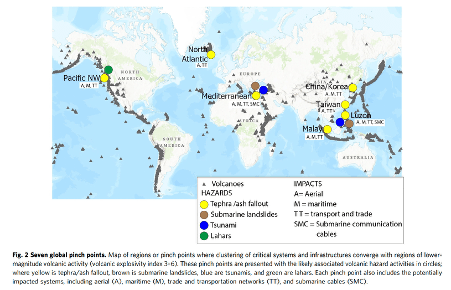
Researchers have previously noted the potential catastrophic impact of large volcanic eruptions at global ‘pinch points’, which could have impacts for New Zealand akin to, or worse than, the closure of the Strait of Hormuz. As indicated in our submission, we’d like to see even more of these global catastrophic risks deliberated on in the public domain.

Figure credit: Mani et al. 2021

A better definition of national resilience

The definition of national resilience in the final version is also better, broader and more normatively loaded.

The draft defined resilience as the ability to “absorb, adapt to, recover from and transform through shocks and stresses.”

The final changes this to “prevent or minimise, absorb, adapt to, recover from and transform through shocks and stresses to enhance the safety, security and prosperity of our people.”

It also introduces a fairness dimension that is absent or only implicit in the draft: resilience must ensure all communities have the capability to cope, and it explicitly recognises te Tiriti o Waitangi as a foundational framework and supports Māori-led approaches.

Risk AND resilience

The biggest improvement is conceptual. The draft had a section titled “Forces that shape risk and resilience,” but in practice it mostly described forces shaping risk. Our submission pointed to that gap directly and argued that resilience has its own drivers: democratic institutions, cooperation, social capital, geography, and other assets that can be deliberately strengthened.

The final briefing now does exactly that. It has a distinct “Forces that shape resilience” section, and the categories are genuinely good: strong institutions, science/data/knowledge, cooperation, social capital and trust, and geographical advantages such as island geography, biosecurity, domestic food production, and renewable energy access.

We’ve noted before that New Zealand has many such advantages, but these need to be leveraged into resilience measures. A recent paper that one of us (MB) coauthored, actually maps out resilience factors in the face of global catastrophe, finding that New Zealand possesses much potential that could be harnessed with the right policies.

That shift from risk to risk-and-resilience matters because it changes the briefing from a catalogue of threats into the beginnings of a framework for agency and resilience building. Resilience is no longer treated as just the residual after we list what can go wrong. It is treated as something we can intentionally develop.

Need to ensure ‘basic needs’ for survival

Another important improvement is the stronger focus on basic needs. Our submission argued that resilience planning should centre on continuity of food, water, shelter, energy, communications, and transport, and that government should think in terms of backup or “Plan B” infrastructures, not just hardening the primary system. The final briefing does not go all the way there, but it does improve materially. Its definition of resilience now explicitly includes ensuring people can access “food, shelter, water and electricity” during crises, while also keeping government and businesses functioning.

Public deliberation is necessary

The final briefing also improves on participation. It refers to deliberative democracy around risk, explicitly noting that this could help address hard questions. That is not a trivial addition. Once we admit (as the briefing does) that resilience involves trade-offs, who pays, what gets protected, what standards we adopt, and how much redundancy we are willing to fund, then expert analysis alone is not enough. These are public choices. They require informed public judgment.

The community section is more participatory in the final. The draft’s “Community-led solutions” stresses preparedness, local supplies, and learning from Sweden and the UK. The final keeps those elements but adds a new paragraph on communities having a strong interest in resilience decision-making and introduces the Citizens Assembly on Auckland’s water supply as an example of deliberative democracy. That is a real change in the final’s imagination of resilience: not just communities as recipients or responders, but communities as central co-decision-makers.

Transparency and risk dialogue

Calls for transparency are improved. In our submission we called for a detailed publicly accessible National Risk Register. The final briefing now includes Annex 1: National Risk Register 2025 (which is also available on the DPMC’s website).

National Risks are comprised of hazards (non-malicious and often natural occurrences like earthquakes) and national security threats (malicious, such as cyberattacks, armed conflict, or disruption from new technologies like AI and biotechnology). The annex includes both.

That annex materially changes the document’s function: it is no longer just an interpretive briefing, but also a reference document that anchors the narrative in a formal risk inventory and explicitly links the briefing to that wider national risk architecture. This is a significant step forward. Public discussion about resilience is always thinner than it should be when the public cannot see the government’s underlying picture of risk.

That said, the usefulness of either the annex or the DPMC’s equivalent website are very limited by their lack of detailed information. The threats and hazards really just constitute a list of bad things, without details of likelihoods, worked scenarios illustrating first order and cascading consequences, current plans, and a menu of desired resilience options for public deliberation.

Giving credit for a much improved final briefing should not mean pretending the job is done.

Our submission argued that New Zealand’s resilience thinking should extend more explicitly to global catastrophic and existential risks, including conflict risks, advanced AI, bioengineered pandemics, supervolcanoes, and other globally generated disruptions. The final partially acknowledges this wider landscape by noting that national risks include hazards and national security threats, including armed conflict and disruption from AI and biotechnology. But it then explicitly confines the briefing itself to hazards. That is understandable administratively, but analytically it leaves an important gap.

The most obvious remaining limitation is scope, this briefing focuses on just six selected hazards. Many other hazards exist, as do malicious threats, but there are also many risks that are neither natural hazards, nor malicious threats to New Zealand, some of these are global and catastrophic in nature.

At some point, and in some form, organisations and citizens need to be provided with this broader picture of risk information, in a way that is not distributed across the silos of the public sector, a bit here, a bit there, and a bit left out. 

National security

Sitting in another silo, is the companion briefing to the LTIB discussed above. The 2023 National Security Long-term Insights Briefing acknowledges that global, externally originating crises, such as geopolitical conflict or disruptions to international systems, can pose significant risks to New Zealand. However, that briefing treats these risks largely at a high, conceptual level, framing them within broader trends like declining international order rather than analysing their concrete impacts.

As a result, it does not sufficiently grapple with the severe, practical consequences that a major global trade or energy disruption could have for a remote, import-dependent country like New Zealand.

It is notable that although these briefings mention resilience measures like battery storage, solar electricity, and basic needs such as food security, neither mentions liquid fuel at all. There is a single phrase in the new annex of the hazards briefing under “significant disruption or failure of critical infrastructure”, which says just “impact to… liquid fuel supplies”.  

In the present global context that is surprising. Our submission highlighted, ‘cascading global system failures (e.g., telecommunications, energy grids, shipping, fuel supply)’ as major hazards, the details of which should be included in public facing risk briefings.

Our NZCat report in 2023 concluded that the second most critical action the country needed to take to mitigate national risk was:

  • Immediately develop an updated National Fuel Plan (that quantifies the volume needed by critical sectors and how to supply it) (p.104).

This was second only to:

  • Immediately undertake a systematic & comprehensive National Risk Assessment (that explicitly includes global catastrophic risks).

We still believe these are two critical actions New Zealand must take as a nation (as a collaboration between the public sector and civil society).

Read our 2025 blog analysing New Zealand’s liquid fuel security

National risk registers lack half the picture

Risk registers, as in the briefing’s annex, are still only half of what the nation needs. A list of risks is valuable. But if the briefing now endorses deliberative democracy, then the next step is obvious: we also need a corresponding list of mitigation options. Not necessarily mapped one-to-one against risks in a simplistic way, but a structured set of possible measures that correspond either to individual risks or to common cross-risk impacts whether these be liquid fuel constraints, or food disruption, catastrophic electricity loss, internet or communications failure, supply chain fracture, population displacement, or insurance retreat.

Global catastrophes will tend to have their consequences through common pathways, and it is in these pathways (as well as across key sectors) where resilience must be developed. The Figure illustrates three of these, namely ‘sunlight reduction’ (crop yields, food security, global food trade disruption); ‘global catastrophic infrastructure loss’ (interruptions to global energy supply, national electricity, or liquid fuel availability), and ‘global catastrophic biological risk’ (ie disease/pandemic disruption):

Figure credit: Jehn et al. 2026

Only with clear and detailed information on all of the above can the public deliberate meaningfully on what we actually want to plan for, build, fund, what trade-offs we are prepared to make, and which resilience measures deserve priority.

A risk register tells us what might happen.

A mitigation register and ‘wish list’ would let us debate what we want to do about it.

With the National Hazards Board now former and new governance arrangements being made for the National Resilience System, there is an opportunity for a new approach to risk prioritisation, transparency, and structured public deliberation on resilience options.

There is also an opportunity to implement a ‘third line of defence’ through establishing an independent Parliamentary Commissioner for Catastrophic Risk, or a national Chief Risk Officer. This could help ensure integration of disparate risk silos and systematic coverage of all risk to New Zealand.

That, in our view, is where this should all go next. The final LTIB is very much better than the draft. The government officials writing it deserve recognition for that. And precisely because it is better, it opens the door to the next, harder, and more democratic conversation.