
A practical follow-up to the “Reality of Everything” Symposium and other recent discussions of humanity’s predicament

TLDR/Summary
- Events like Wellington’s recent “Reality of Everything” Symposium diagnose the world’s predicament vividly, but seldom pause to define the terms doing the heavy lifting: global catastrophic risk, systemic risk, polycrisis, metacrisis.
- This guide follows a through-line, from the hazards we can see down to the drivers we usually can’t: what could go badly wrong (global catastrophic risk), how failures spread (systemic risk), how they entangle and compound (polycrisis), and why we keep generating them (the metacrisis).
- For a climate-focused audience the key move is this: carbon emissions and climate change are one thread, not the whole cloth, one of several global catastrophic risks, spreading and compounding through a tightly-coupled world.
- Beneath all of it sit behavioural and evolutionary drivers, the ultimate causes of the proximate symptoms policy usually addresses. Defined precisely, the metacrisis is not “many crises at once” but the degradation of our collective capacity to adapt, introduced briefly here and developed elsewhere.
A superb diagnosis, with the terms left undefined
Gatherings like the Reality of Everything Symposium are strong on diagnosis: speaker after speaker showed, compellingly, that human society is in overshoot, that planetary boundaries are being breached, and that our crises are interlocking rather than separate.
What such events seldom do is define the words carrying the argument. Global catastrophic risk, systemic risk, polycrisis and metacrisis sometimes get used almost interchangeably, partly blurring into an anxious hum.
That blurring matters, because it is difficult to prioritise within, or act upstream of, a problem space you cannot name.
This blog is a short field guide, organised as a chain of four questions, each reaching a little deeper than the last.
First question: what could go badly wrong? (Global catastrophic risk)
Start with the hazards themselves. Global catastrophic risk (GCR) is the study of events and processes large enough to overwhelm civilisation’s capacity to cope: nuclear war, engineered pandemics, extreme outcomes from artificial intelligence, famine-creating volcanic eruptions, and runaway climate change.
These risks are sometimes defined as those that would put the lives of 10% of humanity at risk, up to and including human extinction. The field’s contribution is a long horizon and a willingness to take seriously events that are unlikely in any given year but so consequential their expected harm can dwarf that of familiar disasters, a blind spot the UN’s own 2025 Global Assessment Report and Pact for the Future now concede.
For readers who arrived through climate, this is the first and most useful reframing: climate change is not a category of its own, apart from “other” risks, but one member of the GCR family. Treating it as one thread among several, rather than the whole cloth, is what lets the rest of the picture come into focus (we develop this widening of the lens here in the context of Aotearoa New Zealand).
Second question: how do failures spread? (Systemic risk)
Knowing which hazards could be catastrophic is not the same as understanding how a shock propagates. That is the work of global systemic risk, and it involves a genuine shift in perspective: instead of seeing the global system as an innocent bystander that receives hazards from outside (eg pandemics, storms, or volcanic eruptions), systemic-risk thinking treats the system itself as a generator of them.
Liu and Renn distil the hallmarks: densely connected feedback networks, in which effects loop back to change their own causes; strong nonlinearity, so a small nudge can trigger a disproportionate response once a tipping point is crossed; causation that jumps across sectoral and national borders; and deep uncertainty, because the system’s behaviour cannot be read off from any single part.
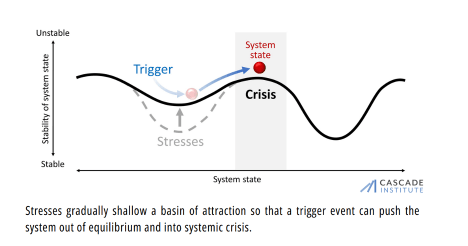
A useful mental image, repurposed from Siegenfeld and Bar-Yam, is a hundred ladders leaning against a wall. Tie them together for “efficiency” and each ladder becomes steadier on its own, less likely to fall. But if one does fall, it now drags all the others down with it. That is tight coupling: the very connections that make a system efficient in calm times make it fragile in a crisis. The 2011 Tōhoku earthquake rippling through just-in-time supply chains, and the 2021 Suez Canal blockage halting roughly a tenth of world trade from a single stuck ship, are textbook cases of triggers tipping stressed systems into crisis.
Two refinements are worth carrying forward. The Cascade Institute’s stress–trigger-crisis model separates the slow-moving stresses that quietly erode a system’s resilience (over-connection, homogenisation, concentration) from the fast-moving triggers that finally tip it over. And Arnscheidt and colleagues name risk-creating actors, those who extract a local advantage while loading cost onto the whole system, as a primary driver of global vulnerability. We return to this idea below.
Third question: how do crises compound? (Polycrisis)
Systemic risk explains how one system tips over. Polycrisis describes what happens when several do so at once and turn out to be wired together. Lawrence and colleagues give the field its working definition, the causal entanglement of crises across global systems in ways that significantly degrade humanity’s prospects, and specify how that entanglement happens, through three pathways.
The first is common stresses: a single underlying pressure, climate change being the obvious one, simultaneously weakens food, water, migration and security systems, so separate crises flare up together not by coincidence but from a shared root. The second is domino effects: a crisis in one system directly triggers one in another, as when a regional conflict becomes an energy shock, which becomes a food-price shock, which becomes political instability somewhere else entirely. The third, and most insidious, is inter-systemic feedback: two crises reach back and worsen each other in a loop, each making the other harder to resolve.
Run those pathways together and you get the defining feature of a polycrisis, the whole is genuinely worse than the sum of its parts, precisely because the parts are no longer independent. The years 2020–2023, when a pandemic, a European war, and energy, food and inflation shocks all fed into one another, are the case study everyone now reaches for.
Liu and Renn clarify the complementarity: systemic risk research specifies the conditions under which cascading failure becomes possible, polycrisis research tracks the cascades once entangled, and neither yet explains why governance consistently fails to adapt.
Somewhat soberingly, the most comprehensive systematic review of polycrisis to date catalogues the component crises and their drivers, then characterises many of those drivers as asserted rather than analysed. The field has mapped the entanglement in impressive detail but cannot yet say why it keeps happening, or why most of these crises, flagged as far back as the 1970s (eg Club of Rome report), remain unresolved. Which brings us to the deepest question.
Fourth question: why do we keep generating a fragile world? (From what to why)
There is a pattern. Each of the first three questions excels at describing what is happening and how it unfolds; none quite explains why humanity keeps generating the conditions behind catastrophic, systemic and polycrisis risk in the first place.
Biology offers a precise way to name the gap. Ernst Mayr distinguished proximate causes, the immediate mechanism, as in “the bird migrates because shortening days trigger a hormonal response”, from ultimate causes, ie the evolutionary reason the mechanism exists at all. Crucially, these are not two links in one chain but two answers to different questions about the same behaviour: how it works, and why it was selected for.
Almost everything governments fund, and almost everything discussed at events like Reality of Everything, acts on our behaviours and their fallout. Cut emissions, reduce consumption, diversify trade, stockpile fuel, plan for the next storm. This work is necessary. But it operates on the expression of humanity’s drives and their downstream consequences while leaving the ultimate question untouched: why do humans reliably develop the appetites for growth, status and accumulation whose collective expression produces these risks?
Suppress one proximate expression and the underlying disposition, its evolutionary rationale and sustaining forces still intact, tends to resurface through another. That is why symptom-by-symptom effort keeps falling behind: we are managing the outputs of drives whose reason for being we have not addressed.
The fields already working at the ultimate level are behavioural and evolutionary sciences. The same two questions extend beyond genes. Institutions and norms are culturally transmitted traits with their own proximate mechanisms, meaning how they operate today, and their own ultimate explanations, meaning why competition between groups selected and spread them. That dual structure is what earns “institutional” its place alongside the evolutionary drivers. These fields trace some of today’s crises to a “human behavioural crisis“, a suite of drives toward growth, status and consumption that were once adaptive and are now exploited at planetary scale.
Reach further back and the pattern is evolutionary. Competition between human groups, cultural niche construction, and technological evolution have ratcheted us toward ever-greater scale and environmental control, while rewarding strategies that pay off locally even when ruinous globally, the “risk-creating actors” of the systemic-risk literature, now seen from below. This is the multipolar trap, in which each player, acting rationally in its own interest, helps produce an outcome nobody wants.
So what, precisely, is the Metacrisis?
Here the vocabulary finally separates cleanly. A crisis is a single system in trouble. A polycrisis is many crises causally entangled, worse than the sum of their parts. The metacrisis is the layer beyond both: the ultimate, upstream drivers, behavioural, institutional and evolutionary, that keep generating and re-generating the whole mess.
I think this can be tightened one step further. Rather than a vague gesture at “everything, but deeper,” the metacrisis can be defined as the degradation of the conditions that allow risk-reducing solutions to accumulate and persist, a crisis not of any particular risk but of humanity’s capacity to adapt to large-scale risk at all.
In evolutionary language that capacity is called evolvability, and when its supporting conditions erode together, good solutions stop compounding and governance fails consistently across otherwise unrelated domains. Where the more familiar framing locates the metacrisis in a crisis of collective sense-making, of how we perceive and make meaning, this one locates it a step wider, in the adaptive machinery that would let good solutions take hold and accumulate at all; sense-making is then one input to that capacity rather than the whole of it.
I flag this lens for completeness; it is deliberately provocative and, for now, a theoretical framework rather than the settled account, developed in current work and presented in nascent form at recent risk-science conferences. Watch this space for my imminent pre-print research paper.
Why this matters, especially if you came via climate concern
If you arrived at the ‘Reality of Everything’ and global risk through climate change, the upshot is liberating rather than deflating. Climate change (CO2/radiative forcing) is one of nine planetary boundaries, and the climate crisis is one expression of a larger predicament driven by common upstream forces.
Seeing the through-line, hazards, stresses, how they spread, how they compound, and why we keep making them, lets you do two things at once: keep pushing on the proximate work that is urgent and real, while recognising where climate action connects to other risk like pandemic preparedness, trade and supply-chain resilience, and the health of the institutions on which all risk mitigation depends.
Naming the space is the difference between fighting symptoms one at a time and acting on the mechanisms that produce them. That is the conversation we hope events like Reality of Everything can grow into next, and it is one this small field guide is meant to kick start.
Thanks again to the Symposium organisers and participants.


2 thoughts on “Polycrisis, Metacrisis, Systemic Risk: A Definitional Field Guide to the Reality of Everything”