The 2026 Volcanic Impacts on Climate and Society (VICS) Conference brought together the VICS community, a working group associated with PAGES: Past Global Changes, to consider past, present and future eruptions.
For a global catastrophic risk audience, the central message was clear: volcanic eruptions are not merely local geological disasters. Large eruptions can, and have, become global climate, food, trade, financial and political shocks.
More importantly, large volcanic eruptions are rarely “single-cause” disasters. They typically act as amplifiers: triggering or worsening existing vulnerability across food systems, markets, disease dynamics, migration, state fragility and geopolitical instability.
That makes such eruptions particularly important for global systemic risk, catastrophic risk, and polycrisis thinking, as a large volcanic eruption is a plausible trigger that could tip already stressed critical global systems into crisis, and there is historical precedent.
The VICS Conference also sharpened a second point we have made in our work, which includes analysis of the Tambora eruption and volcanic winter and nuclear winter and trade disruption, namely that abrupt sunlight reduction is not only a climate problem, it is a civilisation-support problem.
The interdisciplinary workshops hosted at VICS provided a template for how academics, policymakers and emergency management personnel can use scenarios to better understand and prepare for the global and cascading effects of large volcanic eruptions.
With next year’s 2027 VICS Conference being held in Taupō New Zealand – this country has an extra opportunity to bring particular focus to all these issues.
Past: volcanic eruptions as amplifiers, not sole causes
The first day of the VICS Conference focused on the past, treated as the best available laboratory for understanding how societies respond to sudden climate shocks.
A repeated structure appeared. We see eruption, atmospheric perturbation, regional climate anomaly, crop harvest stress, grain price spikes, disease, migration, and unrest. But the causal chain was never simple. One eruption does not produce one global outcome. The same event may bring cold and wet conditions to one region, warm and dry conditions to another, and little obvious disruption elsewhere. Latitude, season, eruption chemistry, injection height, background climate state, crop calendars, trade networks, political capacity and social vulnerability all typically matter.
This is exactly why volcano risk is a global systemic-risk problem. Many past eruptions have caused reductions in global mean temperature. A global-mean temperature number can be useful, but people do not eat global means. They eat crops grown in particular regions, during particular seasons, embedded in particular market and political systems.
Some of the strongest evidence for volcanic effects and response came from combining “archives of nature” and “archives of society”: ice cores, tephra records, sulphur (and its isotopes), tree rings, cave records and marine records alongside diaries, parish burial records, grain prices, market records and historical texts. That fusion allows researchers to ask not only “did an eruption occur?” but “when, where, how high did the emissions go, what climate response followed, and how did societies mediate the harm?”
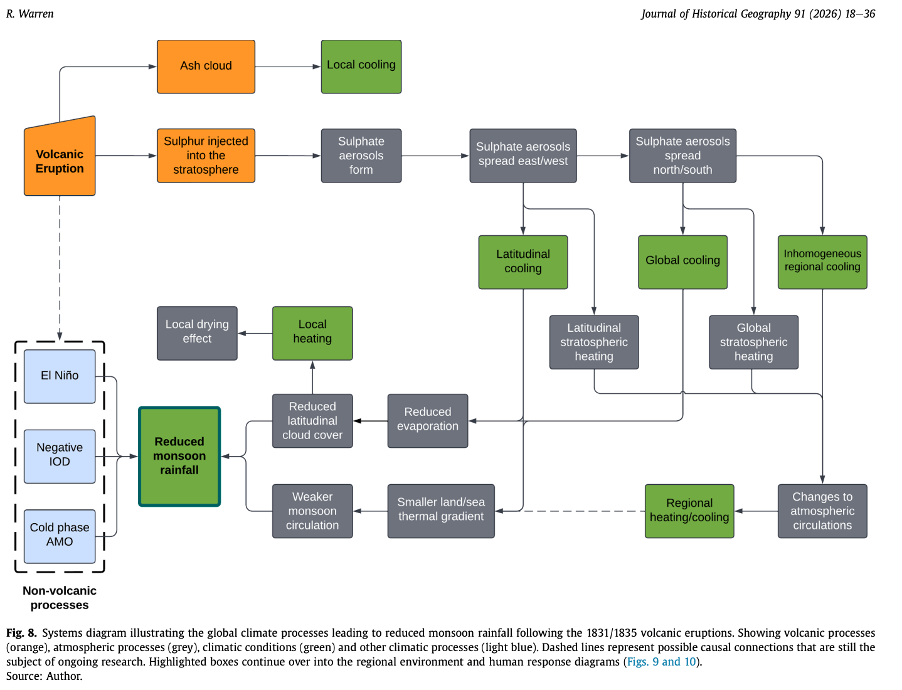
Examples ranged from Icelandic eruptions and their climate fingerprints, to 17th-century northern Europe, to China, Japan and the early 19th-century crisis years around the Tambora eruption. The 1690s in northern Europe were particularly instructive: Scotland, Finland and Norway all experienced cold, harvest failure and very high mortality, but outcomes varied. Norway’s grain imports and social-political context appear to have buffered some impacts. The lesson is not “eruption equals famine.” It is “eruption plus vulnerability plus failed response equals catastrophe.” The figure below is a systems diagram showing the cascading impacts of the 1831/1835 eruptions (as described in Richard Warren’s talk).
Image credit: Warren 2026, Journal of Historical Geography, CC-BY-4.0
Past–present: the wrong volcano may be in our risk model
Day two pushed the evidence closer to present-day risk. A key theme was that high-latitude and mid-latitude eruptions may matter more than the standard catastrophic tropical-volcano mental model suggests.
Ally Peccia’s work on the 43 BCE Okmok II eruption in Alaska was striking in this regard. A remote Aleutian eruption appears to line up with cold, famine and major documented crises across the late Roman Republic, Egypt, China, Sri Lanka and India. The key scientific issue (especially for thinking about future eruptions) is not simply how large the eruption was, but how much sulphur reached the stratosphere, how it spread, and how sensitive the Northern Hemisphere climate was to that loading.
This matters because the world’s preparedness imagination still tends to picture a Tambora-like tropical eruption. Tambora remains the benchmark, and rightly so. But VICS reinforced that remote extratropical volcanoes can be especially globally consequential. They may “punch above their weight” hemispherically.
If risk assessments focus too narrowly on the volcanic explosivity index (VEI), tropical latitude, or direct local exposure, they may miss the events most relevant to global food and trade disruption, the cascading systemic effects.
Anja Schmidt’s keynote made this even sharper. She argued that the VEI is not well suited to climate-risk thinking because it does not reliably track sulphur release or climate response. A proposed Volcano-Climate Index would instead rank eruptions by climate effect. This is the kind of shift risk governance often needs: from measuring the hazard in geological terms to measuring what actually matters for human systems, thereby allowing risk assessment in terms of likelihood of catastrophic climate impacts.
Schmidt also flagged a striking probability: a substantial chance (70%) of Pinatubo-scale eruption induced cooling before 2100. The risk is not just the global cooling. It is estimating cascading hazards and socio-economic consequences in a hyperconnected world.
That is where volcano science needs to meet food-system modelling, shipping, finance, public health, conflict studies and national resilience planning. This is important because the Pinatubo eruption in 1991 (in the Philippines) had a greater impact on global food production (maize down 9%) than any severe El Nino, though this is complicated by the fact that the eruption may have triggered an El Nino!
In today’s even more interconnected, food trade-dependent, and conflict-ridden world, the implications for food security would be even more serious.
There is also an uncomfortable analogue between large volcanic eruptions and nuclear war (and its stratospheric soot injection from burning cities), as well as geoengineering as a response to climate heating. Nuclear winter, volcanic winter and solar geoengineering all involve sunlight reduction, altered precipitation and non-uniform regional effects. They differ enormously in cause and governance, but they stress some of the same civilisational-support systems: food, trade, energy, trust and political coordination. We contend that the likelihood (and therefore the food/trade/societal resilience policy response) to climate altering shocks, needs to account for the aggregate probability of severe volcanism, nuclear war, geoengineering policy, and other drivers.
Future: the next eruption happens in a warmer, more connected world
The future-focused day on day three of the Conference, made the global catastrophic risk relevance explicit.
Markus Stoffel returned to Tambora as the benchmark: the 1815 eruption, roughly 1°C Northern Hemisphere cooling, failed harvests, grain price spikes, the “year without a summer,” and severe global consequences.
But the more important point is that a Tambora-scale eruption today would not occur in the world of 1815. It would occur in a world of more thaneight billion people, tightly coupled trade, just-in-time supply chains, financial contagion, geopolitical tension, fragile trust, and climate-stressed food systems.
That is the polycrisis point. The eruption is not the whole disaster. It is the initiating shock in an already stressed system.
May Chim’s modelling, as summarised at the Conference, suggested that global warming may amplify future eruption impacts: a Pinatubo-sized eruption later this century could cool the surface more than the same eruption in a pre-industrial climate. This is because of altered plume height, aerosol behaviour and ocean heat dynamics. In other words, climate change may not simply be one background risk among many. It may change the behaviour of other risks.
James Dalziel’s insurance and financial-risk talk showed how poorly prepared institutions remain. Recent volcanic losses look small compared with storms and floods, but the tail is large. Lloyd’s/Cambridge-style scenarios suggest a plausible extreme volcanic event could produce multi-trillion-dollar economic impacts over five years, with losses travelling through insurance, aviation, shipping, supply chains, food systems and healthcare.
Mike Cassidy’s presentation brought the global catastrophic and volcanic risk cases together. Policymakers under-prioritise volcanic risk because eruptions seem rare, local and geophysical. But the most consequential harms are often second- and third-order cascades: poor harvests, grain price rises, disease, famine, migration, unrest, political instability and long recovery times. A single eruption may be a 2–4-year shock. An eruption cluster can become a 7–15-year depression because societies do not get time to recover before the next forcing arrives and forcing can compound.
This is where analogy to the recent Hormuz Strait maritime chokepoint disruption is useful. This case showed how quickly a geographically concentrated shock can become an energy, fertiliser, shipping, inflation and security problem.
A major eruption could do something similar, but through ash, aviation closure, food-system stress, climate anomalies and trade interruption at the same time. For New Zealand, this matters because geographic isolation is both a resilience asset and a vulnerability. We may be food-producing, renewable-energy-rich and distant from many conflict zones, but we are also deeply dependent on imported liquid fuels, imported components, global markets and functioning maritime trade.
What is the global community still missing?
The VICS Conference suggested several gaps.
First, we still need better scientific reconstruction of past eruptions: eruption timing, source attribution, sulphur budgets, stratospheric injection, halogens, aerosol microphysics, plume height and eruption season. These details determine climate impact.
Second, we need regional impact modelling, not just global means. Adaptation happens in breadbaskets, ports, watersheds, insurance books and political systems.
Third, we need integrated food-trade-economy-public-health models for abrupt sunlight reduction scenarios. This is where our own Tambora work and our ASRS/nuclear-winter work should be brought together.
Fourth, we need serious scenario exercises. The VICS Conference included exercises around Kikai and Campanian Ignimbrite scenarios, two large magnitude 7 eruptions with likely associated climatic shocks, these represented not the worst-case event (e.g. a rare super eruption), but a ‘reasonable worst case’ given both volcanoes have endured these eruptions before, VICS asked what if these eruptions happened today?
Scenario exercises were run at VICS with interdisciplinary experts from academia (a range of different expertise from volcanologists, climate experts, historians) to policymakers. The aim was to provide a timeline of likely impacts from volcanic climate hazards, and the impacts to society. As part of the exercise, intervention points were added, where policy action and preparedness could mitigate some of the worst impacts.
Given the interdisciplinary range of the participants, the idea was to build a shared mental model and common language, to learn from each other and leave with the same picture of the threat and how everyone’s work connects. By laying out the timeline as a series of events, it also aimed to help to make an otherwise ungraspable large risk, somewhat tractable, while exposing the gaps and uncertainties in our knowledge.
As a test exercise, and with a limited window of time, the scenarios were a success. Discussions were clarifying and productive and helped some participants to fully understand the scale of the risk, when taken as a whole. The exercise created connections between policymakers and scientists and built an understanding of the limitations in governing the response during or after the event. VICS hopes to build on these scenario exercises at their next events, as they stimulated important conversations, which talks and posters alone could not achieve.
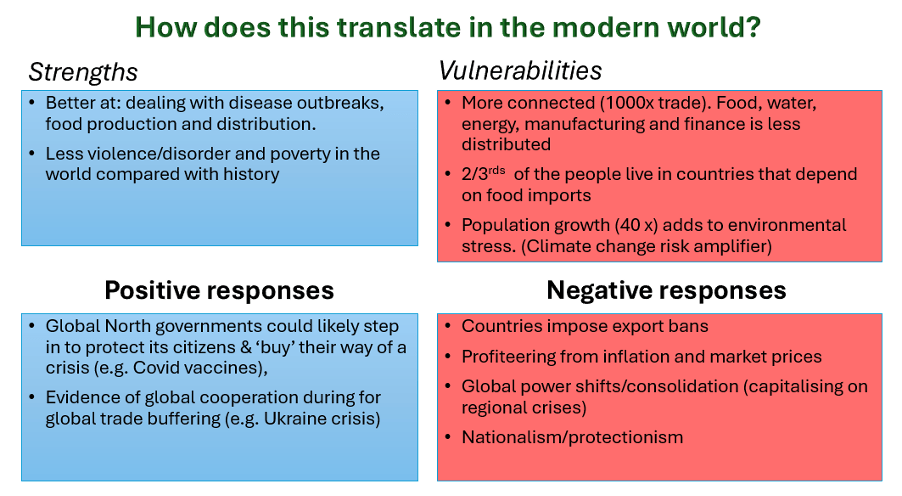
Fifth, the world needs to know what actually works to mitigate volcano climate risk. Cassidy’s “what worked and what didn’t” in past volcano climate shocks framing is crucial. Historical cases suggest that buffers, imports, social trust, functioning markets, local adaptation, transparent information, and competent governance can reduce harm. But panic buying, food export bans, conflict, brittle supply chains and poor communication can amplify it (see the figure below, which compares historical and modern context, and what worked and didn’t work to mitigate volcano climate impact).
Image credit: Mike Cassidy, VICS 2026
Implications for action
For New Zealand and other remote nations, volcanic risk should be treated with anticipatory governance of catastrophic societal risk, not just geological hazard management. That means adding large distant eruptions to national risk assessments; stress-testing food, fuel, medicine and maritime logistics; building food plans for ASRS (abrupt sunlight reduction scenarios) that cover both nuclear and volcanic winter; modelling trade interruption alongside climate disruption; and creating a vulnerability register and mitigation register for vital functions.
Internationally, volcanic-risk work needs to move from “what is the eruption probability?” to “which societal functions fail, in what order, and what keeps them running?” That means whole-of-system exercises involving volcanologists, climate scientists, food-system experts, insurers, shipping experts, public-health planners, defence, finance, and policymakers.
The strongest lesson from VICS may be that the past is not past. It is an archive of natural experiments in stress, shock and response. The next large eruption will not by itself determine whether the outcome is difficult, disastrous or globally catastrophic. The outcome will depend on the state and responses of the systems it strikes.
The eruption is the trigger. The catastrophe is the cascade. The work now is to make sure the resilience building initiatives exist to put the brakes on those cascades.
The global risk picture is serious and, for several risks, worsening: geopolitical turmoil, the risk of nuclear conflict, bioengineered pandemics, large volcanic eruptions, severe space weather, AI-enabled systemic failures, and the trade and supply-chain collapse that an isolated trading nation would feel most.
New Zealand is ill-prepared. Useful work on planning and resilience exists, but it is fragmented, ad hoc, domestic, short-horizon, and largely silent on global catastrophic risk.
We propose a Parliamentary Commissioner for Catastrophic Risk (PCCR), an independent Officer of Parliament modelled on the proven Parliamentary Commissioner for the Environment, and we’ve drafted a Bill to show it can be done.
The public mood is shifting from efficiency and profit toward resilience and security. The data back this: a majority of New Zealanders, across the political spectrum, support institutional action on catastrophic risk.
2026 is an election year. Which party will pick this up and campaign on it?
The global situation is serious, and New Zealand is not ready
The world is not short of warnings. Across our recent work, including our two Policy Quarterly papers (2021, 2025) and our synthesis of the latest European risk-science conference, we have made the same case. Risk governance still systematically under-weights the low-probability, high-impact, cross-border catastrophes that a small, remote, trade-dependent nation is most exposed to. Great Power war, nuclear war and nuclear winter, extreme pandemics, large volcanic eruptions, solar storms, AI catastrophes: are each individually unlikely in any given year, but collectively close to certain over the decades, and capable of severing the flow of fuel, fertiliser, medicines and food on which NZ depends.
Our country has pieces of an answer, a National Risk Register, DPMC’s resilience work, the National Emergency Management Agency (NEMA), sectoral strategies. But these all remain fragmented, focused on familiar domestic hazards, after-the-fact response plans to international crises, and are quiet on the risk of global catastrophe. Some activity is real. The coordination, the scope, and the public conversation are missing.
Why central, independent oversight, and why now
This is not just an organisational gap. As one of us argued at the SRA-E conference, fragile systems are selected for. Where no agency faces real pressure to look across silos and over the horizon, none does, and individually rational behaviour (each department defending its own patch, each firm externalising its risk) compounds collective danger. Siloed risk assessment can even improve one entity’s resilience while degrading the whole. Correcting that requires a body whose explicit job is to suppress this drift: to aggregate across hazards, take the long view, a view of global reality, realistic futures, tail risk, and answer to Parliament rather than the three-year cycle.
That is the logic behind risk mitigation best-practice harnessing “three lines of defence”: operational agencies on the front line, DPMC providing managerial oversight, and an independent scrutineer, the PCCR, as the third line. The Commissioner would not run emergencies. Instead, the Commissioner would:
Assess global, systemic, and catastrophic risk
Critique national risk assessments and risk registers (including what they leave out and how little they say about mitigationoptions)
Advocate for basic-needs continuity and regional cooperation with Australia and the Pacific, and, crucially,
Open these questions to the public through deliberative democracy, such as Citizens’ Assemblies.
The aversion to “scaring the public” has to go; the evidence is that people are ahead of the institutions, and are seeking security, resilience, and sustainable wellbeing amid global turmoil.
We’ve drafted the Bill – in the open
To move from argument to action, we’ve prepared draft legislation for NZ: the Parliamentary Commissioner for Catastrophic Risk Bill. It borrows the durable architecture of the Parliamentary Commissioner for the Environment, Officer of Parliament status, a long appointment term insulated from electoral pressure, independence from ministerial direction, and adds a statutory definition of basic needs, oversight of national risk processes, and a mandate for transparent reporting. The draft has been peer-reviewed by a legal colleague, though no doubt it could be improved further in a robust Select Committee process with public input.
We envision a small office (perhaps 8–10 people, no operational role) against the scale of harm it would help avoid: the cost-benefit ratio could be overwhelming, and the resilience co-benefits, local food, energy security, better infrastructure, would help New Zealanders now.
We are publishing this openly, for discussion, inspiration, and debate. That is deliberate. We are not slipping it to a staffer’s personal email, or hand-delivering hard copies to leave no digital trail, as recently alleged in the lobbying over NZ’s climate legislation. Good risk governance is the opposite of regulatory capture: transparent, contestable, and built in public.
An election-year question
“Balancing the books” is not a national strategy for a century this turbulent, where it is unclear how business-as-usual energy and financial architectures will keep performing. We need a vision of serious, long-term resilience, de-risking while we still can in the face of catastrophes we can foresee and the ones we can’t. The UK is drafting law, the EU is building the system, the Nordics already live preparedness. 2026 is a NZ election year. Global instability is real and rising, and this should be front and centre.
So here is the question for every NZ political party: who will take this Bill, or one like it, and campaign on it?
Please consider filling out our webform with your thoughts and feedback.
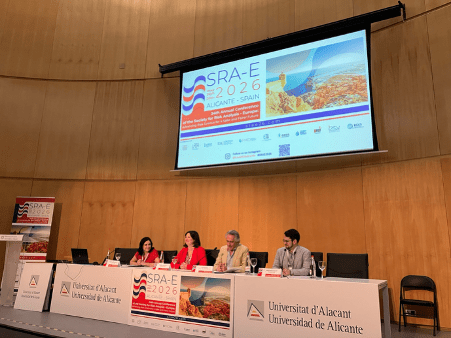
Society for Risk Analysis (Europe), “Advancing Risk Science for a Safer, Fairer, Future,” University of Alicante, Spain, 26–29 May 2026
(In-depth read, ~15-20 min)
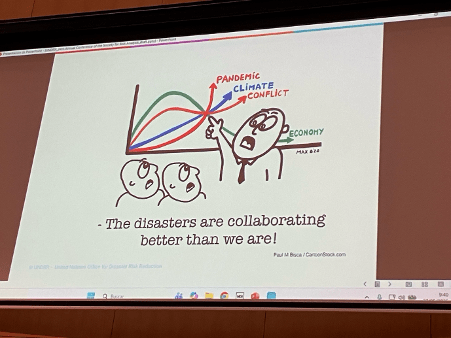
Slide seen at the 2026 SRA-E Conference: Photo credit – the author
TLDR/Summary
I attended SRA-E 2026 in Alicante (Spain) and gave two talks, the first presentation on what the data really say about Covid-19 pandemic preparedness and strategy, and a second presentation arguing that the deepest driver of global risk is evolutionary dynamics. Audio and slides for both are linked below. What follows is my synthesis of the meeting.
The strongest message of the conference was clear: stop asking which hazard will strike and start asking which vital functions could fail and must be kept running. The European Commission’s Joint Research Centre, an EU “threat-agnostic resilience” project, and the polycrisis sessions all converged on this, the same logic as in our recent “vulnerability register / mitigation register” blog.
The argument is no longer theoretical. While the UK is drafting legislation, the EU is rolling out a Preparedness Union Strategy, and the Nordic states already run whole-of-society preparedness as routine, NZ is behind, isolated, and the gap is widening.
Trust was the keystone variable almost everywhere, in disaster response, finance, insurance, refugee preparedness and aid. Because trust underwrites cooperation at every level, its erosion is a first-order driver of global systemic risk, not a soft add-on.
The conference kept reaching for an evolutionary vocabulary without naming it: modularity, redundancy, diversity, selection, plasticity, arms races. That is exactly the integrative gap my second talk set out to fill, arguing that evolution generalists could be integrated across risk governance.
A persistent blind spot on global risk remained: the “big risk picture.” Much of the programme stayed at the level of local risk, individual banks, regional floods, and household security, while genuinely systemic and global-catastrophic risk was carried by only a handful of keynotes and one session.
Bottom line for New Zealand: the international risk-science community, the EU and comparable democracies are starting to build the anticipatory-governance architecture we called for in our recent Policy Quarterlypaper. The case has shifted from “here is an argument” to “here is what everyone else is already doing, why aren’t we?”
2026 is an election year in New Zealand, global risk and resilience should be a central election issue.
A broad risk conference
SRA-E Conference Alicante: photo credit the author
The Society for Risk Analysis is not a disaster-relief NGO or a climate-adaptation forum. It is a broad professional society for the science of risk, governance, toxicology, engineering, policy analysis, mathematics, law, behavioural science, and its European arm gathered this year at the University of Alicante under the banner “Advancing Risk Science for a Safer, Fairer, Future.”
That breadth is the point, and the tension. As SRA International’s president Benjamin Trump and SRA-E’s president Angela Bearth both stressed, SRA is not one methodology or philosophy but a meeting place for everyone who works on risk, an opportunity for integration across silos at a moment when the future of the international institutions that fund and use risk science is genuinely uncertain. I attended representing Adapt Research and the New Zealand charity Islands for the Future of Humanity. Much of what the conference’s strongest sessions argued, my colleague Nick Wilson and I have been arguing for some time:
That risk science still systematically under-weights the low-probability, high-impact, cross-border catastrophes that an isolated trading nation is most exposed to, and
That the remedy is to shift from cataloguing hazards to governing for resilience building.
What was striking about the Alicante Conference was how selected sessions echoed this argument, in a context where resilience-minded regions of the world have begun to act. This is my synthesis, necessarily shaped by what I was able to attend, given the parallel nature of the many sessions.
My two presentations: on Covid-19 and the Metacrisis
“After the Dust Has Settled: Covid-19 outcomes, preparedness, strategy and structural determinants” (Boyd & Wilson): Audio (13min); Slides
Early in the pandemic, confident slogans hardened into conventional wisdom: preparedness doesn’t work; border restrictions do nothing; authoritarian regimes did better. Each was dressed in data. Our work asked whether the data held up once analysed properly, and largely they did not. The early null and reverse correlations between pandemic preparedness and outcomes were artefacts of poor method: failure to adjust for age structure, reliance on reported rather than excess mortality.
Correct these and separate islands from non-islands, and preparedness did predict lower excess mortality for non-islands, while for islands the duration of border controls mattered most; jurisdictions pursuing explicit exclusion-and-elimination strategies recorded the lowest mortality of all.
The headline for a risk-science audience was methodological: data quality and appropriate analysis matter enough to reverse the field’s hasty early conclusions. The fuller story is in our three research papers on Covid-19 preparedness, strategy, and structural correlates of outcome.
“Why Have We Built Such a Fragile World? Evolvability, Systemic Traps, and the Metacrisis Driving Global Risk” (Boyd & Wilson): Audio (14min); Slides
The biologist E.O. Wilson once diagnosed the modern predicament as humanity having:
Palaeolithic emotions, medieval institutions, and godlike technology.
This remains relevant today and is effectively a structural diagnosis. Technological evolution outruns institutional, which outruns genetic, and that mismatch between the nature of our decisions and the scale of their effects (carbon emissions, weapons of mass destruction, digital networks) is the foundational risk-generating mechanism of the Anthropocene.
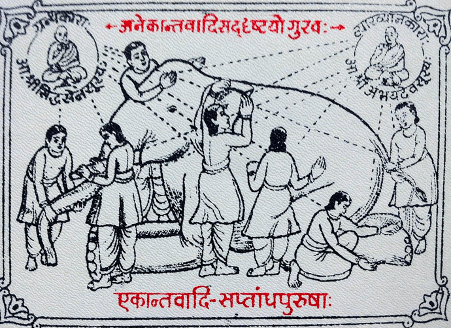
The fields studying global risk: disaster risk reduction, global catastrophic risk studies, national risk assessments, systemic-risk studies, polycrisis scholarship, and behavioural science, each grasp part of the global risk elephant but none integrates the whole.
These fields explain the HOW of catastrophic risk; they leave unanswered the WHY: why humans keep producing the systemic conditions that generate global risk.
Image credit: romana klee on Flickr
The answer, I argued, is evolutionary, and not metaphorically. Selection is substrate-neutral: it operates wherever there is heritable variation, differential fitness and differential reproduction, including among firms, policies and institutions, multiplying whatever is locally fittest; virality, profit, prestige, blind to long-term welfare. Two dynamics in particular build fragility: the defection trap (no firm or state faces real selection pressure against emitting carbon) and arms races (AI-safety investment that is competitively disadvantageous; platforms selected toward engagement maximisation – including outrage).
Worse, we are degrading our own evolvability:
variation gives way to homogenisation
modularity to tight coupling
transmission fidelity to a fragmented information commons
stable selective environments to policy ping-pong, and
outlaw suppression to regulatory capture – of particular import in New Zealand media at present with allegations of risk-creating industry influence on climate legislation.
The above, formally, is a metacrisis, not “many crises at once,” but the degradation of the conditions that let risk-reducing adaptations compound.
Part of the solution can be borrowed from evolutionary oncology (cancer treatment): suppress, don’t try to eradicate defectors, build redundant multi-layer suppression, and design stable environments that reward cooperation. Effective risk governance must actively cultivate evolvability. The full argument, applied to New Zealand, runs through our Policy Quarterlypaper, and you can hear highlights in my talk. This framing is deliberately provocative and, for now, remains a theoretical lens rather than the established account.
I went to Alicante with this evolutionary lens. The conference kept intentionally and unintentionally holding it up to the light.
The Conference keynotes
Natalia Alonso Cano (UNDRR) opened with “Beyond business as usual: accelerating resilience building in a complex risk landscape.” She argued, rightly, that resilience-building is now a necessity, reporting partial progress against the Sendai Framework, but against a worsening backdrop. The number of people affected by disasters globally keeps increasing, and the annual global cost, including ecosystem impacts, runs at an estimated US$2.3 trillion.
But the gap I flag is the one the title promised: after “beyond business as usual,” the mechanism on offer amounted to better data plus more inclusiveness. Worthy, not transformative.
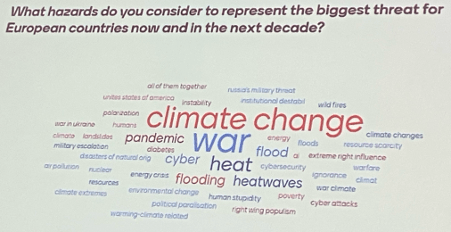
There was a sharper, data-specific problem. Cano ran an exercise asking participants to name Europe’s biggest threat, before arguing that it is in fact “heat stress”.
Risk conference participant responses when asked to rate Europe’s biggest threat (photo credit: the author)
European heat mortality is serious, the WHO estimates around 175,000 heat-related deaths a year in its European Region, about 36% of an estimated 489,000 globally each year. But a “biggest threat” exercise weighted by familiarity systematically under-rates the low-probability, high-impact scenarios that do the real long-run damage.
The 2025 UNDRR’s Global Assessment Report (GAR) top-five hazards exclude pandemics, plausibly a health-silo artefact (with the WHO responsible for pandemics), yet a single moderate pandemic dwarfs annual heat mortality: Covid-19’s toll had reached some 27 million dead by mid-2023. The point is not that heat doesn’t matter; it is that the instruments we use to set priorities can be quietly mis-calibrated against exactly the tail-risk framing the UN GAR has started calling for.
Christina Corbane (Joint Research Centre, European Commission) delivered the standout. “From risk knowledge to policy action” opened with precisely the right question:
not which hazard will occur, butwhich societal vital functions could fail and need resilience?
That is the same move the City of Rotterdam’s Vital Systems programme makes (which I covered in my blog on the European Urban Resilience Forum last year), and the same move Nick and I make in calling for a vulnerability register and a mitigation register rather than merely a national risk or hazard register in our April 2026 blog.
Corbane framed the EU’s emerging Preparedness Union Strategy around an all-hazards, whole-of-government, whole-of-society approach resting on three moves:
a comprehensive risk-and-threat assessment to expose preparedness gaps;
minimum preparedness requirements; and
“preparedness by design.”
Her through-line, preparedness is a way of governing, and the thing risk assessment is ultimately for, is one I’d underline twice. It’s not enough for a national risk register to simply be a list of bad things that could happen. There needs to be public information about the preparedness gaps.
The JRC’s Disaster Risk Management Knowledge Centre integrates a multi-hazard knowledge base, and its 2025 science-for-policy report on current and emerging risks catalogues 47 risks, including cross-border and High-Impact Low-Probability (HILP) events, assessed not just for likelihood but for cascading impacts, compound relationships and, the part that particularly matters, mitigation currently in place and mitigation still advised. Beneath it sit concrete operational tools, the Risk Data Hub mapping hazards, exposure and vulnerability, the Copernicus Emergency Management Service running round-the-clock monitoring and early warning, the INFORM risk indices, and a European Crisis Management Laboratory connecting science to operational decision-making.
First: this is, almost line for line, the architecture New Zealand lacks and needs, ideally built with Australia, since the most serious risks are often cross-border (pandemics, trade and supply shocks).
Second: a knowledge centre that integrates, standardises and transmits risk knowledge across a union is high-fidelity information transmission plus niche scaffolding, two conditions for adaptive evolvability, built deliberately into governance.
Jens Zinn (University of Melbourne), building on the 2022 Victorian floods, argued that vulnerability is not found but manufactured, through the interaction of institutional calculations, social imaginaries and embodied experience. Institutional models lean on flawed proxies, poverty as the key variable, an idealised “resilient population”, when in fact precariousness is universal. The corrective is epistemological pluralism: stop manufacturing the vulnerabilities you claim to manage. This rhymes with the historical evidence that equitable institutions out-survive steep, extractive hierarchies (see Luke Kemp’s recent book).
Magda Osman (University of Cambridge) argued that policy too often puts the cart before the horse, arriving with embedded assumptions before establishing whether a phenomenon is even real or measurable (of rapid reviews requested by policy, she noted, only about 47% contained a research question). I admired the “question the question” discipline; it supports the long-standing call for getting assumptions and values onto the table at the start of national risk assessment. But her suggestion that SRA publish its own risk register would need to ensure that critical systems, vulnerability, and mitigation options feature prominently (and that there is then engagement with policy-makers in nation states).
Jorge Olcina (University of Alicante), delivering in Spanish with live AI translation, argued that geography sets hard limits: planning must be local, involve citizens, and work on the shorter timescales people actually care about (next summer, not 2100). A single flood map is no longer enough; we need multi-risk maps, civil works, planning and risk education. It is not the case that ‘everything is possible’ in a place, and nor should it be permitted, especially when considering flood and climate risk.
The systemic risk, polycrisis, and catastrophic-threats session
This was the richest session I attended, and the closest to our own work, including talks by:
Benjamin Trump who presented a network analysis of the Late Bronze Age collapse. Invasion mattered, he argued, but the real question is why the system was so susceptible. Mapping politics and trade layers, they found a generally resilient network in which single-node failures recovered quickly, but the simultaneous failure of as few as two regions could cascade to total disruption, and war plus climate striking together did exactly that. The governance lesson was pointed: flat-hierarchy networks were agile, redundant and more equal, while pronounced hierarchy bred fragility.
Reinhard Mechler reframed the case for resilience investment around a triple resilience dividend: prevent losses, capture co-benefits, and unblock development potential. The recurring refrain, resilience of what, and for whom?, was the right one. In our own NZCat Report on NZ’s options for building resilience to catastrophic shocks like nuclear war, we itemised the potential co-benefits, but more work could be done to demonstrate development potential that flows from resilience building.
Other highlights
The standout of the theoretical foundations stream, and one of the most relevant talks of the conference for global risk, was delivered by José Palma-Oliveira, “Reframing Risk Governance through Threat-Agnostic Resilience.” The EU- and UKRI-funded AGILE project pursues agnostic risk management for high-impact, low-probability (HILP events; and far from a theory exercise, it is a practitioner-led consortium building a replicable, tiered stress-testing methodology and applying it across nine real-world case studies in different countries and sectors.
The central move is to stop asking which hazard and start asking resilience of what, defining the system by the vital functions that must survive different shocks, then hunting for the common points of failure that recur across otherwise unrelated threats (echoes of our own, ‘solve for nuclear war, solve for all’ framing in the 2023 NZCat Report).
As Palma-Oliveira framed it, resilience rests on five components, modularity, distributedness, redundancy, diversity, plasticity, assessed through that tiered method. Notably, AGILE takes seriously exactly the tail risk the rest of the programme tended to skirt: its reference library catalogues super-volcanic eruptions, Carrington-scale solar storms and impact events alongside the more familiar hazards.
Those five components map almost directly onto the conditions for evolvability, with plasticity supplying the temporal dimension. The ingredient I’d press them to add is the one my argument dwelt on: defector / outlaw suppression. A system can be modular, distributed, redundant, diverse and plastic and still be hollowed out by risk-creating actors whose locally successful strategies degrade the whole. This was a gap visible elsewhere too, in a talk about diaspora humanitarianism where informal transnational actors became trusted aid channels after the 2024 Turkey–Syria earthquake, demonstrating the modular variety a resilient system wants while running into the credibility problems that make defector/outlaw-suppression necessary.
Furthermore, discussing the evolution/risk governance link with the presenter later, we touched on the problem of global coordination, and the evolutionary drivers against that. Our discussion then leaped into the natural importance of local and regional initiatives to combat the impacts of global risk, initiatives which are also aware that done poorly, they could themselves exacerbate global risk ‘elsewhere’.
What was missing at the conference is as telling. The financial and digital-systems sessions were competent but pitched almost entirely at the level of small discrete entities, individual banks, personal loans, household security, small qualitative surveys.
Genuinely systemic, let alone global, financial risk barely featured. This was a critique that held again just as it did regarding the SRA-Australasia Conference in Christchurch in January 2026: the “big risk picture” (especially beyond climate mitigation and adaptation) remains under-served relative to the volume of small, common-risk studies. Yet most future harm lies, in expectation, in systemic and global risk. I’d emphasise again that carbon dioxide is just one of nine planetary boundaries, and planetary boundaries do not cover diverse global risks as diverse as geopolitical tension, artificial intelligence, or demographic transitions.
The threads running through it all
Stepping back, several themes emerged for global risk mitigation, each pointing the same way.
Trust was a keystone for risk reduction. It surfaced as the binding variable almost everywhere: eroded state trust routing aid through diaspora NGOs; trust as the strongest predictor of insurance uptake and the moderator of third-party risk in finance; “auditable trust” as the lesson of a catastrophic North Macedonian nightclub fire; trust as the mediator that helps refugees prepare; legitimacy crises as the tipping point in disaster response.
My synthesis is more ambitious than any single talk’s: because trust underwrites cooperation at every level, cells, organisms, social groups, institutions, nation states, its erosion is a first-order driver of global systemic risk. A world without capacity for trust is losing its capacity to cooperate its way out of the metacrisis. Trust needs to be engineered, and technology exists to scaffold it, whether block chains, polis-style democratic processes and citizens’ assemblies, or a clamp-down on lobbying and money in politics, trust can be sustained and cultivated.
The field kept reaching for an evolutionary vocabulary without naming it. AGILE’s five components are evolvability conditions in other words. The Bronze Age collapse work is selection and network structure made literal.
The evolutionary framework offers to integrate all this: naming why fragile architectures and maladaptive incentives are repeatedly selected for and locked in, despite most people’s good intentions.
“Systems and vital functions, not hazards” was the single strongest convergent message relevant to global risk. Corbane’s five shifts, AGILE’s threat-agnostic resilience, and the polycrisis and collapse work all rejected hazard-by-hazard planning in favour of asking what the system is, what it must keep doing, and how harm cascades. This is the cleanest support for a move from hazard-centric national risk registers to a vulnerability-register / mitigation-register approach, and for anticipatory governance of national and cross-border risk.
Cross-border interdependence was the default, not the exception, most JRC-catalogued risks are cross-border; cross-border burn-care capacity was the hard lesson of the North Macedonia nightclub fire; and diaspora flows are transnational by nature. The implication for New Zealand is a national and cross-border risk system built with Australia and our Pacific neighbours.
And “Fairer” in the conference theme earned its place. Equity ran through the programme as more than a slogan: Zinn’s manufactured vulnerability, refugee disaster-vulnerability as structurally produced, the deliberate inclusion of people with intellectual disabilities in preparedness design (one researcher made the case for stories, a folk tale of a green goblin at the water’s edge who grabs careless children does more for water safety than any fact sheet. Stories do not just protect children at the water’s edge; as articulated recently in the Existential Crunch blog, “How environmental politics lost the future,” the failure of climate and risk politics is at root a failure of narrative. Facts and doom have not moved us, and only vivid, hopeful visions of a different future will.)
Who bears risk, and whose knowledge counts, are part of systemic resilience, not separate from it. Stakeholder engagement throughout the national risk mitigation process is essential. You cannot ‘do’ a risk assessment and then consult on it, because the assessment process itself is value-laden from the start. National risk assessment and mitigation must be transparent, open, and created by all.
The “wider risk lens” argument is no longer theoretical
When previously arguing that nations should widen their risk lens to global catastrophic and systemic risk, build anticipatory-governance institutions, treat resilience as a way of governing, and develop a degree of self-sufficiency and regionalism in the face of global risk, we were making a case against the grain and established practice.
That has changed. Beyond the SRA-E Alicante conference, the same arguments now arrive from multiple directions at once, attached not to think-pieces but to legislation, EU strategy, and standing national programmes.
The United Kingdom is drafting law, and submissions to the House of Lords’ new National Resilience Committee include those of:
Lord Toby Harris, chair of the UK National Preparedness Commission, who argues the UK needs a genuine whole-of-society approach, and proposes merging a National Resilience Act and a Defence Readiness Act into a single National Resilience and Defence Readiness Bill for 2026–27. This will place legal obligations on public bodies, set expectations for business, and establish an independent National Resilience Committee modelled on the Climate Change Committee. He is pointed about transparency: the 2025 UK National Risk Register lists 89 acute risks but says almost nothing about mitigation. Every one of those threads, an independent statutory body, the business-engagement gap, the transparency critique of hazard registers without mitigation, is something we’ve argued for New Zealand, including our long-standing call for a Parliamentary Commissioner for Catastrophic Risk. The difference is that in the UK it is plausibly now a live legislative target.
Professor Liz Varga, whose submission, for the UK Collaboratorium for Research in Infrastructure and Cities notes that traditional risk management is structurally inadequate for cascading risk, “reasonable worst-case” scenarios are already being exceeded, and siloed organisational risk assessment can improve one entity’s resilience while degrading the wider system’s, the defection problem in infrastructure language. Her illustration of the regulatory-minimum-versus-actual-resilience gap is striking: an emergency water standard of 10 litres per person per day against average demand of 136. She argues from history that equitable resilience, not elite-focused recovery, gives states long-term stability, echoing the Bronze Age.
The European Union is building the system, and Corbane’s keynote (above) was not a proposal but a progress report.
The Nordics already live preparedness, with a recent case study from the Accelerator for Systemic Risk Assessment (ASRA; whose Paris symposium I covered last year) documents how Sweden and Finland run whole-of-society preparedness as routine. Sweden’s Civil Contingencies Agency coordinates across every sector and level of government, distributes the “In case of crisis or war” booklet to every household, runs an annual Preparedness Week, and sustains 19 voluntary civil-defence organisations; household self-sufficiency rose from 26% to 37% in a single year. As one Finnish researcher put it, preparedness should be “part of everyday life.”
What this means for New Zealand
Put everything together and the implication is stark. The international risk-science community, the EU and comparable Westminster democracies are now actively building the kernels of an anticipatory-governance architecture for global risk. New Zealand is not leading this. We are not even keeping pace.
Our 2025 Policy Quarterlypaper assessed the Department of the Prime Minister and Cabinet’s 2025 draft long-term insights briefing, the final version of which was a genuinely welcome shift toward anticipatory thinking, though not official policy. Our critique found that the briefing exemplified a deeper blind spot: a focus on familiar, local natural hazards and incremental climate risk, while an entire menu of global catastrophic and systemic risk goes missing in publicly-facing risk work. The war on Iran and the Hormuz crisis illustrated this just months later.
In an election year this should be an election issue.
The reform agenda we set out, emerging in the UK, EU and Nordics, maps onto a handful of concrete moves:
Widen the hazard scope to include large-scale (including nuclear) conflict, large global volcanic eruptions, bioengineered pandemics, severe solar storms, catastrophic infrastructure and food-system failures, and advanced-AI risks.
Build a vulnerability register and a mitigation register, not just a risk register. Following Corbane’s question and AGILE’s logic, catalogue which vital functions (water, food, energy, transport, communications) must keep running under any scenario, where the gaps are, and what we’d do about them.
Ensure NEMA and the Infrastructure Commission work together. The Commission’s currently climate-focused mandate should expand to comprehensive global-risk consideration, and prevention-and-resilience should sit alongside response-and-recovery, not in a separate silo.
Create dedicated, independent risk institutions, a Chief Risk Officer or Parliamentary Commissioner for Catastrophic Risk, insulated from the short electoral cycle that systematically starves long-term resilience, exactly the independent statutory body the UK is now moving to legislate.
Guarantee basic-needs continuity with a “Plan B.” Define critical survival level basic needs in legislation and develop distributed, redundant backstops, local biofuels, distributed food production, resilient inter-island transport, backup communications for core functions. Redundancy here is not inefficiency; it is insurance, and modularity that preserves evolvability when the world changes. NZ$18 billion invested in Nordic-style whole-of-society resilience would likely do much more for New Zealand’s long-term wellbeing than spending it on one road.
Engage the public, transparently and deliberatively. The aversion to “scaring the public” has to go. Our own research found majority support, 56–63%, across the political spectrum, among New Zealanders for institutional reform to manage global catastrophic risk. People are ahead of the institutions. Citizens’ assemblies on resilience and trade-offs would build the democratic legitimacy that stabilises long-term commitments, and the trust the conference identified as the keystone.
Cooperate regionally. Most catastrophic risks that would harm us are cross-border, so the response must be too. Joint preparedness with Australia and Pacific neighbours, on vaccine manufacturing, shipping resilience, strategic stockpiles, shared risk assessment, turns our isolation from a pure vulnerability into a hedge. The recent NZ-Singapore agreement on energy and food was a valuable step in this direction.
Conclusion: cultivate evolvability, and begin
I went to Alicante to argue that the world’s risk-science establishment under-weights the catastrophes a small, remote, trade-dependent nation is most exposed to. The policy world, in the UK, the EU and the Nordic states, has begun through small steps to act on these risks.
The deepest message of my own talk on the metacrisis and evolvability is that effective risk governance must do more than respond to hazards or map risk systems and cascades. It must actively cultivate the structural features that support risk mitigation: maintain the variation, modularity, information and knowledge transmission fidelity, stable selective environments and outlaw-suppression mechanisms under which cooperative, resilient, adaptive solutions can accumulate faster than the metacrisis and its evolutionary dynamics degrades them.
Every convergent theme of the conference, vital functions over hazards, trust as the binding variable, cross-border cooperation as default, equity as structural, is, at root, a piece of that same project.
New Zealand is unusually well placed to lead, with its geography, renewable-energy potential, strong institutions, social capital, and a public that the data show is ready. What we lack is not capability or even consensus. We need a start, and the political will to diverge from a myopic focus on ‘balancing the books’ or bending to the lobby of existing risk-creating actors, and to instead leverage the co-benefits and development catalysis of the triple resilience dividend.
The rest of the world has begun. The only remaining question is how long New Zealand intends to keep waiting.