
What the Latest European Risk Analysis Conference Means for Global Risk and New Zealand

Society for Risk Analysis (Europe), “Advancing Risk Science for a Safer, Fairer, Future,” University of Alicante, Spain, 26–29 May 2026

(In-depth read, ~15-20 min)
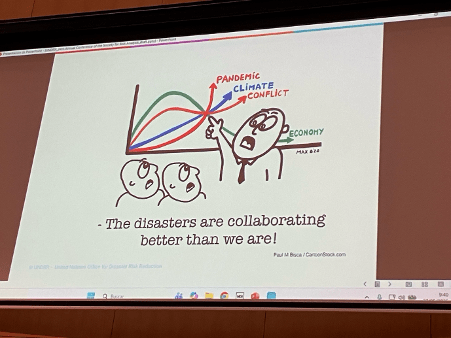
Slide seen at the 2026 SRA-E Conference: Photo credit – the author

TLDR/Summary

  • I attended SRA-E 2026 in Alicante (Spain) and gave two talks, the first presentation on what the data really say about Covid-19 pandemic preparedness and strategy, and a second presentation arguing that the deepest driver of global risk is evolutionary dynamics. Audio and slides for both are linked below. What follows is my synthesis of the meeting.
  • The strongest message of the conference was clear: stop asking which hazard will strike and start asking which vital functions could fail and must be kept running. The European Commission’s Joint Research Centre, an EU “threat-agnostic resilience” project, and the polycrisis sessions all converged on this, the same logic as in our recent “vulnerability register / mitigation register” blog.
  • The argument is no longer theoretical. While the UK is drafting legislation, the EU is rolling out a Preparedness Union Strategy, and the Nordic states already run whole-of-society preparedness as routine, NZ is behind, isolated, and the gap is widening.
  • Trust was the keystone variable almost everywhere, in disaster response, finance, insurance, refugee preparedness and aid. Because trust underwrites cooperation at every level, its erosion is a first-order driver of global systemic risk, not a soft add-on.
  • The conference kept reaching for an evolutionary vocabulary without naming it: modularity, redundancy, diversity, selection, plasticity, arms races. That is exactly the integrative gap my second talk set out to fill, arguing that evolution generalists could be integrated across risk governance.
  • A persistent blind spot on global risk remained: the “big risk picture.” Much of the programme stayed at the level of local risk, individual banks, regional floods, and household security, while genuinely systemic and global-catastrophic risk was carried by only a handful of keynotes and one session.
  • Bottom line for New Zealand: the international risk-science community, the EU and comparable democracies are starting to build the anticipatory-governance architecture we called for in our recent Policy Quarterly paper. The case has shifted from “here is an argument” to “here is what everyone else is already doing, why aren’t we?”
  • 2026 is an election year in New Zealand, global risk and resilience should be a central election issue.

A broad risk conference
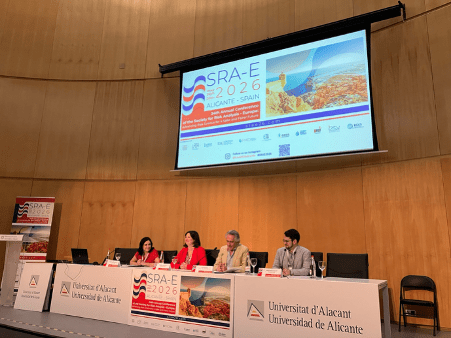
SRA-E Conference Alicante: photo credit the author

The Society for Risk Analysis is not a disaster-relief NGO or a climate-adaptation forum. It is a broad professional society for the science of risk, governance, toxicology, engineering, policy analysis, mathematics, law, behavioural science, and its European arm gathered this year at the University of Alicante under the banner “Advancing Risk Science for a Safer, Fairer, Future.”

That breadth is the point, and the tension. As SRA International’s president Benjamin Trump and SRA-E’s president Angela Bearth both stressed, SRA is not one methodology or philosophy but a meeting place for everyone who works on risk, an opportunity for integration across silos at a moment when the future of the international institutions that fund and use risk science is genuinely uncertain. I attended representing Adapt Research and the New Zealand charity Islands for the Future of Humanity. Much of what the conference’s strongest sessions argued, my colleague Nick Wilson and I have been arguing for some time:

  • That risk science still systematically under-weights the low-probability, high-impact, cross-border catastrophes that an isolated trading nation is most exposed to, and
  • That the remedy is to shift from cataloguing hazards to governing for resilience building.

We have made that case recently in Policy Quarterly, and provided details of this thinking in blogs last year on the UNDRR’s Global Platform, the ASRA systemic-risk symposium, and the European Urban Resilience Forum.

What was striking about the Alicante Conference was how selected sessions echoed this argument, in a context where resilience-minded regions of the world have begun to act. This is my synthesis, necessarily shaped by what I was able to attend, given the parallel nature of the many sessions.

My two presentations: on Covid-19 and the Metacrisis

“After the Dust Has Settled: Covid-19 outcomes, preparedness, strategy and structural determinants” (Boyd & Wilson): Audio (13min); Slides

Early in the pandemic, confident slogans hardened into conventional wisdom: preparedness doesn’t work; border restrictions do nothing; authoritarian regimes did better. Each was dressed in data. Our work asked whether the data held up once analysed properly, and largely they did not. The early null and reverse correlations between pandemic preparedness and outcomes were artefacts of poor method: failure to adjust for age structure, reliance on reported rather than excess mortality.

Correct these and separate islands from non-islands, and preparedness did predict lower excess mortality for non-islands, while for islands the duration of border controls mattered most; jurisdictions pursuing explicit exclusion-and-elimination strategies recorded the lowest mortality of all.

The headline for a risk-science audience was methodological: data quality and appropriate analysis matter enough to reverse the field’s hasty early conclusions. The fuller story is in our three research papers on Covid-19 preparedness, strategy, and structural correlates of outcome.

“Why Have We Built Such a Fragile World? Evolvability, Systemic Traps, and the Metacrisis Driving Global Risk” (Boyd & Wilson): Audio (14min); Slides

The biologist E.O. Wilson once diagnosed the modern predicament as humanity having:

Palaeolithic emotions, medieval institutions, and godlike technology.

This remains relevant today and is effectively a structural diagnosis. Technological evolution outruns institutional, which outruns genetic, and that mismatch between the nature of our decisions and the scale of their effects (carbon emissions, weapons of mass destruction, digital networks) is the foundational risk-generating mechanism of the Anthropocene.

The fields studying global risk: disaster risk reduction, global catastrophic risk studies, national risk assessments, systemic-risk studies, polycrisis scholarship, and behavioural science, each grasp part of the global risk elephant but none integrates the whole.

These fields explain the HOW of catastrophic risk; they leave unanswered the WHY: why humans keep producing the systemic conditions that generate global risk.
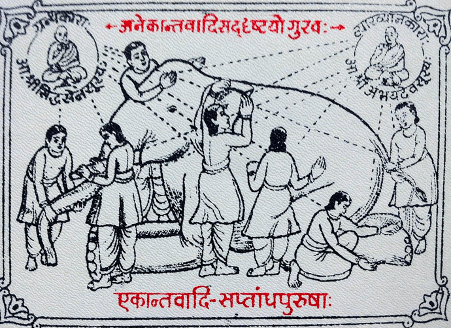
Image credit: romana klee on Flickr

The answer, I argued, is evolutionary, and not metaphorically. Selection is substrate-neutral: it operates wherever there is heritable variation, differential fitness and differential reproduction, including among firms, policies and institutions, multiplying whatever is locally fittest; virality, profit, prestige, blind to long-term welfare. Two dynamics in particular build fragility: the defection trap (no firm or state faces real selection pressure against emitting carbon) and arms races (AI-safety investment that is competitively disadvantageous; platforms selected toward engagement maximisation – including outrage).

Worse, we are degrading our own evolvability:

  • variation gives way to homogenisation
  • modularity to tight coupling
  • transmission fidelity to a fragmented information commons
  • stable selective environments to policy ping-pong, and
  • outlaw suppression to regulatory capture – of particular import in New Zealand media at present with allegations of risk-creating industry influence on climate legislation.

The above, formally, is a metacrisis, not “many crises at once,” but the degradation of the conditions that let risk-reducing adaptations compound.

Part of the solution can be borrowed from evolutionary oncology (cancer treatment): suppress, don’t try to eradicate defectors, build redundant multi-layer suppression, and design stable environments that reward cooperation. Effective risk governance must actively cultivate evolvability. The full argument, applied to New Zealand, runs through our Policy Quarterly paper, and you can hear highlights in my talk. This framing is deliberately provocative and, for now, remains a theoretical lens rather than the established account.

I went to Alicante with this evolutionary lens. The conference kept intentionally and unintentionally holding it up to the light.

The Conference keynotes

Natalia Alonso Cano (UNDRR) opened with “Beyond business as usual: accelerating resilience building in a complex risk landscape.” She argued, rightly, that resilience-building is now a necessity, reporting partial progress against the Sendai Framework, but against a worsening backdrop. The number of people affected by disasters globally keeps increasing, and the annual global cost, including ecosystem impacts, runs at an estimated US$2.3 trillion.

But the gap I flag is the one the title promised: after “beyond business as usual,” the mechanism on offer amounted to better data plus more inclusiveness. Worthy, not transformative.

There was a sharper, data-specific problem. Cano ran an exercise asking participants to name Europe’s biggest threat, before arguing that it is in fact “heat stress”.
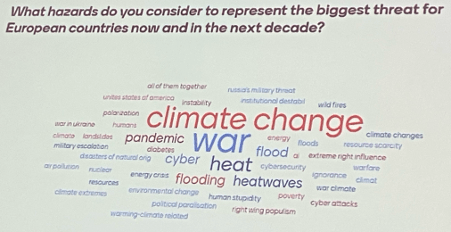
Risk conference participant responses when asked to rate Europe’s biggest threat (photo credit: the author)

European heat mortality is serious, the WHO estimates around 175,000 heat-related deaths a year in its European Region, about 36% of an estimated 489,000 globally each year. But a “biggest threat” exercise weighted by familiarity systematically under-rates the low-probability, high-impact scenarios that do the real long-run damage.

The 2025 UNDRR’s Global Assessment Report (GAR) top-five hazards exclude pandemics, plausibly a health-silo artefact (with the WHO responsible for pandemics), yet a single moderate pandemic dwarfs annual heat mortality: Covid-19’s toll had reached some 27 million dead by mid-2023. The point is not that heat doesn’t matter; it is that the instruments we use to set priorities can be quietly mis-calibrated against exactly the tail-risk framing the UN GAR has started calling for.

Christina Corbane (Joint Research Centre, European Commission) delivered the standout. “From risk knowledge to policy action” opened with precisely the right question:

not which hazard will occur, but which societal vital functions could fail and need resilience?

That is the same move the City of Rotterdam’s Vital Systems programme makes (which I covered in my blog on the European Urban Resilience Forum last year), and the same move Nick and I make in calling for a vulnerability register and a mitigation register rather than merely a national risk or hazard register in our April 2026 blog.

Corbane framed the EU’s emerging Preparedness Union Strategy around an all-hazards, whole-of-government, whole-of-society approach resting on three moves:

  • a comprehensive risk-and-threat assessment to expose preparedness gaps;
  • minimum preparedness requirements; and
  • “preparedness by design.”

Her through-line, preparedness is a way of governing, and the thing risk assessment is ultimately for, is one I’d underline twice. It’s not enough for a national risk register to simply be a list of bad things that could happen. There needs to be public information about the preparedness gaps.

The JRC’s Disaster Risk Management Knowledge Centre integrates a multi-hazard knowledge base, and its 2025 science-for-policy report on current and emerging risks catalogues 47 risks, including cross-border and High-Impact Low-Probability (HILP) events, assessed not just for likelihood but for cascading impacts, compound relationships and, the part that particularly matters, mitigation currently in place and mitigation still advised. Beneath it sit concrete operational tools, the Risk Data Hub mapping hazards, exposure and vulnerability, the Copernicus Emergency Management Service running round-the-clock monitoring and early warning, the INFORM risk indices, and a European Crisis Management Laboratory connecting science to operational decision-making.

She closed with five needed shifts:

  • hazards → systems;
  • static assessment → dynamic intelligence (risk assessment isn’t one-and-done);
  • sectoral evidence → interoperable knowledge;
  • response capacity → anticipatory governance;
  • scientific outputs → policy action.

I sat there thinking two things:

First: this is, almost line for line, the architecture New Zealand lacks and needs, ideally built with Australia, since the most serious risks are often cross-border (pandemics, trade and supply shocks).

Second: a knowledge centre that integrates, standardises and transmits risk knowledge across a union is high-fidelity information transmission plus niche scaffolding, two conditions for adaptive evolvability, built deliberately into governance.

Jens Zinn (University of Melbourne), building on the 2022 Victorian floods, argued that vulnerability is not found but manufactured, through the interaction of institutional calculations, social imaginaries and embodied experience. Institutional models lean on flawed proxies, poverty as the key variable, an idealised “resilient population”, when in fact precariousness is universal. The corrective is epistemological pluralism: stop manufacturing the vulnerabilities you claim to manage. This rhymes with the historical evidence that equitable institutions out-survive steep, extractive hierarchies (see Luke Kemp’s recent book).

Magda Osman (University of Cambridge) argued that policy too often puts the cart before the horse, arriving with embedded assumptions before establishing whether a phenomenon is even real or measurable (of rapid reviews requested by policy, she noted, only about 47% contained a research question). I admired the “question the question” discipline; it supports the long-standing call for getting assumptions and values onto the table at the start of national risk assessment. But her suggestion that SRA publish its own risk register would need to ensure that critical systems, vulnerability, and mitigation options feature prominently (and that there is then engagement with policy-makers in nation states).

Jorge Olcina (University of Alicante), delivering in Spanish with live AI translation, argued that geography sets hard limits: planning must be local, involve citizens, and work on the shorter timescales people actually care about (next summer, not 2100). A single flood map is no longer enough; we need multi-risk maps, civil works, planning and risk education. It is not the case that ‘everything is possible’ in a place, and nor should it be permitted, especially when considering flood and climate risk.

The systemic risk, polycrisis, and catastrophic-threats session

This was the richest session I attended, and the closest to our own work, including talks by:

Benjamin Trump who presented a network analysis of the Late Bronze Age collapse. Invasion mattered, he argued, but the real question is why the system was so susceptible. Mapping politics and trade layers, they found a generally resilient network in which single-node failures recovered quickly, but the simultaneous failure of as few as two regions could cascade to total disruption, and war plus climate striking together did exactly that. The governance lesson was pointed: flat-hierarchy networks were agile, redundant and more equal, while pronounced hierarchy bred fragility.

Reinhard Mechler reframed the case for resilience investment around a triple resilience dividend: prevent losses, capture co-benefits, and unblock development potential. The recurring refrain, resilience of what, and for whom?, was the right one. In our own NZCat Report on NZ’s options for building resilience to catastrophic shocks like nuclear war, we itemised the potential co-benefits, but more work could be done to demonstrate development potential that flows from resilience building.

Other highlights

The standout of the theoretical foundations stream, and one of the most relevant talks of the conference for global risk, was delivered by José Palma-Oliveira, “Reframing Risk Governance through Threat-Agnostic Resilience.” The EU- and UKRI-funded AGILE project pursues agnostic risk management for high-impact, low-probability (HILP events; and far from a theory exercise, it is a practitioner-led consortium building a replicable, tiered stress-testing methodology and applying it across nine real-world case studies in different countries and sectors.

The central move is to stop asking which hazard and start asking resilience of what, defining the system by the vital functions that must survive different shocks, then hunting for the common points of failure that recur across otherwise unrelated threats (echoes of our own, ‘solve for nuclear war, solve for all’ framing in the 2023 NZCat Report).

As Palma-Oliveira framed it, resilience rests on five components, modularity, distributedness, redundancy, diversity, plasticity, assessed through that tiered method. Notably, AGILE takes seriously exactly the tail risk the rest of the programme tended to skirt: its reference library catalogues super-volcanic eruptions, Carrington-scale solar storms and impact events alongside the more familiar hazards.

Those five components map almost directly onto the conditions for evolvability, with plasticity supplying the temporal dimension. The ingredient I’d press them to add is the one my argument dwelt on: defector / outlaw suppression. A system can be modular, distributed, redundant, diverse and plastic and still be hollowed out by risk-creating actors whose locally successful strategies degrade the whole. This was a gap visible elsewhere too, in a talk about diaspora humanitarianism where informal transnational actors became trusted aid channels after the 2024 Turkey–Syria earthquake, demonstrating the modular variety a resilient system wants while running into the credibility problems that make defector/outlaw-suppression necessary.

Furthermore, discussing the evolution/risk governance link with the presenter later, we touched on the problem of global coordination, and the evolutionary drivers against that. Our discussion then leaped into the natural importance of local and regional initiatives to combat the impacts of global risk, initiatives which are also aware that done poorly, they could themselves exacerbate global risk ‘elsewhere’.

What was missing at the conference is as telling. The financial and digital-systems sessions were competent but pitched almost entirely at the level of small discrete entities, individual banks, personal loans, household security, small qualitative surveys.

Genuinely systemic, let alone global, financial risk barely featured. This was a critique that held again just as it did regarding the SRA-Australasia Conference in Christchurch in January 2026: the “big risk picture” (especially beyond climate mitigation and adaptation) remains under-served relative to the volume of small, common-risk studies. Yet most future harm lies, in expectation, in systemic and global risk. I’d emphasise again that carbon dioxide is just one of nine planetary boundaries, and planetary boundaries do not cover diverse global risks as diverse as geopolitical tension, artificial intelligence, or demographic transitions.

The threads running through it all

Stepping back, several themes emerged for global risk mitigation, each pointing the same way.

Trust was a keystone for risk reduction. It surfaced as the binding variable almost everywhere: eroded state trust routing aid through diaspora NGOs; trust as the strongest predictor of insurance uptake and the moderator of third-party risk in finance; “auditable trust” as the lesson of a catastrophic North Macedonian nightclub fire; trust as the mediator that helps refugees prepare; legitimacy crises as the tipping point in disaster response.

My synthesis is more ambitious than any single talk’s: because trust underwrites cooperation at every level, cells, organisms, social groups, institutions, nation states, its erosion is a first-order driver of global systemic risk. A world without capacity for trust is losing its capacity to cooperate its way out of the metacrisis. Trust needs to be engineered, and technology exists to scaffold it, whether block chains, polis-style democratic processes and citizens’ assemblies, or a clamp-down on lobbying and money in politics, trust can be sustained and cultivated.

The field kept reaching for an evolutionary vocabulary without naming it. AGILE’s five components are evolvability conditions in other words. The Bronze Age collapse work is selection and network structure made literal.

The evolutionary framework offers to integrate all this: naming why fragile architectures and maladaptive incentives are repeatedly selected for and locked in, despite most people’s good intentions.

“Systems and vital functions, not hazards” was the single strongest convergent message relevant to global risk. Corbane’s five shifts, AGILE’s threat-agnostic resilience, and the polycrisis and collapse work all rejected hazard-by-hazard planning in favour of asking what the system is, what it must keep doing, and how harm cascades. This is the cleanest support for a move from hazard-centric national risk registers to a vulnerability-register / mitigation-register approach, and for anticipatory governance of national and cross-border risk.

Cross-border interdependence was the default, not the exception, most JRC-catalogued risks are cross-border; cross-border burn-care capacity was the hard lesson of the North Macedonia nightclub fire; and diaspora flows are transnational by nature. The implication for New Zealand is a national and cross-border risk system built with Australia and our Pacific neighbours.

And “Fairer” in the conference theme earned its place. Equity ran through the programme as more than a slogan: Zinn’s manufactured vulnerability, refugee disaster-vulnerability as structurally produced, the deliberate inclusion of people with intellectual disabilities in preparedness design (one researcher made the case for stories, a folk tale of a green goblin at the water’s edge who grabs careless children does more for water safety than any fact sheet. Stories do not just protect children at the water’s edge; as articulated recently in the Existential Crunch blog, “How environmental politics lost the future,” the failure of climate and risk politics is at root a failure of narrative. Facts and doom have not moved us, and only vivid, hopeful visions of a different future will.)

Who bears risk, and whose knowledge counts, are part of systemic resilience, not separate from it. Stakeholder engagement throughout the national risk mitigation process is essential. You cannot ‘do’ a risk assessment and then consult on it, because the assessment process itself is value-laden from the start. National risk assessment and mitigation must be transparent, open, and created by all.

The “wider risk lens” argument is no longer theoretical

When previously arguing that nations should widen their risk lens to global catastrophic and systemic risk, build anticipatory-governance institutions, treat resilience as a way of governing, and develop a degree of self-sufficiency and regionalism in the face of global risk, we were making a case against the grain and established practice.

That has changed. Beyond the SRA-E Alicante conference, the same arguments now arrive from multiple directions at once, attached not to think-pieces but to legislation, EU strategy, and standing national programmes.

The United Kingdom is drafting law, and submissions to the House of Lords’ new National Resilience Committee include those of:

  • Lord Toby Harris, chair of the UK National Preparedness Commission, who argues the UK needs a genuine whole-of-society approach, and proposes merging a National Resilience Act and a Defence Readiness Act into a single National Resilience and Defence Readiness Bill for 2026–27. This will place legal obligations on public bodies, set expectations for business, and establish an independent National Resilience Committee modelled on the Climate Change Committee. He is pointed about transparency: the 2025 UK National Risk Register lists 89 acute risks but says almost nothing about mitigation. Every one of those threads, an independent statutory body, the business-engagement gap, the transparency critique of hazard registers without mitigation, is something we’ve argued for New Zealand, including our long-standing call for a Parliamentary Commissioner for Catastrophic Risk. The difference is that in the UK it is plausibly now a live legislative target.
  • Professor Liz Varga, whose submission, for the UK Collaboratorium for Research in Infrastructure and Cities notes that traditional risk management is structurally inadequate for cascading risk, “reasonable worst-case” scenarios are already being exceeded, and siloed organisational risk assessment can improve one entity’s resilience while degrading the wider system’s, the defection problem in infrastructure language. Her illustration of the regulatory-minimum-versus-actual-resilience gap is striking: an emergency water standard of 10 litres per person per day against average demand of 136. She argues from history that equitable resilience, not elite-focused recovery, gives states long-term stability, echoing the Bronze Age.

The European Union is building the system, and Corbane’s keynote (above) was not a proposal but a progress report.

The Nordics already live preparedness, with a recent case study from the Accelerator for Systemic Risk Assessment (ASRA; whose Paris symposium I covered last year) documents how Sweden and Finland run whole-of-society preparedness as routine. Sweden’s Civil Contingencies Agency coordinates across every sector and level of government, distributes the “In case of crisis or war” booklet to every household, runs an annual Preparedness Week, and sustains 19 voluntary civil-defence organisations; household self-sufficiency rose from 26% to 37% in a single year. As one Finnish researcher put it, preparedness should be “part of everyday life.”

What this means for New Zealand

Put everything together and the implication is stark. The international risk-science community, the EU and comparable Westminster democracies are now actively building the kernels of an anticipatory-governance architecture for global risk. New Zealand is not leading this. We are not even keeping pace.

Our 2025 Policy Quarterly paper assessed the Department of the Prime Minister and Cabinet’s 2025 draft long-term insights briefing, the final version of which was a genuinely welcome shift toward anticipatory thinking, though not official policy. Our critique found that the briefing exemplified a deeper blind spot: a focus on familiar, local natural hazards and incremental climate risk, while an entire menu of global catastrophic and systemic risk goes missing in publicly-facing risk work. The war on Iran and the Hormuz crisis illustrated this just months later.

In an election year this should be an election issue.

The reform agenda we set out, emerging in the UK, EU and Nordics, maps onto a handful of concrete moves:

  • Widen the hazard scope to include large-scale (including nuclear) conflict, large global volcanic eruptions, bioengineered pandemics, severe solar storms, catastrophic infrastructure and food-system failures, and advanced-AI risks.
  • Build a vulnerability register and a mitigation register, not just a risk register. Following Corbane’s question and AGILE’s logic, catalogue which vital functions (water, food, energy, transport, communications) must keep running under any scenario, where the gaps are, and what we’d do about them.
  • Ensure NEMA and the Infrastructure Commission work together. The Commission’s currently climate-focused mandate should expand to comprehensive global-risk consideration, and prevention-and-resilience should sit alongside response-and-recovery, not in a separate silo.
  • Create dedicated, independent risk institutions, a Chief Risk Officer or Parliamentary Commissioner for Catastrophic Risk, insulated from the short electoral cycle that systematically starves long-term resilience, exactly the independent statutory body the UK is now moving to legislate.
  • Guarantee basic-needs continuity with a “Plan B.” Define critical survival level basic needs in legislation and develop distributed, redundant backstops, local biofuels, distributed food production, resilient inter-island transport, backup communications for core functions. Redundancy here is not inefficiency; it is insurance, and modularity that preserves evolvability when the world changes. NZ$18 billion invested in Nordic-style whole-of-society resilience would likely do much more for New Zealand’s long-term wellbeing than spending it on one road.
  • Engage the public, transparently and deliberatively. The aversion to “scaring the public” has to go. Our own research found majority support, 56–63%, across the political spectrum, among New Zealanders for institutional reform to manage global catastrophic risk. People are ahead of the institutions. Citizens’ assemblies on resilience and trade-offs would build the democratic legitimacy that stabilises long-term commitments, and the trust the conference identified as the keystone.
  • Cooperate regionally. Most catastrophic risks that would harm us are cross-border, so the response must be too. Joint preparedness with Australia and Pacific neighbours, on vaccine manufacturing, shipping resilience, strategic stockpiles, shared risk assessment, turns our isolation from a pure vulnerability into a hedge. The recent NZ-Singapore agreement on energy and food was a valuable step in this direction.

Conclusion: cultivate evolvability, and begin

I went to Alicante to argue that the world’s risk-science establishment under-weights the catastrophes a small, remote, trade-dependent nation is most exposed to. The policy world, in the UK, the EU and the Nordic states, has begun through small steps to act on these risks.

The deepest message of my own talk on the metacrisis and evolvability is that effective risk governance must do more than respond to hazards or map risk systems and cascades. It must actively cultivate the structural features that support risk mitigation: maintain the variation, modularity, information and knowledge transmission fidelity, stable selective environments and outlaw-suppression mechanisms under which cooperative, resilient, adaptive solutions can accumulate faster than the metacrisis and its evolutionary dynamics degrades them.

Every convergent theme of the conference, vital functions over hazards, trust as the binding variable, cross-border cooperation as default, equity as structural, is, at root, a piece of that same project.

New Zealand is unusually well placed to lead, with its geography, renewable-energy potential, strong institutions, social capital, and a public that the data show is ready. What we lack is not capability or even consensus. We need a start, and the political will to diverge from a myopic focus on ‘balancing the books’ or bending to the lobby of existing risk-creating actors, and to instead leverage the co-benefits and development catalysis of the triple resilience dividend.

The rest of the world has begun. The only remaining question is how long New Zealand intends to keep waiting.

A Vision for National Resilience: Our submission on DPMC’s Long-term Insights Briefing

Have your say on the DPMC’s Insights Briefing by 27 August

Background

New Zealand public sector agencies must prepare a ‘long-term insights briefing’ every three years. This is an opportunity to look beyond short-term political cycles and use foresight to see what really matters to New Zealand over the longer course.

In 2025 DPMC has collaborated with the National Hazards Board, and the Ministry for the Environment to produce a draft Briefing on “Building Resilience to Hazards“.

In the present global ecological and geopolitical context it seems nothing could be more important and the document is currently out for public consultation.

We have submitted feedback on this Briefing. The opening paragraphs of our submission read as follows:

Introduction

Islands for the Future of Humanity commend the Department of the Prime Minister and Cabinet (DPMC), National Hazards Board, and Ministry for the Environment for producing the Draft Long-Term Insights Briefing (LTIB) on Building New Zealand’s Long-Term Resilience to Hazards (2025). It is clear that considerable effort has gone into framing resilience as a long-term national priority, one that reaches beyond the short-term horizons of electoral cycles. The LTIB recognises that resilience is essential not only for hazard response but also for long-term wellbeing and prosperity. This acknowledgment is timely and welcome.

This submission offers constructive feedback aimed at strengthening the LTIB. Specifically, we argue for expanding the scope of hazards considered, embedding a systemic and evolutionary risk framework, ensuring that the focus of government is on safeguarding basic needs in all circumstances, and advancing institutional reforms that guarantee transparency, accountability, and informed consent. We also highlight the importance of reframing resilience as an opportunity for national growth, rather than primarily a narrative of risk and trade-offs.

By adopting these improvements, the LTIB has the potential to position New Zealand as a global leader in anticipatory governance of global risks and hazards.

You can read our full submission here (PDF, 12 pages).

Do you agree with us? Public consultation is open until 27 August, you can have your say by completing the simple online form found here.

Consider donating

If you support our project of providing non-partisan evidence-based information and options to support resilience to global catastrophic risks, then consider donating to help our charity Islands for the Future of Humanity.

Your support allows us to continue producing risk information and resilience options that could benefit New Zealand and the world.

Building Real Resilience: Our Submissions on NZ’s Fuel and Infrastructure Plans

Do these NZ government draft plans adequately address national resilience?

TLDR/Summary

  • The NZ Government is consulting on two major draft plans: the National Infrastructure Plan and the National Fuel Security Plan.
  • Our charity, Islands for the Future of Humanity, submitted responses to both, urging stronger planning for global catastrophic risks (GCRs) like nuclear war, extreme pandemics, or trade collapse.
  • We find both plans lack adequate preparation for long-term or extreme global disruptions or global critical infrastructure destruction.
  • Our recommendations include more focus on infrastructure essential for providing basic needs like water, food, transport and communications in the worst possible scenarios, such as trade isolation.
  • We also propose mandatory resilience assessments in all infrastructure investment decisions, explicitly addressing potential global catastrophes.
  • Submissions are open: help shape NZ’s future resilience before the deadlines—6 August (Infrastructure) and 25 August (Fuel Security).

Two critical government consultations

The New Zealand government has called for submissions on drafts of two major plans pertaining to national infrastructure and fuel security.

The NZ Infrastructure Commission and the Ministry of Business, Innovation and Employment (MBIE) have asked how we can future-proof the systems that keep our country running.

Our non-partisan independent charity Islands for the Future of Humanity has made submissions on both, advocating for a bold shift in how we think about resilience: not just to climate change or short-term shocks, but to global catastrophic risks (GCRs) that could fundamentally alter New Zealand’s operating environment.

We find that neither draft satisfactorily addresses global catastrophic risk. We need to ask more of our decisionmakers to ensure national resilience and future wellbeing.

Government plans need to ensure basic needs like food, water, transport and communications can be provided no matter what catastrophes befall the world.

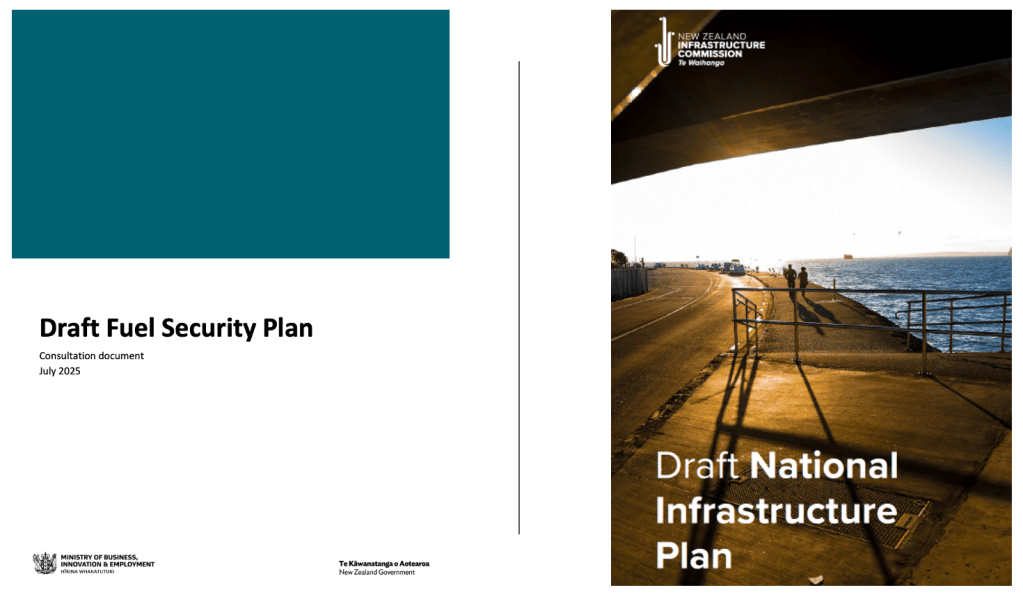
The Draft National Fuel Security Plan, released by MBIE, proposes stockholding obligations, better data visibility, expanded fuel storage, and support for biofuels and EVs. The Plan builds on the 2025 Fuel Security Study, which modelled a severe 90-day disruption to fuel imports (and which we critiqued in a previous post finding the analysis wanting). While welcome progress, the draft plan stops short of addressing how New Zealand could survive a prolonged or permanent disruption to global fuel supply—such as from nuclear conflict, electromagnetic pulse, or widespread supply chain collapse. These are not science fiction; they’re now being actively studied by global agencies, including the US National Academies of Sciences and a new UN Scientific Panel on nuclear war impacts (see our previous post on these reports).

In our submission, we call for a fuel system that guarantees basic needs—food, water, critical transport—under even the worst scenarios. That means modelling fuel demand for essential services in year-long (or longer) disruptions, and developing domestic liquid fuel production capacity, especially regionally distributed biofuel refineries that can pivot between commercial and crisis modes. Electrification is essential, but we must also prepare for shocks that knock out the electric grid itself, as detailed in our recent webinar and expert panel discussion on catastrophic electricity loss.

Meanwhile, the Draft National Infrastructure Plan, published by the NZ Infrastructure Commission, takes a broad look at long-term investment challenges. It rightly addresses fiscal constraints, climate resilience, and aging infrastructure—but barely mentions the possibility of catastrophic global disruption, yet the risk of this is clearly rising, as we’ve discussed in a previous post. Our submission urges the Commission to embed systemic risk and GCR thinking into infrastructure planning, including:

  • Distributed and resilient energy and food systems,
  • Domestic cloud and communication infrastructure,
  • Transport redundancy across islands and to Australia, and
  • Pandemic-ready health facilities and critical supply sovereignty.

We also argue for mandatory resilience assessments in infrastructure funding decisions, contemplating catastrophic risk scenarios, and using long timeframes and appropriate discount rates that don’t marginalise future generations.

Both submissions draw on our wider work, including our NZCat Report, which maps how island nations like New Zealand are vulnerable to GCRs, but with foresight can play a vital global role in preserving human civilisation through catastrophe—if we plan accordingly.

You can read our submissions

Read our submission on the Fuel Security Plan
Read our submission on the Infrastructure Plan

Do you agree with us?

Have your own say – submissions to both consultations are still open:

Let’s make sure resilience means more than recovery after the fact, or merely protecting business as usual. It must mean anticipatory governance and preparedness for whatever comes.

Support our work

If you support this kind of thinking and work, then help us free up time to do more. Please consider donating via our NZ registered charity’s givealittle page.

Think Beyond Climate: What New Zealand Can Learn from the European Urban Resilience Forum 2025

As the storm clouds of global systemic and catastrophic risk appear, Rotterdam is wrestling with innovation in urban resilience. Photo: the author

TLDR/Summary

  • I attended the 2025 European Urban Resilience Forum in Rotterdam and learned the following:
  • There is a resilience blind spot: European cities excel at climate adaptation but miss the bigger picture—climate change is just one of 14 global systemic stresses that could cascade into catastrophic failures.
  • Cities like Rotterdam have made advances: Treating cities like accident patients, monitoring vital systems (electricity, water, transport, communications) through cross-sector teams that meet fortnightly, building relationships and understanding system interdependencies.
  • War is a resilience killer: Geopolitical conflicts from Ukraine to India-Pakistan tensions are overwhelming political bandwidth needed for long-term resilience planning, diverting resources from preparation to immediate survival.
  • New Zealand’s unique challenge: Our geographic isolation could be either shield or vulnerability—New Zealand needs resilience systems that preserve urban functions when global supply chains collapse, not just protection from local weather events.
  • We must move beyond simple climate thinking: Nuclear conflict, extreme pandemics, and system-wide failures don’t respect borders—urban resilience must address the full spectrum of global catastrophic risk.
  • The bottom line: New Zealand must ensure cities can maintain basic human needs (water, food, energy, communications) post-catastrophe, turning our remoteness into strength rather than weakness.
  • A Judging Panel at the Forum concurred that pilot projects are over—we need systematic approaches that seek to change the mechanics of cities.
  • Action needs to include cooperation among organisations. At home this might mean NEMA working seriously with the Infrastructure Commission, overseen by Chief Risk or Resilience Officers to build resilient solutions ahead of time.
  • Graphical recordings of the European Resilience Forum 2025 sessions can be accessed here.

Introduction

I attended the European Urban Resilience Forum (Rotterdam, June 25-27), which brought together city leaders, policy makers, and resilience practitioners grappling with an uncomfortable reality: traditional approaches to climate adaptation may no longer be sufficient in an era of converging and interacting global risks.

Rotterdam’s vice-mayor discussed life six metres below sea level, while Greek innovation seeks to detect wildfires using AI-enabled drones, and Ukrainian municipal officials are balancing climate action against the immediate demands and effects of war. Discussions at the Forum revealed both the promise and limitations of current resilience thinking.

While many European cities are pioneering innovative climate adaptation approaches, there was also a critical blind spot that New Zealand, given its unique geography and vulnerabilities, cannot afford to ignore: the need to build resilience not just to local climate impacts, but to the full spectrum of global catastrophic and systemic risk and the various cascading and interacting effects that could reshape our world.

The State of Play: Europe’s Resilience Foundations

The Forum’s opening session, featuring a video message from Kamal Kishore of the United Nations Office for Disaster Risk Reduction, established the context that while disaster-related deaths have declined decade on decade, exposure to droughts and seismic risks continues to rise across Europe’s increasingly urbanised landscape. The message was clear, cities house 70% of Europe’s population and face disproportionate climate impacts, but this concentration also presents an opportunity for disproportionate positive impact through targeted urban resilience investments.

Rotterdam’s vice-mayor delivered practical wisdom: we need to make cities green. At six meters below sea level, Rotterdam has learned that green infrastructure—water buffers, reduced concrete, car-free spaces—isn’t just about aesthetics. It’s about heat stress relief, flood management, and public health.

The city’s Roofscape Rotterdam tool allows users to map how 18 square kilometres of roof space could contribute to energy, water management, and other resilience goals, exemplifying the kind of bold and systematic thinking needed.

Our own food system research has recently argued for discussions about land use policy in the context of urban and near urban agriculture for resilience. Similar interactive tools could encourage the public to explore and debate optimal land use policy in New Zealand to balance resilience and development.

A recurring theme at the Forum was multilevel governance with risk ownership at every scale, supported by central government. European officials consistently emphasised the need to move beyond viewing resilience as a cost, instead acknowledging it as essential infrastructure investment that protects people, economies, and existing assets, with figures suggesting every dollar spent on resilience prevents ten dollars in future harm.

The Collaboration Imperative

The European Urban Resilience Forum June 25-27, Rotterdam. Photo: the author

Although collaboration was spoken of across many contexts, the most innovative and actioned insights came from Rotterdam’s Maarten Nypels who oversees the Vital Urban Systems programme. Maarten articulated both the theoretical and practical dimensions of addressing our current predicament. He observed that “most crises are manmade”, a point that aligns with metacrisis thinking I’ve outlined in my recent blogs. He noted that humanity needs to understand how we created global and systemic vulnerabilities before we can address them effectively. This was a perspective missing from many reactive resilience solutions.

One of Maarten’s practical solutions is transformative: treat a city like an accident patient whose vital signs need constant monitoring. Rotterdam’s Vital Systems resilience program brings together experts responsible for electricity, water, transport, communications, and data systems in iterative fashion. Meeting fortnightly for three hours, these professionals developed deep understanding of system interdependencies and potential cascading failures, understanding each other’s systems. More importantly, they built the relationships and communication channels that enable rapid coordinated response when crises hit.

This model addresses a fundamental challenge in resilience building: breaking down silos and addressing resilience with cross-cutting approaches, agnostic to the specific hazards, whether climate change or otherwise.

Lessons about the Hurricane Katrina recovery efforts presented by Cedric Grant reinforced this. As a Director of recovery, he provided key learnings such as New Orleans developing five microgrid electrical systems to prevent future total power loss, and collaborating with global experts from the Netherlands on flood protection, but also the learning that childcare availability determines whether people can report to work during recovery. The social infrastructure proved as critical as the physical.

The Blind Spot: Systemic risk and polycrisis

The Forum included a session on the current global polycrisis, in which panellists acknowledged the need for holistic approaches, but the discussion fell short of addressing the full spectrum of systemic and global catastrophic risk.

Climate change dominated discussions, despite being just one of 14 global systemic stresses. The holistic agenda needs to encompass disaster risk reduction, systemic risk (system-wide failures), polycrisis (interacting and cascading risks), the underlying stresses generating these risks, and the underlying drivers of humanity’s current predicament. These drivers include human behaviour, and evolutionary and game-theoretic processes subsumed under the moniker of ‘metacrisis’, just as Maarten alluded.

Visual summary of the session on polycrisis and urban resilience. Image credit: carlottacat.com

The narrow focus on climate mitigation and adaptation becomes particularly problematic when considering New Zealand’s unique position. A recent Cambridge Centre for the Study of Existential Risk (CSER) paper highlighted the crucial intersection between global systemic risk and global catastrophic risk. Nuclear war, extreme pandemics, and supervolcano eruptions don’t just interact with existing vulnerabilities—their effects can amplify through global systems to produce catastrophic outcomes. These systems include many that are not traditionally considered in climate change mitigation and adaptation thinking.

Figure credit: Arnscheidt et al. (2025)

For New Zealand, this intersection is critical. Our geographic isolation, which provides some protection from certain risks (eg pandemics), also creates unique vulnerabilities.

At the Forum, war emerged repeatedly as a barrier to resilience building, not just in Ukraine, but as a persistent drain on political attention and resources. Politicians are overwhelmed by war considerations across multiple theatres. This must be curtailed if humanity is to ensure resilience to the systemic and catastrophic risk we have created. War is accelerating humanity’s race to the bottom.  

Lessons for New Zealand Urban Resilience Policy

New Zealand needs to consider the full and real consequences of escalating global war, potential global systemic failures, and the other varied hazards, vulnerabilities, amplifying and latent factors that contribute to global catastrophic risk, especially from the perspective of a remote island nation.

As well as asking how our cities can resist the effects of flooding, cyclones, and heat, while reducing emissions, we also need to be investing in ways to prevent disruption due to lack of industrial inputs like fuel, fertiliser and imported spare parts. We should design our vital systems to be self-contained, diverse, and resilient. We need to anticipate the demands of communications in the event of catastrophic internet failure, how to transport and process food with limited liquid fuel, and how to mitigate harmful mis- and dis-information, and a host of other system wide risks. 

New Zealand’s resilience planning must extend beyond climate adaptation and economic resilience to address global catastrophic risks. This means ensuring that vital urban systems—electricity, energy, food supply, transport of critical goods—can operate at minimum levels post-catastrophe. It’s more than planting trees or providing heat shelters; it’s about maintaining basic human needs (like water, food, shelter, energy, transport, communications) when global systems fail. Action such as that which Rotterdam is taking, described by Maarten Nypels, was one of the few examples of genuine resilience building across risks that I heard at the Forum.

New Zealand’s new Space Weather plan, developed by NEMA, exemplifies this challenge. The plan focuses on response but it needs integration with the likes of the Infrastructure Commission’s long-term infrastructure plan to ensure that we’re not stuck in cycles of response and recovery, but rather we build out resilient solutions ahead of time. In London response and recovery teams are now co-located with resilience and prevention teams. NEMA must work with the Infrastructure Commission, and consider systemic risk beyond climate adaptation.

Our own report Aotearoa NZ, Global Catastrophe, and Resilience Options lays out one possible vision of extreme risk governance and relevant investment options.

To achieve this upstream investment, finance sessions at the Forum emphasised that investors need detailed plans and predictable contexts. Cities will only be resilient if they’re resilient to the spectrum of Anthropocene risk. For New Zealand, this means building resilience systems that work whether the challenge is climate change, pandemics, or potential Northern Hemisphere nuclear conflict. It means ensuring our remote location becomes a strength rather than a vulnerability.

The conference’s emphasis on Chief Resilience Officers and acceleration of implementation has particular relevance for New Zealand and resonates with much of our previous work, such as our call for a Parliamentary Commissioner for Extreme Risks. Our cities need systematic approaches to resilience that acknowledge our unique vulnerabilities while learning from innovations in Europe and elsewhere.

Judges dispensing sustainability awards at the Forum were clear, that the time of pilot projects is over. Winning entries were visionary, and aimed at changing the mechanics of cities fundamentally.

Conclusions

Much was said and shared at the European Urban Resilience Forum, and I have necessarily focused on just a few themes, namely the need to incorporate an understanding of global systemic and global catastrophic risk in urban resilience programmes.

The Forum demonstrated that the solutions exist, but we need the political will to implement them at scale. For New Zealand, the imperative is clear: we must build resilience systems that address not just the climate crisis, but the full spectrum of global catastrophic risks that could affect our remote island nation.

Perhaps most striking for New Zealand observers is how geopolitical instability emerged as a defining constraint on resilience planning. Ukrainian representatives highlighted the cruel paradox of needing to build climate resilience while resources are diverted to immediate survival. This reality check extends beyond Ukraine—panellists repeatedly noted how global conflicts from Israel and Gaza to Iran to India-Pakistan tensions are overwhelming political bandwidth needed for long-term resilience planning.

For New Zealand, this raises fundamental questions about how our geographic remoteness might be both shield and vulnerability in an era where Northern Hemisphere conflicts, extreme pandemics, or other global catastrophic risks could profoundly impact our resilience assumptions and supply chains. A new wave of resilience action needs to address global systemic and catastrophic risk.

Changing the Rules to Soften Humanity’s Hard Landing: A Systemic Risk Approach to Everything Going Wrong at Once

A Tale of Two Conferences Part II: ASRA ‘Currents of Change’ Symposium 2025

(In-depth read, 15 min)

The importance of nature was clear at Les Fontaines – venue for the ASRA Symposium. Photo credit: the author

TLDR/Summary

  • Part II of a two-part blog series reporting on a pair of crisis/disaster risk conferences – this one covers the ASRA ‘Currents of Change’ Symposium, which offered a refreshing contrast to the UN’s symptom-focused approach detailed in Part I.
  • ASRA brought systems thinking to crisis management – 250 multidisciplinary experts tackled interconnected “polycrisis” issues rather than isolated disasters, focusing on the deeper stresses that drive cascading failures.
  • Keynote speakers delivered transformation-focused messages – Poet Ben Okri challenged humanity to become “the people our times require,” while Christiana Figueres emphasised that “linear thinking has no place” in addressing systemic risk.
  • Practical tools emerged alongside theory – ASRA launched STEER, a beta tool for systemic risk assessment, and workshops demonstrated hands-on polycrisis analysis and intervention design using real global stresses and future scenarios.
  • The hard truth: single solutions won’t work – Whether it’s capitalism, carbon emissions, or specific leaders, there’s no single root cause to our interconnected crises; siloed institutions impede the interdisciplinary approaches we desperately need.
  • Bottom line: humanity has the frameworks and community, but the race against time continues – ASRA provided genuine hope and practical starting points, but whether this scales fast enough to prevent humanity’s “hard landing” remains the crucial question.

Definitions

Global systemic stresses: long-term processes that weaken the resilience of critical global systems by increasing pressures, sharpening contradictions, and expanding vulnerabilities. These stresses make systems more vulnerable to trigger events that push them into a crisis.

Polycrisis: The simultaneous occurrence of multiple, interconnected crises that exacerbate each other, creating a situation more severe than the sum of its parts. It’s not just a collection of unrelated crises, but rather a situation where different crises interact and amplify the negative impacts of each other.

Systemic risk: The potential for multiple, increasingly severe, abrupt, differentiated yet interconnected, and potentially long-lasting and complex impacts on coupled natural and human systems. Systemic risk implies the potential for system-level breakdown and cascading consequences across human and natural systems.

Metacrisis: In this blog ‘metacrisis’ refers to the collection of forces: evolutionary, social, technological, and game theoretic, that drive and give rise to global systemic stresses, and resulting crises, polycrisis, and systemic risk.

Introduction & Context

Twenty-four hours after leaving the UN Office for Disaster Risk Reduction Global Platform in Geneva, somewhat pessimistic about humanity’s trajectory, I found myself at Les Fontaines in Chantilly Gouvieaux, France, for an entirely different kind of gathering.

The Accelerator for Systemic Risk Assessment (ASRA) was hosting the ‘Currents of Change’ Symposium – the first transdisciplinary global meeting dedicated to action on systemic risk.

The Symposium offered what the UNDRR Global Platform appeared to miss: clear-eyed analysis of the deeper and interconnected stresses driving cascading crises, coupled with actionable frameworks for addressing them.

ASRA represents a fresh approach to global catastrophic risk. As a network of 90 transdisciplinary experts, it brought together 250 systemic risk practitioners and stakeholders to tackle what ASRA defines as systemic risk: “the potential for multiple, increasingly severe, abrupt, differentiated yet interconnected, and potentially long-lasting and complex impacts on coupled natural and human systems.”

Unlike traditional disaster risk conferences focusing on specific hazards, ASRA addressed the underlying patterns generating cascading failures across interconnected systems. The goal: prevent, mitigate, adapt, and transform away from systemic risk before it overwhelms humanity’s response capacity.

Opening Address: Ben Okri’s Call for Transformation

Ben Okri delivers the opening address at ASRA’s Symposium. Photo credit: the author.

British/Nigerian poet and author Ben Okri gave the opening keynote, a moving, powerful account of humanity’s current predicament that immediately distinguished this gathering from conventional policy conferences. As a renowned novelist, Okri brought a different lens that cut through technocratic language to human realities.

“Many things have come into reality that cannot sustain themselves,” Okri observed – capturing what metacrisis theorist Daniel Schmachtenberger had described as humanity’s “self-terminating race” (see Part I).

But rather than dwelling in despair, Okri challenged humanity towards transformation thinking: “We must not make the mistake of thinking that the present will become the future.”

His diagnosis was unflinching. “Nations cannot talk of making themselves ‘great’ at the expense of making the rest of humanity small,” directly addressing the zero-sum thinking that underlies the competitive dynamics driving many global systemic stresses.

Most crucially: “We cannot combat the difficulty of our times as the people we used to be, we have to be fit and healthy, and we have to create wider and wider communities and alliances and we have to fight the evil of our times intelligently.”

This call for intelligent, collaborative action echoed throughout the Symposium’s technical sessions.

Keynote: Christiana Figueres on Transformative Change

The first keynote session saw Christiana Figueres, former Executive Secretary of the UN Framework Convention on Climate Change and architect of the Paris Agreement, demonstrate how systemic thinking translates into concrete action. Her presentation exemplified the Symposium’s approach of inclusive systematic analysis with practical optimism.

“In the face of systemic risk, linear thinking has no place today,” Figueres began, directly addressing the siloed thinking that limited many of the UNDRR discussions I had attended the previous week (see Part I).

We have the technology and understand interconnectedness, she continued, the question is implementation. Furthermore, rather than aiming to minimise our impact, we should actively seek to restore nature, shifting from ‘sustaining’ to ‘regenerating.’

Costa Rica provided her key example, where laws now facilitate payment for environmental services, resulting in increased forest cover from 29% to 55%. This demonstrates how changing incentive structures drives systemic change.

Figueres used the metaphor of a spider web for interactions in complex systems, explaining that we can’t control the web through top-down decrees, but we can observe “which threads are being pulled and how” and identify effects and leverage points where small changes create large systemic shifts.

Christiana Figueres speaking at the 2025 ASRA Symposium. Photo: the author.

Most importantly, Figueres identified a crucial constraint: “The scarcest resources at the moment are kindness and love.” She warned against letting news feeds crowd out genuine learning sources, including learning from the natural world. In a similar vein, I’ve previously blogged on Jaron Lanier’s calls for deleting all your social media ‘right now’, in my post on Covid, Trump, and algorithms.

Panel Discussions: Scale, Speed, and Systemic Solutions

ASRA Symposium panels tackled how we can meet the scale, scope and speed required for transformation. Unlike conferences focusing on incremental improvements, panellists grappled directly with the need to change human systems.

Participants spoke of bold actions, trust, and “crazy imagination.” One participant noted that, “change happens at the speed of trust,” and “we need to be good ancestors, that’s all.”

But the panellists also honestly assessed barriers, noting for example that Ministers of Finance lack technical understanding of systemic risk. We need bold moves in building systemic resilience so that human systems can handle the stress of the transformation that is required to reduce risk in the long term. However, the current efficiency vs resilience trade-off balance is wrong – we’ve built fragile systems optimised for short-term performance. We must stress-test our systems (whether financial, trade, food, or whatever vital system) and ask if the future we’re creating is resilient to the shocks that are increasingly likely. These stress tests require facilitated dialogue and knowledge sharing across the sectors and systems.

On the required foresight, participants emphasized anticipatory governance as key. Long-term efficiency comes through resilience, not optimisation, because iterated disasters and shocks will undermine efficient systems more over time than resilient systems.

Unfortunately, current crisis response follows whack-a-mole patterns addressing symptoms not causes. Humanity lacks the appropriate anticipatory governance, mechanisms to effect system redesign, and cross-border, regional and global coordination. In particular, we need to stop trying to solve global problems with national tools (as this will lead us into the game theoretic traps and harmful zero-sum dynamics).

“We shouldn’t fix the past, we need to build the future. It was these old systems that have led us here,” noted one panellist. Furthermore, we should act with “good enough information and fast enough action” rather than delays in search of perfect knowledge and optimal decisions.

The way the world seems stuck in rigid historical frames and decision processes, maladaptive in a present world of crisis and existential threats, reminds me of a scene in the film No Country for Old Men. Once he has outwitted the hero, villain Anton Chigurh observes:

“If the rule you followed brought you to this, of what use was the rule?”

The world and its legacy rule-based institutions appear to be in a similar bind. A new system of rules and processes is needed, or humanity will be brought “to this”.

Anton Chigurh, the villain in No Country for Old Men, challenges humanity to reflect on our systems and processes. Miramax Films (2007).

Launch of the STEER Tool: Practical Systemic Risk Assessment & Response

At the Symposium, ASRA launched STEER (Systemic Tool to Explore and Evaluate Risks), a tool designed to help users ‘steer’ away from systemic crisis and toward solutions.

Currently in beta, STEER will make systemic risk assessment accessible to organisations, governments, and researchers across all systems and sectors.

STEER represents practical systems thinking and helps users map interconnections (systemic risk assessment) and identify intervention points (systemic risk responses) for systemic impact, rather than analysing risks in isolation. A combination of drop down menus, tutorial material, and prompts for reflection and action guide users through the processes of systemic risk assessment and response.

STEER will be publicly launched later this year, but feedback from conference attendees  (all experts on systemic risk) beta testing the platform was very positive.

The ASRA Symposium provided opportunities for attendees to engage in the kind of processes that STEER encourages, through various workshops and side-events. I managed to attend two of these.

Workshop 1: Understanding Systemic Risk as Polycrisis

I participated in a breakout session facilitated by the Cascade Institute. This provided a hands-on polycrisis analysis exercise. The workshop highlighted global stresses and groups plotted possible interactions among these along with the triggers that could tip such interactions into crises. This helps us understand why so much is going wrong at the same time.

The theoretical basis for the Cascade Institute’s approach is their stress-trigger-crisis model. The model shows that stresses push systems toward points where triggers might create disequilibrium (and likely associated harm in human and ecological systems). Even without triggers, inexorable stressors will push systems into potentially harmful new states (eg, as the left hand depression in the figure below becomes shallower). Averting crises requires acting on stresses of three types: pressures, contradictions, and vulnerabilities.

Figure credit: Cascade Institute’s ‘Stress-Trigger-Crisis’ model (2024)

The Institute previously identified 14 global systemic stresses which create cascading failure conditions for humanity, and which must be addressed to have hope of mitigating the present polycrisis (you can read more about these here):

  • Climate heating
  • Ecological degradation
  • Toxicity
  • Zoonotic disease transfer
  • Demographic divergence
  • Concentrated industrial food production
  • Changing energy supply
  • Financial interconnectedness
  • Economic headwinds
  • Economic inequality
  • Ideological fragmentation and polarization
  • Political-institutional decay
  • Great power hegemonic transition
  • Propagation of artificial intelligence

Working groups mapped interactions between three assigned stressors each, analysing how crises emerge when triggers act within these interactions. Each crisis can become a trigger within other patterns.

The messy but structured and necessary process to understand complex systemic risk. Photo credit: the author.

For example, my group was tasked with considering interactions among:

  • North-South demographic divergence
  • The concentrated nature of industrial food production
  • Rising economic inequality

Interactions between these factors could be stressed further by events such as a policy shift in migration settings, or synchronous heatwaves in critical food production regions, leading to a crisis of workforce availability and food production, resulting in famine or war, with these crises then being the triggers of other global crises in cascading fashion.

The exercise rapidly demonstrated how current conditions create multiple, interacting, cascading failures – a polycrisis rather than isolated events. And we only considered three of the 14 global stresses!

Crucially, we brainstormed interventions for crisis mitigation through anticipatory action, such as sensible migration policies, sustainability criteria on imports, more heterogeneous distributed food systems, with food system buffers, and policies that alleviate economic inequality to hedge against short-term price shocks.

Key insight: There’s no single root cause of a polycrisis. It is not simply capitalism, carbon emissions, or the actions of particular leaders, but everything in conjunction. Single-point solutions won’t work. Siloed institutions impede solutions, which require interdisciplinary complex systems thinking.

Workshop 2: Preparing for Catastrophic System Failure

Another workshop facilitated by David Korowicz addressed whether catastrophic system failure can be mitigated ahead of time. We contemplated a scenario where (for the purposes of the foresight exercise) a national Cabinet has knowledge that a catastrophe severely decreasing goods, services, and energy access will happen in either 1, 4, or 8 years. Our group was tasked with considering how we would act with such information under the 4-year time horizon.

Roughly the results of our deliberations can be summarised as follows:

  • Prevent panic while being clear resilience is a fundamental priority and the nation needs to start seriously working to mitigate likely effects of future crises.
  • Assess physical security and available resources, ensuring physical safety and liaising with trusted international partners.
  • Strengthen connections at all levels across government and society (families, communities, regions, international).
  • Analyse complex reactions to crisis – how will people and countries respond? Will there be national hoarding with export controls? Ensure appropriate engagement with behavioural scientists.
  • Map consequences for energy, transport, food, and communications systems.
  • Stocktake the minimum functions required to sustain society according to hierarchy of needs (water, food, shelter, energy, etc).
  • Develop mitigation options for each critical function in context of the catastrophe.
  • Ensure redundant structures for communications, food, shelter.
  • Strategic stockpiling while understanding supply constraints from other jurisdictions doing the same.
  • Roll out incentives for electrification, local biofuels, distributed food production, and other resilience measures.
  • Sequence and prioritise all interventions for maximum effectiveness.

Admittedly all the above were developed on the fly in half an hour, but the exercise raised two key questions for me.

  • First, this all sounded incredibly familiar, and is basically the content of our own organisation’s detailed report on New Zealand’s vulnerability and resilience options against the risk of Northern Hemisphere nuclear war.

Recent media reporting on our study can be found here. You can read the rich and detailed report here, which is effectively a maturity model for resilience to global catastrophic risks, including one-page ‘cheat sheets’ for each key sector and for global catastrophic risk management.

  • Second, why haven’t governments of the world conducted this kind of exercise, and developed and implemented exactly these plans and programmes, in conjunction with their citizens, given the perilous state of the world?

The workshop discussions also highlighted that this kind of resilience doesn’t depend on nationalistic self-sufficiency but on creating systems that are less susceptible to cascading collapses: locally resilient food and energy, regional governance, delinking from fragile global finance, mutual support networks. But also, and importantly, linkages with regional partners, collaborations of nations to ensure trade and supply through investment in strategic infrastructure and plans, and the avoidance of hoarding, which although seems rational for individual jurisdictions, could actually lower the global mean ability to ride out the crisis, creating overall more harm.

Addressing the Causes of Global Systemic Stresses themselves

The workshops demonstrated that there are positive steps humanity can take towards limiting future catastrophe harm, even harm stemming from system-wide failures. We can implement systems thinking, map systemic interactions, develop resilience through anticipatory governance, conduct preparedness exercises, and reduce the human and environmental impact, and therefore depth of the economic harm that global systemic risk threatens.

ASRA’s greatest contribution was acknowledging this challenge while providing concrete intervention tools. Much more work is needed, particularly to address what drives these global stresses, including rivalrous dynamics preventing coordination, exponential technological advancement creating risks faster than assessment is possible, and resource degradation amid coordination failures. The impact of global stress reduction through systems thinking and action may still not be enough, because civilisation’s underlying dynamics don’t support such action. We’re potentially stuck in evolutionarily stable strategies where aggressive, exploitative behaviours outcompete cooperative, long-term alternatives – even when cooperation ensures collective survival.

All that said, the frameworks discussed and exercised at the ASRA Symposium offer genuine starting points for a new cognitive frame and for systemic intervention.

Conclusion: Building on Systemic Foundations

The contrast between the UNDRR Global Platform and the ASRA Symposium was striking and illuminates the limitations of current disaster risk reduction efforts, which are probably largely driven by historic silos.  

While UNDRR demonstrated genuine commitment to developing resilience, discussion remained trapped within frameworks addressing symptoms rather than systems. ASRA took a fundamentally different approach, placing difficult systemic questions at the analytic heart. The result was honest assessment combined with practical intervention tools.

Most importantly, ASRA provided a transformation-focused community of practice. The Symposium demonstrated that systemic risk assessment isn’t an abstract academic exercise. It’s an urgent practical necessity for decision-makers navigating interconnected worlds where risks cascade faster than traditional approaches can address. This practical necessity needs to be resourced. Analysts and decision-makers across all vital sectors and systems need time and space to cooperate, coordinate, and hash-out these problems around the same table.

The challenge of disaster risk reduction, building immunity to global catastrophic risks, and transforming human systems away from those that generate these risks remains enormous. Changing competitive dynamics and evolutionarily stable strategies requires changes from individual consciousness right up to global governance.

We can respond and recover from various crises, we can build resilience and mitigate the impact of future crises, we can reduce systemic risk through judicious systems transformation, we can mitigate the polycrisis by minimising the global systemic stresses, but only by intervening on the forces comprising the metacrisis can we prevent global stresses and crises being thrown up again and again, in increasingly severe form.

I reported Daniel Schmachtenberger’s views in Part I. He notes that the race dynamics of humanity are self-terminating. Individual improvement is insufficient – we need to bend the entire arc of human history. Ben Okri echoed this at ASRA: “We have to find better alternatives to the current direction of history.”

But frameworks, tools, and community emerging from initiatives like ASRA provide hopeful foundations and Ben Okri’s challenge echoes as warning and invitation. We cannot combat our times’ difficulties as the people we used to be, but we can choose to become the people our times require.

Whether this mindset and process scales and accelerates quickly enough to bend the arc of human history before the “hard landing” becomes inevitable remains the question.