
By Matt Boyd & Nick Wilson
TLDR/Summary:
- The New Zealand DPMC and Ministry for the Environment’s briefing on resilience to hazards was tabled in Parliament in February 2026.
- We revisit this briefing amid the current global crisis arising from conflict in the Middle East.
- The final document is a clear improvement over the earlier 2025 draft, and credit to government officials is due.
- Though it still focuses on selected hazards, it better balances discussion of both risks and resilience, highlighting key resilience drivers like institutions, trust, and geography.
- It strengthens focus on maintaining basic needs during crises (food, water, energy, shelter).
- Public participation and deliberative democracy on risk and resilience are more clearly emphasised.
- A National Risk Register is now included as an annex, improving transparency, but this list still very much lacks depth.
- Disparate bodies of risk and resilience information now exist, but there is no one-stop shop for a comprehensive view of New Zealand’s national vulnerabilities and mitigation options.
- Adding a national mitigation register and ‘wish list’ would let society deliberate on what to do.
- Major gaps remain in public information on national risk, especially around global catastrophic risks (eg, wars impacting fuel supply, and worse).
- Official work on the National Resilience System is welcome, but stronger governance arrangements could help (eg, an independent Parliamentary Commissioner for Catastrophic Risks / Chief Risk Officer).
DPMC’s/MfE’s briefing on long-term resilience
A long-term insights briefing (LTIB) on New Zealand’s resilience to hazards, produced by the Department of Prime Minister and Cabinet (DPMC) and the Ministry for the Environment (MfE), was tabled in Parliament and examined by the Environment Select Committee in February 2026.
Considering the 2026 Strait of Hormuz crisis, it is worth assessing how this document has evolved, and what it signals not just about New Zealand’s approach to natural hazards, but to national risk more generally.
The draft of this LTIB was released in August 2025 and treated resilience as a national priority, acknowledged catastrophic hazards, and appropriately articulated the need to shift the conversation from response to crises to anticipatory governance for mitigating harms.
That mission was welcomed. But the draft also had clear gaps. It leaned heavily toward describing risks rather than resilience, it underplayed the importance of public deliberation, and it lacked the kind of transparent national risk architecture that would let the public see the broader picture across all risk.
We critiqued the draft of this briefing back in 2025 and provided a submission making the case that the opportunity was there to strengthen this publicly facing risk management document through broader risk coverage, including severe global catastrophic risks.
The draft also inspired us to write a peer-reviewed paper on anticipatory governance for major risks to New Zealand, published in Policy Quarterly (Nov 2025).
An improved framework for national hazards
The final published LTIB is substantially better. Not perfect. Not complete. But better in ways that matter, and that deserves to be said plainly.
The final version develops the hazard landscape a bit more fully, prefacing discussion of six selected hazards (pandemics, earthquake, tsunami, volcanic activity, severe weather and flooding, and space weather) with a clearer explanation that National Risks include both hazards and national security threats.
Furthermore, the final briefing is clear that New Zealand’s National Risk Register includes 14 hazards and 11 national security threats, and that the briefing is intentionally limited to the selected hazards, thereby carving out more limited scope for the briefing. Notably, three of these hazards are potentially global in scope and impact (pandemics, volcanic activity – causing volcanic winter, and space weather).
All this is good progress, but it leaves open the need for a comprehensive risk document, a place where citizens and organisations can explore all threats and hazards in detail, as well as global trends and global risks that might impact New Zealand.
The fragmented nature of the national approach to risk makes operational decision-making on resilience options difficult. This is important because resilience measures tend to be cross-cutting, mitigating a range of threats and hazards, local and global, if wisely chosen. Although central responsibility for certain risks might be siloed, organisations and citizens are not and want to know about the full spectrum of risk, without hunting out diverse information, across multiple entities.
There’s more than one way to close a strait
Within the hazard descriptions themselves, the final version tightens wording and adds some useful nuance. One notable addition is the final’s mention of very large volcanic events, including the global effects of eruptions like Mt Tambora (1815), which was not present in the draft.
Global effects of such eruptions are listed, including crop failures, famine, trade disruption and impacts on infrastructure and supply chains, which could be ‘severe’ and felt worldwide.
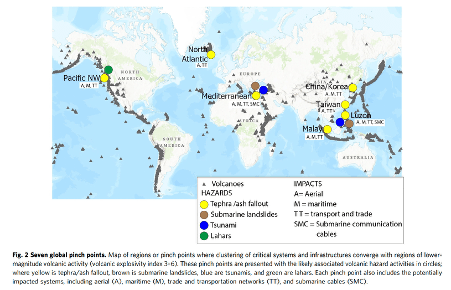
Researchers have previously noted the potential catastrophic impact of large volcanic eruptions at global ‘pinch points’, which could have impacts for New Zealand akin to, or worse than, the closure of the Strait of Hormuz. As indicated in our submission, we’d like to see even more of these global catastrophic risks deliberated on in the public domain.
A better definition of national resilience
The definition of national resilience in the final version is also better, broader and more normatively loaded.
The draft defined resilience as the ability to “absorb, adapt to, recover from and transform through shocks and stresses.”
The final changes this to “prevent or minimise, absorb, adapt to, recover from and transform through shocks and stresses to enhance the safety, security and prosperity of our people.”
It also introduces a fairness dimension that is absent or only implicit in the draft: resilience must ensure all communities have the capability to cope, and it explicitly recognises te Tiriti o Waitangi as a foundational framework and supports Māori-led approaches.
Risk AND resilience
The biggest improvement is conceptual. The draft had a section titled “Forces that shape risk and resilience,” but in practice it mostly described forces shaping risk. Our submission pointed to that gap directly and argued that resilience has its own drivers: democratic institutions, cooperation, social capital, geography, and other assets that can be deliberately strengthened.
The final briefing now does exactly that. It has a distinct “Forces that shape resilience” section, and the categories are genuinely good: strong institutions, science/data/knowledge, cooperation, social capital and trust, and geographical advantages such as island geography, biosecurity, domestic food production, and renewable energy access.
We’ve noted before that New Zealand has many such advantages, but these need to be leveraged into resilience measures. A recent paper that one of us (MB) coauthored, actually maps out resilience factors in the face of global catastrophe, finding that New Zealand possesses much potential that could be harnessed with the right policies.
That shift from risk to risk-and-resilience matters because it changes the briefing from a catalogue of threats into the beginnings of a framework for agency and resilience building. Resilience is no longer treated as just the residual after we list what can go wrong. It is treated as something we can intentionally develop.
Need to ensure ‘basic needs’ for survival
Another important improvement is the stronger focus on basic needs. Our submission argued that resilience planning should centre on continuity of food, water, shelter, energy, communications, and transport, and that government should think in terms of backup or “Plan B” infrastructures, not just hardening the primary system. The final briefing does not go all the way there, but it does improve materially. Its definition of resilience now explicitly includes ensuring people can access “food, shelter, water and electricity” during crises, while also keeping government and businesses functioning.
Public deliberation is necessary
The final briefing also improves on participation. It refers to deliberative democracy around risk, explicitly noting that this could help address hard questions. That is not a trivial addition. Once we admit (as the briefing does) that resilience involves trade-offs, who pays, what gets protected, what standards we adopt, and how much redundancy we are willing to fund, then expert analysis alone is not enough. These are public choices. They require informed public judgment.
The community section is more participatory in the final. The draft’s “Community-led solutions” stresses preparedness, local supplies, and learning from Sweden and the UK. The final keeps those elements but adds a new paragraph on communities having a strong interest in resilience decision-making and introduces the Citizens Assembly on Auckland’s water supply as an example of deliberative democracy. That is a real change in the final’s imagination of resilience: not just communities as recipients or responders, but communities as central co-decision-makers.
Transparency and risk dialogue
Calls for transparency are improved. In our submission we called for a detailed publicly accessible National Risk Register. The final briefing now includes Annex 1: National Risk Register 2025 (which is also available on the DPMC’s website).
National Risks are comprised of hazards (non-malicious and often natural occurrences like earthquakes) and national security threats (malicious, such as cyberattacks, armed conflict, or disruption from new technologies like AI and biotechnology). The annex includes both.
That annex materially changes the document’s function: it is no longer just an interpretive briefing, but also a reference document that anchors the narrative in a formal risk inventory and explicitly links the briefing to that wider national risk architecture. This is a significant step forward. Public discussion about resilience is always thinner than it should be when the public cannot see the government’s underlying picture of risk.
That said, the usefulness of either the annex or the DPMC’s equivalent website are very limited by their lack of detailed information. The threats and hazards really just constitute a list of bad things, without details of likelihoods, worked scenarios illustrating first order and cascading consequences, current plans, and a menu of desired resilience options for public deliberation.
Giving credit for a much improved final briefing should not mean pretending the job is done.
Our submission argued that New Zealand’s resilience thinking should extend more explicitly to global catastrophic and existential risks, including conflict risks, advanced AI, bioengineered pandemics, supervolcanoes, and other globally generated disruptions. The final partially acknowledges this wider landscape by noting that national risks include hazards and national security threats, including armed conflict and disruption from AI and biotechnology. But it then explicitly confines the briefing itself to hazards. That is understandable administratively, but analytically it leaves an important gap.
The most obvious remaining limitation is scope, this briefing focuses on just six selected hazards. Many other hazards exist, as do malicious threats, but there are also many risks that are neither natural hazards, nor malicious threats to New Zealand, some of these are global and catastrophic in nature.
At some point, and in some form, organisations and citizens need to be provided with this broader picture of risk information, in a way that is not distributed across the silos of the public sector, a bit here, a bit there, and a bit left out.
National security
Sitting in another silo, is the companion briefing to the LTIB discussed above. The 2023 National Security Long-term Insights Briefing acknowledges that global, externally originating crises, such as geopolitical conflict or disruptions to international systems, can pose significant risks to New Zealand. However, that briefing treats these risks largely at a high, conceptual level, framing them within broader trends like declining international order rather than analysing their concrete impacts.
As a result, it does not sufficiently grapple with the severe, practical consequences that a major global trade or energy disruption could have for a remote, import-dependent country like New Zealand.
It is notable that although these briefings mention resilience measures like battery storage, solar electricity, and basic needs such as food security, neither mentions liquid fuel at all. There is a single phrase in the new annex of the hazards briefing under “significant disruption or failure of critical infrastructure”, which says just “impact to… liquid fuel supplies”.
In the present global context that is surprising. Our submission highlighted, ‘cascading global system failures (e.g., telecommunications, energy grids, shipping, fuel supply)’ as major hazards, the details of which should be included in public facing risk briefings.
Our NZCat report in 2023 concluded that the second most critical action the country needed to take to mitigate national risk was:
- Immediately develop an updated National Fuel Plan (that quantifies the volume needed by critical sectors and how to supply it) (p.104).
This was second only to:
- Immediately undertake a systematic & comprehensive National Risk Assessment (that explicitly includes global catastrophic risks).
We still believe these are two critical actions New Zealand must take as a nation (as a collaboration between the public sector and civil society).

National risk registers lack half the picture
Risk registers, as in the briefing’s annex, are still only half of what the nation needs. A list of risks is valuable. But if the briefing now endorses deliberative democracy, then the next step is obvious: we also need a corresponding list of mitigation options. Not necessarily mapped one-to-one against risks in a simplistic way, but a structured set of possible measures that correspond either to individual risks or to common cross-risk impacts whether these be liquid fuel constraints, or food disruption, catastrophic electricity loss, internet or communications failure, supply chain fracture, population displacement, or insurance retreat.
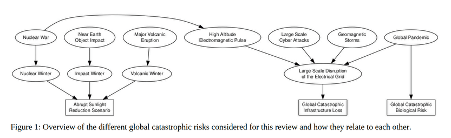
Global catastrophes will tend to have their consequences through common pathways, and it is in these pathways (as well as across key sectors) where resilience must be developed. The Figure illustrates three of these, namely ‘sunlight reduction’ (crop yields, food security, global food trade disruption); ‘global catastrophic infrastructure loss’ (interruptions to global energy supply, national electricity, or liquid fuel availability), and ‘global catastrophic biological risk’ (ie disease/pandemic disruption):
Only with clear and detailed information on all of the above can the public deliberate meaningfully on what we actually want to plan for, build, fund, what trade-offs we are prepared to make, and which resilience measures deserve priority.
A risk register tells us what might happen.
A mitigation register and ‘wish list’ would let us debate what we want to do about it.
With the National Hazards Board now former and new governance arrangements being made for the National Resilience System, there is an opportunity for a new approach to risk prioritisation, transparency, and structured public deliberation on resilience options.
There is also an opportunity to implement a ‘third line of defence’ through establishing an independent Parliamentary Commissioner for Catastrophic Risk, or a national Chief Risk Officer. This could help ensure integration of disparate risk silos and systematic coverage of all risk to New Zealand.
That, in our view, is where this should all go next. The final LTIB is very much better than the draft. The government officials writing it deserve recognition for that. And precisely because it is better, it opens the door to the next, harder, and more democratic conversation.


2 thoughts on “Substantial progress on national resilience briefing; Credit to government officials; Information gaps remain”