By Matt Boyd (with Mike Cassidy reporting on the workshop)
TLDR/Summary
- The 2026 Volcanic Impacts on Climate and Society (VICS) Conference brought together the VICS community, a working group associated with PAGES: Past Global Changes, to consider past, present and future eruptions.
- For a global catastrophic risk audience, the central message was clear: volcanic eruptions are not merely local geological disasters. Large eruptions can, and have, become global climate, food, trade, financial and political shocks.
- More importantly, large volcanic eruptions are rarely “single-cause” disasters. They typically act as amplifiers: triggering or worsening existing vulnerability across food systems, markets, disease dynamics, migration, state fragility and geopolitical instability.
- That makes such eruptions particularly important for global systemic risk, catastrophic risk, and polycrisis thinking, as a large volcanic eruption is a plausible trigger that could tip already stressed critical global systems into crisis, and there is historical precedent.
- The VICS Conference also sharpened a second point we have made in our work, which includes analysis of the Tambora eruption and volcanic winter and nuclear winter and trade disruption, namely that abrupt sunlight reduction is not only a climate problem, it is a civilisation-support problem.
- The interdisciplinary workshops hosted at VICS provided a template for how academics, policymakers and emergency management personnel can use scenarios to better understand and prepare for the global and cascading effects of large volcanic eruptions.
- With next year’s 2027 VICS Conference being held in Taupō New Zealand – this country has an extra opportunity to bring particular focus to all these issues.
Past: volcanic eruptions as amplifiers, not sole causes
The first day of the VICS Conference focused on the past, treated as the best available laboratory for understanding how societies respond to sudden climate shocks.
A repeated structure appeared. We see eruption, atmospheric perturbation, regional climate anomaly, crop harvest stress, grain price spikes, disease, migration, and unrest. But the causal chain was never simple. One eruption does not produce one global outcome. The same event may bring cold and wet conditions to one region, warm and dry conditions to another, and little obvious disruption elsewhere. Latitude, season, eruption chemistry, injection height, background climate state, crop calendars, trade networks, political capacity and social vulnerability all typically matter.
This is exactly why volcano risk is a global systemic-risk problem. Many past eruptions have caused reductions in global mean temperature. A global-mean temperature number can be useful, but people do not eat global means. They eat crops grown in particular regions, during particular seasons, embedded in particular market and political systems.
Some of the strongest evidence for volcanic effects and response came from combining “archives of nature” and “archives of society”: ice cores, tephra records, sulphur (and its isotopes), tree rings, cave records and marine records alongside diaries, parish burial records, grain prices, market records and historical texts. That fusion allows researchers to ask not only “did an eruption occur?” but “when, where, how high did the emissions go, what climate response followed, and how did societies mediate the harm?”
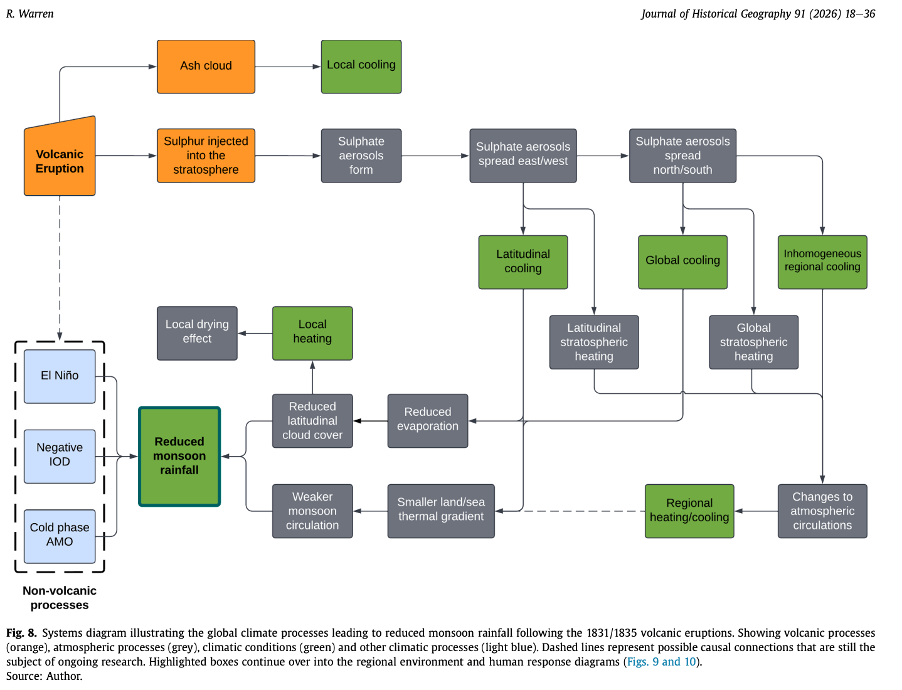
Examples ranged from Icelandic eruptions and their climate fingerprints, to 17th-century northern Europe, to China, Japan and the early 19th-century crisis years around the Tambora eruption. The 1690s in northern Europe were particularly instructive: Scotland, Finland and Norway all experienced cold, harvest failure and very high mortality, but outcomes varied. Norway’s grain imports and social-political context appear to have buffered some impacts. The lesson is not “eruption equals famine.” It is “eruption plus vulnerability plus failed response equals catastrophe.” The figure below is a systems diagram showing the cascading impacts of the 1831/1835 eruptions (as described in Richard Warren’s talk).
Past–present: the wrong volcano may be in our risk model
Day two pushed the evidence closer to present-day risk. A key theme was that high-latitude and mid-latitude eruptions may matter more than the standard catastrophic tropical-volcano mental model suggests.
Ally Peccia’s work on the 43 BCE Okmok II eruption in Alaska was striking in this regard. A remote Aleutian eruption appears to line up with cold, famine and major documented crises across the late Roman Republic, Egypt, China, Sri Lanka and India. The key scientific issue (especially for thinking about future eruptions) is not simply how large the eruption was, but how much sulphur reached the stratosphere, how it spread, and how sensitive the Northern Hemisphere climate was to that loading.
This matters because the world’s preparedness imagination still tends to picture a Tambora-like tropical eruption. Tambora remains the benchmark, and rightly so. But VICS reinforced that remote extratropical volcanoes can be especially globally consequential. They may “punch above their weight” hemispherically.
If risk assessments focus too narrowly on the volcanic explosivity index (VEI), tropical latitude, or direct local exposure, they may miss the events most relevant to global food and trade disruption, the cascading systemic effects.
Anja Schmidt’s keynote made this even sharper. She argued that the VEI is not well suited to climate-risk thinking because it does not reliably track sulphur release or climate response. A proposed Volcano-Climate Index would instead rank eruptions by climate effect. This is the kind of shift risk governance often needs: from measuring the hazard in geological terms to measuring what actually matters for human systems, thereby allowing risk assessment in terms of likelihood of catastrophic climate impacts.
Schmidt also flagged a striking probability: a substantial chance (70%) of Pinatubo-scale eruption induced cooling before 2100. The risk is not just the global cooling. It is estimating cascading hazards and socio-economic consequences in a hyperconnected world.
That is where volcano science needs to meet food-system modelling, shipping, finance, public health, conflict studies and national resilience planning. This is important because the Pinatubo eruption in 1991 (in the Philippines) had a greater impact on global food production (maize down 9%) than any severe El Nino, though this is complicated by the fact that the eruption may have triggered an El Nino!
In today’s even more interconnected, food trade-dependent, and conflict-ridden world, the implications for food security would be even more serious.
There is also an uncomfortable analogue between large volcanic eruptions and nuclear war (and its stratospheric soot injection from burning cities), as well as geoengineering as a response to climate heating. Nuclear winter, volcanic winter and solar geoengineering all involve sunlight reduction, altered precipitation and non-uniform regional effects. They differ enormously in cause and governance, but they stress some of the same civilisational-support systems: food, trade, energy, trust and political coordination. We contend that the likelihood (and therefore the food/trade/societal resilience policy response) to climate altering shocks, needs to account for the aggregate probability of severe volcanism, nuclear war, geoengineering policy, and other drivers.
Future: the next eruption happens in a warmer, more connected world
The future-focused day on day three of the Conference, made the global catastrophic risk relevance explicit.
Markus Stoffel returned to Tambora as the benchmark: the 1815 eruption, roughly 1°C Northern Hemisphere cooling, failed harvests, grain price spikes, the “year without a summer,” and severe global consequences.
But the more important point is that a Tambora-scale eruption today would not occur in the world of 1815. It would occur in a world of more than eight billion people, tightly coupled trade, just-in-time supply chains, financial contagion, geopolitical tension, fragile trust, and climate-stressed food systems.
That is the polycrisis point. The eruption is not the whole disaster. It is the initiating shock in an already stressed system.
May Chim’s modelling, as summarised at the Conference, suggested that global warming may amplify future eruption impacts: a Pinatubo-sized eruption later this century could cool the surface more than the same eruption in a pre-industrial climate. This is because of altered plume height, aerosol behaviour and ocean heat dynamics. In other words, climate change may not simply be one background risk among many. It may change the behaviour of other risks.
James Dalziel’s insurance and financial-risk talk showed how poorly prepared institutions remain. Recent volcanic losses look small compared with storms and floods, but the tail is large. Lloyd’s/Cambridge-style scenarios suggest a plausible extreme volcanic event could produce multi-trillion-dollar economic impacts over five years, with losses travelling through insurance, aviation, shipping, supply chains, food systems and healthcare.
Mike Cassidy’s presentation brought the global catastrophic and volcanic risk cases together. Policymakers under-prioritise volcanic risk because eruptions seem rare, local and geophysical. But the most consequential harms are often second- and third-order cascades: poor harvests, grain price rises, disease, famine, migration, unrest, political instability and long recovery times. A single eruption may be a 2–4-year shock. An eruption cluster can become a 7–15-year depression because societies do not get time to recover before the next forcing arrives and forcing can compound.
This is where analogy to the recent Hormuz Strait maritime chokepoint disruption is useful. This case showed how quickly a geographically concentrated shock can become an energy, fertiliser, shipping, inflation and security problem.
A major eruption could do something similar, but through ash, aviation closure, food-system stress, climate anomalies and trade interruption at the same time. For New Zealand, this matters because geographic isolation is both a resilience asset and a vulnerability. We may be food-producing, renewable-energy-rich and distant from many conflict zones, but we are also deeply dependent on imported liquid fuels, imported components, global markets and functioning maritime trade.
What is the global community still missing?
The VICS Conference suggested several gaps.
First, we still need better scientific reconstruction of past eruptions: eruption timing, source attribution, sulphur budgets, stratospheric injection, halogens, aerosol microphysics, plume height and eruption season. These details determine climate impact.
Second, we need regional impact modelling, not just global means. Adaptation happens in breadbaskets, ports, watersheds, insurance books and political systems.
Third, we need integrated food-trade-economy-public-health models for abrupt sunlight reduction scenarios. This is where our own Tambora work and our ASRS/nuclear-winter work should be brought together.
Fourth, we need serious scenario exercises. The VICS Conference included exercises around Kikai and Campanian Ignimbrite scenarios, two large magnitude 7 eruptions with likely associated climatic shocks, these represented not the worst-case event (e.g. a rare super eruption), but a ‘reasonable worst case’ given both volcanoes have endured these eruptions before, VICS asked what if these eruptions happened today?
Scenario exercises were run at VICS with interdisciplinary experts from academia (a range of different expertise from volcanologists, climate experts, historians) to policymakers. The aim was to provide a timeline of likely impacts from volcanic climate hazards, and the impacts to society. As part of the exercise, intervention points were added, where policy action and preparedness could mitigate some of the worst impacts.
Given the interdisciplinary range of the participants, the idea was to build a shared mental model and common language, to learn from each other and leave with the same picture of the threat and how everyone’s work connects. By laying out the timeline as a series of events, it also aimed to help to make an otherwise ungraspable large risk, somewhat tractable, while exposing the gaps and uncertainties in our knowledge.
As a test exercise, and with a limited window of time, the scenarios were a success. Discussions were clarifying and productive and helped some participants to fully understand the scale of the risk, when taken as a whole. The exercise created connections between policymakers and scientists and built an understanding of the limitations in governing the response during or after the event. VICS hopes to build on these scenario exercises at their next events, as they stimulated important conversations, which talks and posters alone could not achieve.
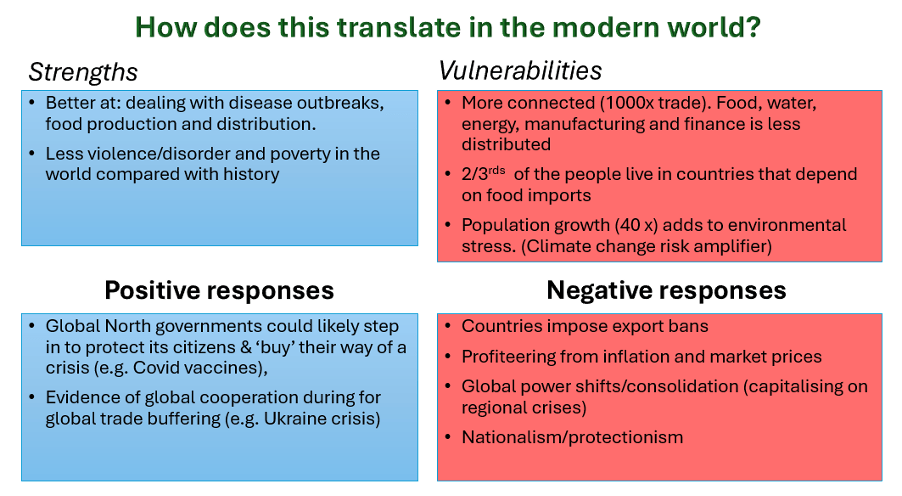
Fifth, the world needs to know what actually works to mitigate volcano climate risk. Cassidy’s “what worked and what didn’t” in past volcano climate shocks framing is crucial. Historical cases suggest that buffers, imports, social trust, functioning markets, local adaptation, transparent information, and competent governance can reduce harm. But panic buying, food export bans, conflict, brittle supply chains and poor communication can amplify it (see the figure below, which compares historical and modern context, and what worked and didn’t work to mitigate volcano climate impact).
Implications for action
For New Zealand and other remote nations, volcanic risk should be treated with anticipatory governance of catastrophic societal risk, not just geological hazard management. That means adding large distant eruptions to national risk assessments; stress-testing food, fuel, medicine and maritime logistics; building food plans for ASRS (abrupt sunlight reduction scenarios) that cover both nuclear and volcanic winter; modelling trade interruption alongside climate disruption; and creating a vulnerability register and mitigation register for vital functions.
Internationally, volcanic-risk work needs to move from “what is the eruption probability?” to “which societal functions fail, in what order, and what keeps them running?” That means whole-of-system exercises involving volcanologists, climate scientists, food-system experts, insurers, shipping experts, public-health planners, defence, finance, and policymakers.
The strongest lesson from VICS may be that the past is not past. It is an archive of natural experiments in stress, shock and response. The next large eruption will not by itself determine whether the outcome is difficult, disastrous or globally catastrophic. The outcome will depend on the state and responses of the systems it strikes.
The eruption is the trigger. The catastrophe is the cascade. The work now is to make sure the resilience building initiatives exist to put the brakes on those cascades.


