TLDR/Summary
- Our new review paper, No place to hide? Regional resilience and vulnerability to global catastrophic risk (Jehn et al. 2026), is published in the peer-reviewed journal Global Challenges.
- The paper reviews the literature on what makes places resilient to pandemics, nuclear war, large volcanic eruptions, near-Earth object impacts, massive cyberattack, geomagnetic storms, and high-altitude electromagnetic pulse (HEMP).
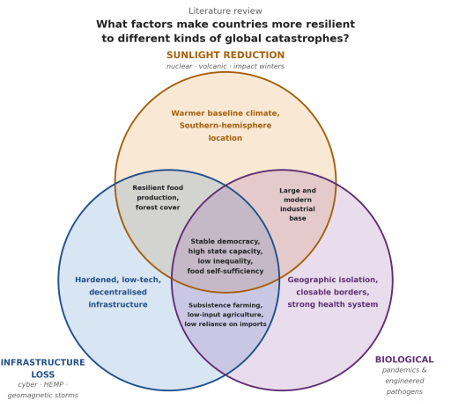
- We organise these into three pathways to harm: abrupt sunlight reduction scenarios (ASRS) including nuclear, volcanic or impact winter; global catastrophic infrastructure loss (GCIL), which is the prolonged loss of electricity, industry and the systems they carry; and global catastrophic biological risk (GCBR), namely pandemics and engineered pathogens.
- Almost all global catastrophic risk (GCR) research has been about hazards. This review addresses the other half of the risk equation, vulnerability and exposure, and is the first to map geographic, institutional and infrastructural resilience factors across the full hazard set together.
- Our blunt conclusion is that no place on Earth is resilient against all kinds of GCR. Australia, New Zealand and Japan are the only countries with evidence in the literature sourced for resilience across all three pathways (and only Australia is directly named in all three), yet all remain dependent on continued trade for commodities like fuel, medicine and fertiliser.
- Across the different risks, common resilience factors that show up most are geographic isolation (eg islands), self-sufficiency (especially in food production), high governance quality (more democratic and lower inequality) and decentralisation to mitigate single point catastrophic failures (eg impacting trade or food supply).
- Governance quality mitigates every hazard we examined: stable democracy, high state capacity, low inequality, low corruption and social cohesion appeared as resilience factors for every GCR category, and they reinforce rather than undermine each other.
- One important contribution is not the map but the trade-offs. Many resilience factors that protect against one pathway expose a country to another. Isolation is a pandemic asset and a GCIL liability. A large industrial base builds resilient-food capacity and digital fragility simultaneously.
- Governance quality and decentralisation stand out as both modifiable by policy and largely free of cross-GCR trade-offs
- For Aotearoa New Zealand (NZ) this finding needs to discipline the development of resilience. Being less exposed is not the same as being a refuge. Geography got NZ to the start line; only intention and policy will get us to a truly resilient state in the face of global catastrophe.
Global Catastrophe as Risk Pathways
The global catastrophic risk field has grown fast over the last decade. This research has been good at analysing hazards, how much soot a nuclear war injects into the stratosphere, what a Carrington-class solar storm does to electrical transformers, how a large magnitude volcanic eruption perturbs the monsoon. Research is far weaker on the question a policymaker in Wellington, Reykjavík or Montevideo actually asks:
Given all this hazard, how exposed are we, and what can we do about it?
That is the gap our review set out to fill. We ran a systematic OpenAlex scan that returned 3,200 candidate papers, screened down to 551, then to 147 read in full. We closed the remaining gaps by bringing in subject-matter expertise on societal collapse, volcanism, cyberattack and food systems, which added a further 77 expert-identified papers, for a final included corpus of 152.
Our synthesis is organised around the three harm pathways rather than a list of hazards, because many different hazards converge on the same failure. Nuclear winter and a Tambora-scale eruption (volcanic winter) both end in a crop-yield problem. Cyberattack, high-altitude electromagnetic pulse (HEMP) and a severe geomagnetic storm all end in a dark grid.
Planning for the pathways, rather than specific hazards, means that most of the risk portfolio is covered.
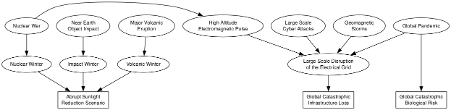
Regular readers will recognise the move. It is the same logic behind our call for a national vulnerability register rather than a hazard register organised around the potential system failure, not the diverse range of triggers and mapped to a set of desired resilience options.
We intentionally did not build an index
We deliberately resisted collapsing all this into a composite GCR resilience score. Trade-offs (see below) are difficult to weigh, we do not yet have the evidence to know whether low inequality matters more than domestic fertiliser production, or island status more than state capacity.
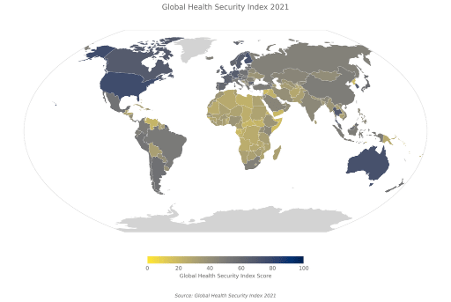
That said, a lot of robust evidence informed this review. Covid-19 supplied a genuine natural experiment: islands recorded 64.8 excess deaths per 100,000 against 194.3 for non-islands and jurisdictions running explicit exclusion and elimination strategies recorded negative excess mortality of -2.1 per 100,000 against 166.5 elsewhere. Democracy and lower inequality both predicted better health (and sometimes macroeconomic) outcomes. That is real evidence about real resilience factors, and it should inform decisions.
Important trade-offs exist
The frequent resilience factors (isolation, self-sufficiency, governance quality and decentralisation) will not surprise anyone in this field. What is new is that these factors are not necessarily additive. They can pull against each other, and we tabulate the tensions explicitly in the paper. For example:
- Geographic isolation lets a country seal a border against a pandemic, but it also puts it a long way from imported spare parts, expertise and medicine after infrastructure loss.
- A large industrial base is what allows breweries and paper mills to be repurposed into resilient food production during an ASRS, but it is also what creates dependence on the complex, digital, globally-sourced supply chains that a GCIL destroys.
- Renewables reduce fossil fuel dependence, but wind and solar output falls during a sunlight reducing scenario.
- High-yield conventional agriculture provides a bigger food buffer and a harder fall when fertiliser stops arriving.
- Islands offering isolation frequently come with active volcanoes/earthquakes, long coastlines and tsunami exposure.
- And the very inefficiency that makes meat production environmentally costly also makes livestock a substantial latent food reserve in a catastrophe.
No volume of outcome data will deduce the right resilience investments for a country, because the question is not only what works. It is how much of one good thing a society is willing to give up for another, under uncertainty, over what time horizon, and for whose benefit. Those are value judgements.
This is precisely why deliberative democratic process, such as citizens’ assemblies, are not a soft add-on to resilience policy but the mechanism by which it becomes legitimate. There are many available avenues to greater resilience. Societies need to see the evidence, deliberate over the trade-offs, and choose.
A theoretical divergence
We also make an important theoretical point, in that mainstream resilience science, following Folke and Walker, prizes connectivity. Our review finds that in the GCR context the ability to disconnect can be protective. Connectivity is genuinely ambivalent, granting access to diverse resources while also transmitting failure.
This aligns with what the Cascade Institute has been arguing about global systemic risk. Their stress–trigger–crisis model separates the slow-moving stresses that quietly erode systemic resilience from the fast triggers that tip a system over, and singles out homogenisation and hyper-connectivity as mutually reinforcing drivers that leave tightly linked global systems prone to synchronous failure.
Dense interconnection is not the opposite of fragility, because past a threshold it is fragility.
Developing refuges against GCR so humanity can reboot civilisation
Previously I have proposed that a refuge is not simply somewhere that happens, by chance, to be less affected by a catastrophe, and suggested three necessary features:
- intention – a deliberate purpose both to protect a population and to preserve or restore the capacity for technological and institutional flourishing.
- compartmentalisation – separation from the harm, achieved by whatever means, islandness, remoteness and surface-independence are merely routes to it, and the real requirement is that the compartment’s outcome be decorrelated from the world’s.
- sustainability – the compartment holds, and complex societal function persists, for as long as necessary.
Baum and Adams, in their study of Western Australia and China as Covid-19 pandemic refuges (Risk Analysis, 2023), work from a considerably broader definition, ie merely a place providing safety or avoiding significant harm, and identify refuges by observed outcome. On that reading a jurisdiction becomes a refuge because case numbers stayed low, and can drift in and out of the status as curves move.
The distinction is not academic hair-splitting, because it changes what a government should do. If refuge is an outcome, you find out whether you were one afterwards. If refuge requires intention, compartmentalisation and sustainability, it is a set of preparations made in advance, and our new review’s central finding reads very differently. “No place to hide” is a statement about incidental safety, and incidental safety was never refuge in the first place.
What the new review adds is a precise inventory of where each candidate’s compartment leaks. Covid was an “underkill” event, and generalising from it to genuinely catastrophic threats is hazardous. Much resilience work remains to be done.
Where this leaves New Zealand
Pre-Covid-19 work by Nick Wilson and I prioritised island nations as pandemic refuges, scored candidates against 14 macroindices in 2021 (Australia 0.71, New Zealand 0.64, Iceland 0.58), and in 2023 ran a food self-sufficiency threshold analysis under severe nuclear winter.
Our new, and international, multi-author review vindicates that programme. Australia and New Zealand (with Japan) are the only countries appearing resilient across all three GCR pathways. It also disciplines the work, as New Zealand carries active volcanoes/earthquakes, a small industrial base, near-total trade dependence for liquid fuel, limited pharmaceutical manufacturing capacity, and a position, alongside places like Tasmania, Ireland, Scandinavia and Canada, inside the high-likelihood zone for severe space weather damage.
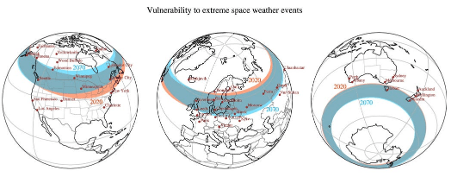
That last point shows that a fall-back refuge chosen for one hazard family can be exposed in another, which strengthens the case for multiple prepared refuges rather than one.
New Zealand features prominently in the GCR resilience literature for a reason. It is remote, temperate, food-producing, democratic, low-inequality, rich in hydro and geothermal energy, and capable of enforcing a border. This combination holds almost nowhere else (Australia is a related case).
These resilience features are a genuine national asset, but are currently unmanaged as resources providing safety in the face of global catastrophic risk. The gap between “less exposed” and “prepared” is entirely composed of things we could choose to do: onshore liquid fuel resilience and a domestic biofuel capability; a trans-Tasman pharmaceutical arrangement and sovereign shipping assets; diverse and distributed food production and strategic reserves; a hardened, islandable grid with black-start capability; backup communications for payments and logistics coordination; seed banking (including landrace banking for old-fashioned/“wild-type” varieties); urban and near-urban agriculture; pre-agreed criteria for when and how to enter a state of deliberate isolation, and whether that state is open or closed.
GCR should also be written into the national risk assessment rather than omitted from it and information publicly disseminated about hazards, vulnerabilities, and resilience investment options.
None of this requires relocating the country. All of it is achievable within a decade, and most of it pays dividends in ordinary times.
This is precisely the premise on which we founded Islands for the Future of Humanity, the non-partisan charity that grew out of the 2023 NZCat project on NZ’s vulnerability and resilience to nuclear war.
The evidence recognises islands as potential refuges, but island nations face real self-reliance constraints, and the work is to turn those vulnerabilities into strengths.
Until now that was largely an inference from our own studies. This new review is the international literature converging on it independently, from a different methodological direction, with a broader hazard set and eight authors across five countries.
Part of Australasia’s prominence no doubt reflects where researchers have chosen to look, and other countries with similar profiles remain understudied, so wider research on regional GCR resilience would be very welcome.
Decentralisation as a key intervention
There is a further way to read the finding that governance quality and decentralisation are the two factors that help against everything catastrophic. In recent work with Nick Wilson on the metacrisis, I argue that humanity’s deeper problem is a degradation of evolvability, ie the conditions under which risk-reducing solutions can be generated, retained and selected for. Five conditions matter: variation, modularity, stability of the selective environment, fidelity of transmission, and suppression of defectors who gain locally while degrading the whole.
Read against that framework, the results of our new Review stop looking like a coincidence. Decentralisation is modularity. It provides semi-independent components that can fail without bringing down the wider system. Governance quality, trust and low inequality are what sustain faithful information transmission and defector suppression. Crop and climate diversity are variation. And a refuge, properly understood, is best seen not as insurance against a named hazard but as a modular societal node that preserves capability and variation through catastrophe and can reseed adaptation afterwards. This protects evolvability itself, and the capacity to rebound.
The above also explains why the trends we flag as concerning (democratic backsliding, rising inequality, supply-chain concentration) degrade resilience against every hazard simultaneously. They are not separate problems but the erosion of the same underlying conditions.
This framing also guides action, as cooperation is far more readily evolvable at regional and bloc scale than globally. This is because the competitive pressure that produces internal cohesion does not exist between planet-scale entities.
All this means the highest-leverage work available to a small country is not to wait for global agreement. It is building deep, redundant, pre-negotiated resilience arrangements with Australia and our Pacific neighbours.
Conclusion
Nowhere is safe from global catastrophe. That finding should not be softened. But exposure is not fate, and the factors that matter most, and matter across hazards in a threat-agnostic way, are the ones squarely within the power of governments willing to look past the electoral cycle to nurture true resilience.
In light of all the above, and in an election year, New Zealand’s task in the face of uncertain times and potential global catastrophe reduces to a single need: stop relying on the accidental benefit of remote geography and start building intentional resilience.

