NZ faces medicines shortage if global trade cut off

Photo by Christine Sandu on Unsplash

The following is a media release by the University of Otago about our latest research paper, which determined that New Zealand would likely struggle to supply most of the commonly prescribed medicines used in acute care if a global catastrophe seriously reduced global trade.

New Zealanders could lose access to life-saving medicines in a trade-ending global catastrophe because imported ingredients are needed to locally manufacture commonly used medicines, research led by the University of Otago, Wellington shows.

The researchers say events such as a Northern Hemisphere nuclear war, a volcanic winter, a bioengineered pandemic, or a major solar storm, could all contribute to a collapse in international trade which would lead to critical shortages of imported medicines.

The research is published in the New Zealand Medical Journal.

The senior researcher, Professor Nick Wilson, from the Faculty of Medicine’s Department of Public Health at the University of Otago, Wellington, says the research shows none of the most widely prescribed 10 medicines for acute conditions, including pain relievers and medicines for treating infections, are able to be made in New Zealand. This is because of a lack of access to the key ingredients, many of which require petrochemical refining which the country no longer has.

Professor Wilson says global manufacturing of medicines has become dependent on just a few countries, with Europe, for example, obtaining 60-80 per cent of its ingredients for generic medicine manufacture from China.

The medicines examined in the study are: the popular pain reliever paracetamol; omeprazole used for acute gastritis and treating gastric ulcers; the antibiotic amoxicillin, used to treat severe bacterial pneumonia; the anti-inflammatory ibuprofen, used for acute pain relief; aspirin, used to manage strokes and heart attacks; the blood pressure medication metoprolol; salbutamol, used for acute asthma attacks; prednisone, a steroid used for severe allergic reactions; the antihistamine cetirizine; and the calcium channel blocker amlodipine, used to manage angina.

Professor Wilson says not only is modern pharmaceutical manufacturing highly dependent on ingredients from petrochemical refining, but New Zealand lacks many other necessary ingredients for the 10 medicines – and the complex industrial infrastructure to synthesise modern medicines at scale.

“The country’s current pharmaceutical industry is focused on secondary manufacturing and formulation, the packaging of imported active ingredients and quality control and testing.

“So once stocks of imported medicines had been exhausted in a post-catastrophe situation, there would likely be increased deaths from infections, heart disease, stroke and asthma.

“New Zealand could potentially build new infrastructure to produce some of the ingredients needed for medicines production by modifying the wood pyrolysis plant in Timaru to produce phenols and furans, or the Glenbrook steel plant to produce benzene/phenol from coke gas. A micro-refinery could also be built for oil extracted in Taranaki or from coal tar from West Coast coal mines.

“But all of these options would be expensive and challenging to undertake in a crisis situation.”

Another of the study authors, independent researcher Dr Matt Boyd, says New Zealand could also consider producing natural alternatives to some medicines, for instance by using salicylic acid from the bark of willow trees as an alternative to aspirin, growing opium poppies to make morphine and codeine, or by using hormones derived from livestock to produce insulin.

But he says, one of the most sensible approaches would be for the New Zealand and Australian Governments to come up with a joint plan to produce and trade key pharmaceuticals.

“Australia still has petrochemical refining, produces some of its own medicines, and is a major global producer of legal morphine from opium poppies. The New Zealand Government could contribute funding towards medicines production in Australia, but it could also help ensure the viability of post-catastrophe Trans-Tasman trade by using locally produced biofuel to keep cargo ships running.”

The research paper, ‘Capacity to manufacture key pharmaceuticals in Aotearoa New Zealand after a global catastrophe’ is authored by Professor Nick Wilson, Peter Wood and Dr Matt Boyd and is published in the New Zealand Medical Journal.

The great divide: How different Covid-19 control strategies shaped pandemic outcomes

By Matt Boyd, Michael Baker, Amanda Kvalsvig & Nick Wilson (cross-posted from the PHCC Blog)

Summary/TLDR

  • At the onset of the Covid-19 pandemic, countries responded in a range of ways.
  • Our new research reveals that those that put in place explicit exclusion/elimination strategies achieved dramatically lower Covid-19 mortality during the critical 2020-21 period.
  • These jurisdictions recorded negative excess mortality—fewer deaths than expected based on previous years—with -2.1 deaths per 100,000 population, compared with 166.5 per 100,000 in other jurisdictions.
  • In particular, island jurisdictions with stringent border restrictions experienced substantially better outcomes than non-islands. 
  • Crucially, we found no consistent evidence that stringent border restrictions harmed economic growth compared to jurisdictions with less stringent restrictions.
  • This finding challenges widespread assumptions about inevitable trade-offs between health and the economy.

The strategic divide in pandemic response

Five years into the Covid-19 pandemic, with an estimated 27.3 million excess deaths globally,1 we now can look back and try to understand which control strategies worked best. This question is important, as the world will face more pandemics in the future, possibly even bioengineered ones.2 

There are clear strategic choices around how to manage a pandemic. A mitigation/suppression approach accepts ongoing community spread while aiming to slow transmission. An exclusion/elimination strategy aims to prevent or rapidly eliminate community transmission.3

Our new peer-reviewed paper published in PLOS Global Public Health,4 identified five jurisdictions that explicitly pursued exclusion/elimination strategies: Australia, China, New Zealand, Singapore, and Taiwan. These weren’t just jurisdictions with low case numbers—they had exclusion/elimination goals and designed comprehensive policies and programmes around them.

Border restrictions

Central to exclusion/elimination strategies were stringent border restrictions. We analysed when jurisdictions reached maximum border closure (Oxford Stringency Index Level 4) and for how long they maintained these controls. Most jurisdictions (82.8%) eventually reached Level 4 restrictions, but the duration varied dramatically. Oceania maintained the longest median duration (768 days), while Western Europe had the shortest.

Very different health outcomes

The excess mortality differences through 2020–2021 were stark:

Explicit exclusion/elimination jurisdictions:

  • Mean age-standardised cumulative excess mortality: -2.1 per 100,000 (negative excess mortality)

All other jurisdictions:

  • Mean age-standardised cumulative excess mortality: 166.5 per 100,000
Figure 1: Age-standardised cumulative excess mortality per 100,000 for 2020–2021 by jurisdiction type and strategy4

Island jurisdictions overall experienced much lower mortality (64.8 per 100,000) compared to non-islands (194.3 per 100,000), regardless of strategic approach.

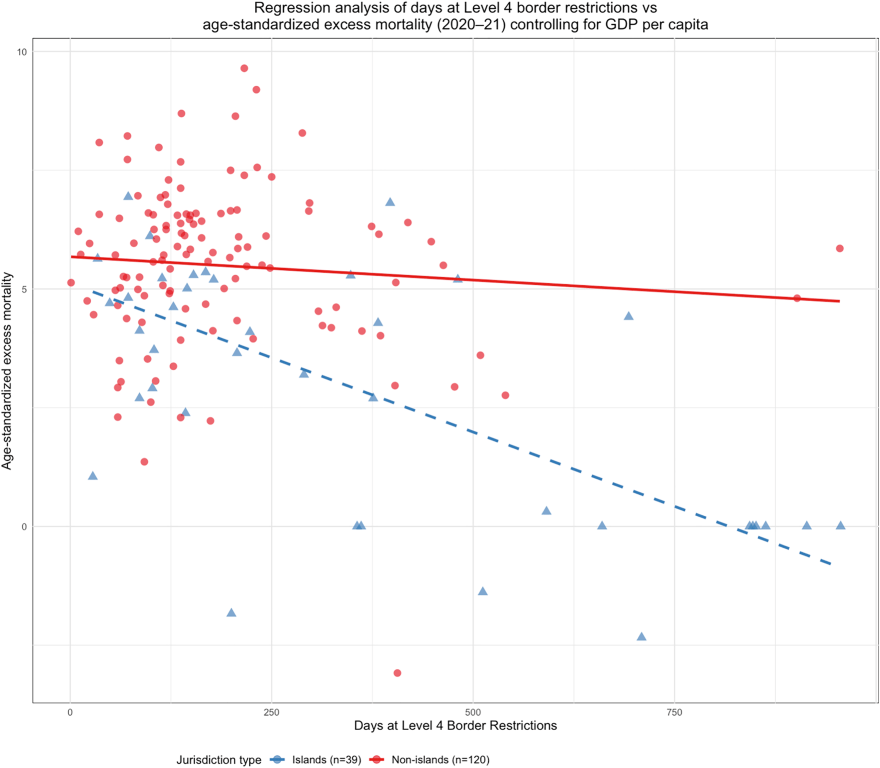
Among jurisdictions implementing Level 4 border restrictions, we found powerful correlations between restriction duration and reduced mortality—but only for islands. That is, in island jurisdictions, the longer border restrictions were in place, the lower the excess deaths. In our regression model accounting for GDP per capita and border restriction duration, these two factors alone explained approximately 58% of the variance in these mortality outcomes (with border restriction duration showing a stronger statistical association with mortality than GDP).

Governance quality: A critical factor

When we controlled for government corruption in our analysis, the picture became more nuanced. The protective effect of border restrictions weakened considerably, while low government corruption itself emerged as a significant predictor of better mortality outcomes.

This finding suggests that effective governance quality, not just border measures alone, was crucial for successful pandemic control. Better-governed jurisdictions (especially the absence of corruption) were more effective at implementing comprehensive public health responses beyond just border restrictions.

Economic impact findings challenge conventional wisdom

One of our most important findings challenges widespread assumptions about health-economy trade-offs. Despite extensive analysis, we found no consistent statistically significant relationships between border measures and GDP growth during the 2020–2021 pandemic period.

The absence of clear economic disadvantages suggests that stringent border restrictions during severe pandemics may not significantly harm economies, relative to those jurisdictions that take other approaches, as is widely assumed.

Figure 2: The relationship between duration of restrictions (days) vs age-standardised cumulative excess mortality for 2020-21 (cube root transformed); Outcomes for non-islands (red) and island jurisdictions (blue) shown seperately.4

Seven success stories

Our paper reports on seven jurisdictions that achieved negative age-standardised cumulative excess mortality during 2020–2021, meaning fewer people died than would be expected in normal times. Six were islands (Antigua and Barbuda, Barbados, Iceland, Japan, New Zealand, Taiwan) plus Mongolia. All used quarantine for arrivals and most implemented Level 4 border restrictions, demonstrating that exceptional outcomes were achievable beyond just explicit exclusion/elimination jurisdictions.

Conclusions

The Covid-19 pandemic created a natural experiment in control strategies across the 193 jurisdictions studied. The results suggest that exclusion/elimination approaches, particularly when implemented with strong governance, achieved dramatically superior health outcomes without apparent economic penalties.

Conclusions of this study are consistent with other quantitative evaluations of the health impact of the elimination strategy. A comparison of OECD island countries found that those that had followed the most proactive exclusion/elimination strategy (NZ and Australia) had the lowest excess mortality.5 They also had relatively good macroeconomic performance compared with countries pursuing a suppression strategy. Previous research also confirms NZ had negative excess mortality during the 2020-21 elimination period.6

As we prepare for future pandemic threats, these insights can inform more proactive approaches. While geography provides some countries with natural advantages, governance quality looks to be an important and modifiable factor in determining pandemic response success. For severe infectious disease threats, the evidence increasingly suggests that exclusion and elimination, rather than acceptance and mitigation, is the path to both better health and economic outcomes. 

These findings have implications for NZ as the Royal Commission of inquiry Phase Two prepares to submit its report in February 2026 and the Government then needs to formulate its response.7 They are also relevant to informing global pandemic preparedness approaches led by the World Health Organization.8

What this briefing adds

  • Jurisdictions implementing explicit exclusion/elimination strategies achieved negative cumulative excess mortality through 2020–21 (-2.1 per 100,000) compared to others (166.5 per 100,000), representing the clearest evidence of the impact of a strategic approach on pandemic outcomes.
  • Duration of maximum border restrictions strongly predicted lower mortality in island jurisdictions, but this effect may be partially due to governance quality rather than border measures alone.
  • No consistent relationships emerged between stringent border measures and GDP growth, challenging assumptions about inevitable health-economy trade-offs.

Implications for policy and practice

  • Future pandemic preparedness should prioritise exclusion/elimination strategies for more severe threats, where geographically and governmentally feasible, particularly for island jurisdictions and countries with strong institutional capacity.
  • Investment in governance quality may be as important as specific pandemic policies, since response effectiveness depends heavily on successful implementation.
  • Further work is needed to extend and validate this research, including: refining the pandemic response classification of specific jurisdictions; extending the analysis of well-being and economic factors beyond the first two pandemic years; and investigating the role of governance factors.

References

  1. Mathieu E, Ritchie H, Rodés-Guirao L, et al. (2020) – “COVID-19 Pandemic” Published online at OurWorldinData.org. Retrieved from: https://ourworldindata.org/coronavirus [Online Resource]
  2. RAND. Global Catastrophic Risk Assessment. Homeland Security Operational Analysis Center; 2024
  3. Baker MG, Wilson N, Blakely T. Elimination could be the optimal response strategy for covid-19 and other emerging pandemic diseases. BMJ. 2020 Dec 22;371. https://doi.org/10.1136/bmj.m4907
  4. Boyd M, Baker MG, Kvalsvig A, Wilson N. Impact of Covid-19 Control Strategies on Health and GDP Growth Outcomes in 193 Sovereign Jurisdictions. PLOS Global Public Health. 2025; 5(10) https://doi.org/10.1371/journal.pgph.0004554
  5. Summers JA, Kerr J, Grout L, et al. A proactive Covid-19 response associated with better health and economic outcomes for OECD High-Income Island Countries. SSM – Population Health 2025;31:101827. https://www.sciencedirect.com/science/article/pii/S2352827325000813
  6. Plank MJ, Senanayake P, Lyon R. Estimating excess mortality during the Covid-19 pandemic in Aotearoa New Zealand. International Journal of Epidemiology. 2025 Aug;54(4):dyaf093. https://doi.org/10.1016/j.ssmph.2025.101827
  7. Baker M, Broadbent A, Kvalsvig A, Wilson N. Improving our pandemic preparedness: Counterfactuals and continuous quality improvement. Public Health Expert Briefing. 2025 Apr 16. https://www.phcc.org.nz/briefing/improving-our-pandemic-preparedness-counterfactuals-and-continuous-quality-improvement
  8. Baker MG, Durrheim D, Hsu LY, Wilson N. COVID-19 and other pandemics require a coherent response strategy. Lancet. 2023 Jan 28;401(10373):265-6  https://doi.org/10.1016/S0140-6736(22)02489-8

Learning from Covid-19: Why NZ Needs a Broader View of Catastrophic Risk

Matt Boyd & Nick Wilson

The Royal Commission of Inquiry’s Report on Covid-19 lessons learned should be expanded and applied across the set of global catastrophic risks that threaten NZ.

Summary/TLDR

The recently published Covid-19 Royal Commission’s lessons should be applied beyond pandemic preparation to address all potential global catastrophic risks (GCRs).

Aotearoa New Zealand (NZ) needs comprehensive plans for scenarios worse than Covid-19, including those involving destruction rather than just disruption of critical systems.

Key priorities include:

  • Developing robust national risk assessment methodology that includes global catastrophes.
  • Building resilience against extended trade isolation.
  • Strengthening core health security measures including investment in public health and border control capabilities.
  • Creating threat-agnostic plans for protecting critical sectors (energy, transport, food, communications).

Anticipatory governance of GCRs requires:

  • Public engagement throughout the planning process.
  • Integration of ethical frameworks.
  • Cost-effectiveness analyses across prevention and mitigation options.
  • Explicit consideration of worst-case scenarios.

Action is needed now while global stability permits meaningful preparation, as future conditions may make building resilience more difficult.

Success requires maintaining public trust, government transparency, and strong coordination across all sectors of society.

Introduction

NZ’s Royal Commission of Inquiry into Covid-19 Lessons Learned published its Phase I Report in November 2024. The Report acknowledges the successes of NZ’s Covid-19 approach, but also the harms and associated lessons. The Commission makes 39 recommendations to help mitigate future pandemics, and other risks to NZ.

The Report covers the all-of-government NZ response to Covid-19, including ‘lockdowns’, border restrictions, the health system response, economy and social impact, vaccination and mandatory measures.

It is a shame that it took a catastrophe for a suite of sensible recommendations to emerge. However, we agree with the authors that action should extend beyond mere pandemic preparation.

In this blog, we look beyond naturally occurring pandemics and applying a global catastrophic risk (GCR) lens, we discuss what the Inquiry Report means in the wider context of national risks.

The Report’s Findings

The Inquiry Report makes eight ‘big picture’ observations about the Covid-19 pandemic, which it presents as follows (p.65):

The Report then follows these observations with six important lessons for the future, which they summarise in the following graphic (p.67):

Global Catastrophic Risks

The Report is explicit that, “many findings and lessons can be usefully applied to other threats [than pandemics].” We leave readers to look at the Inquiry’s Summary Document for full details and a comprehensive list of recommendations for pandemic preparedness. What we wish to highlight are the findings and gaps relevant to a sensible approach to GCRs more generally.

Other threats on the scale of Covid-19, or greater, include more extreme pandemics, perhaps resulting from bioweapon use, or spread of bioengineered pathogens. Also, major global risks such as nuclear war, extreme climate change, volcanic eruptions causing ‘volcanic winter’, global cyberattacks, asteroid and comet impacts, solar storms, and great power conflict. RAND Corporation has detailed most of these risks for the US Government in a 2024 Report. The same thinking underpinning the Inquiry Report on Covid-19 lessons learned, should be applied to these risks as well in coordinated fashion.

Assessing and preparing now for these civilisation-threatening risks is important, because civilisation appears to be entering a period of downturn and fragmentation, as exhibited in a series of concerning megatrends, and as is typical of civilisation cycles across time. This means, however, that the ability to prepare for and mitigate these risks might become more difficult in the medium-term future.

The Report is clear that some of NZ’s Covid-19 successes were down to mere luck, singling out for example the continuation of essential trade (p.49). The importance of locally led initiatives was also critical (p.50). Both resilience to trade disruption and appropriately resourcing communities are important global risk mitigation measures.

The Inquiry Report recommends that future approaches to major catastrophes should make explicit use of ethical frameworks. We completely agree. In fact, we took steps to starting a national conversation on values frameworks and extreme risks with our 2018 paper ‘Existential Risks: New Zealand needs a method to agree on a value framework’. GCR research has become more nuanced since then, but the need for a public conversation to inform national risk strategy remains.

Health Security

It is clear in the Report that public health expertise and infrastructure played a huge role in NZ’s Covid-19 success. While ‘lockdowns’, although often effective, were very expensive and caused harm to many people.

We support the Commission’s calls for investment in public health. We also advocate cost-effectiveness analyses across the many prevention and mitigation options for GCRs. We suspect that some initiatives, such as investing strongly in public health systems and workforce, will turn out to be some of the most cost-effective investments government can make, when the iterated costs of future pandemics are accounted for.

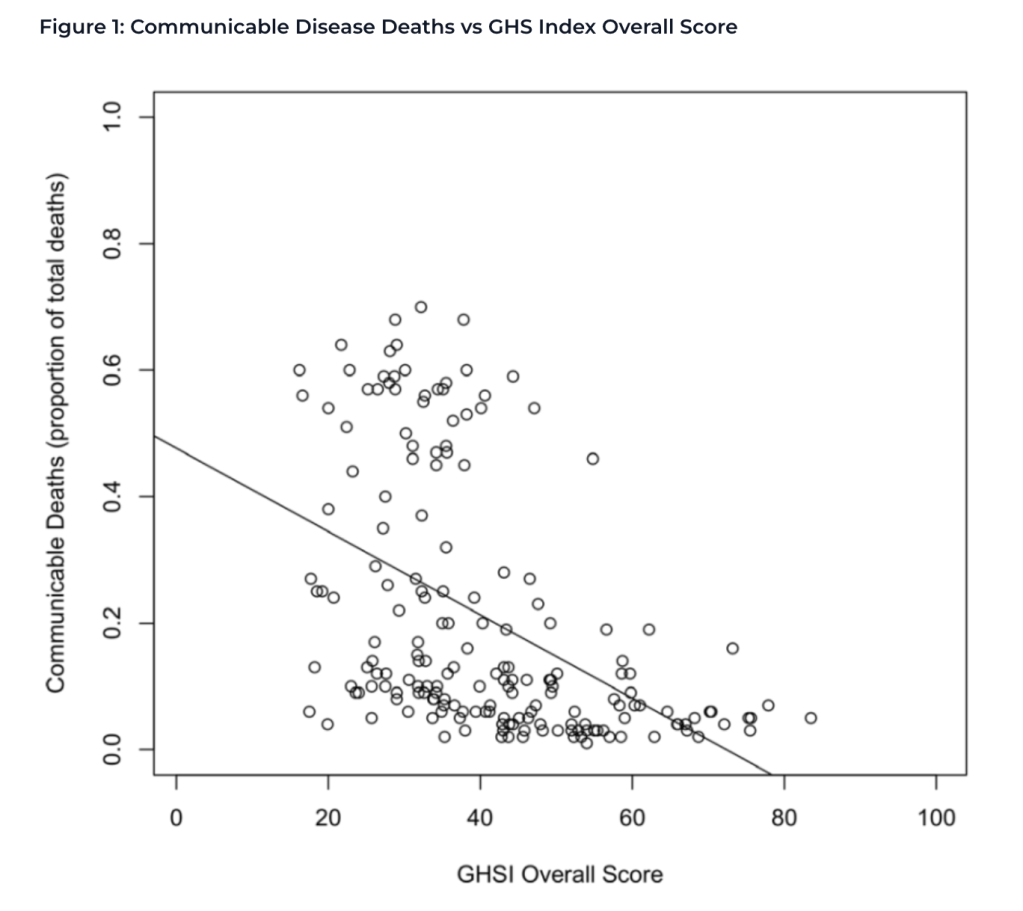
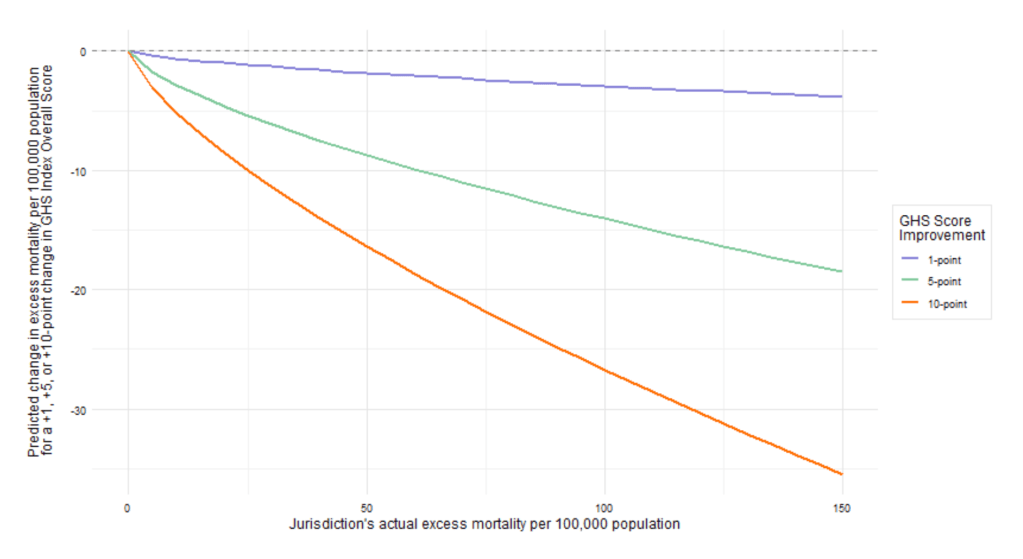
Our own retrospective analyses of Covid-19 outcome data (still in progress and preliminary) suggests that non-island countries experienced a death rate from Covid-19 inverse to the level of development of their core health security measures. Developing capabilities and capacities like those in the Global Health Security Index will be important during pandemics if NZ chooses not to strictly control its borders.

That said, another recent analysis we’ve performed suggests that the longer time islands spent with strict border measures, the fewer Covid-19 deaths they suffered, without any associated adverse economic impact.

We emphasise the difference in the determinants of Covid-19 outcomes between islands and other jurisdictions and caution anyone making comparisons between island and non-island countries.

It is possible that some future pandemics are far worse than Covid-19. See this report by Madhav et al for an indication of how frequently more severe pandemics will strike. NZ’s preparation needs to account for the possibility of a long period of isolation as an island refuge. The cost-effectiveness analyses we advocate above need to account for these likelihoods and which impacts of severe pandemics that we could avert.

Critically, future pandemic plans need to thoroughly consider border closure thresholds, and decision rules for similar, less strict, and more strict border measures depending on the severity and characteristics of a pandemic.

Health security and border measures are important, but we also know that people’s trust in each other, and trust in government, as well as less government corruption, are all strongly associated with pandemic success. These national characteristics must be maintained and strengthened.

Anticipatory Governance

The Inquiry Report strongly recommends more and better coordinated anticipatory governance of pandemic threats. It also highlights the lack of mechanisms to anticipate and evolve response plans. Particularly problematic was a kind of all-eggs-in-one-basket assumption that vaccines would end the pandemic, without a Plan B for emerging from ‘lockdowns’ and other measures.

We agree, and underline that anticipatory governance of pandemics can’t really be separated from governance of all GCRs, given many of the common downstream impacts that GCRs would have on an island nation like NZ.

Planning for pandemics, and especially a pandemic with the characteristics of Covid-19 was undercooked in NZ. If this is true of possibly the largest threat in expectation that the country was known to face, then it is likely to be truer for other GCRs. We note that NZ has only just (Nov 2024) released its first ever plan for a space weather catastrophe. The country needs plans for other GCRs, and threat agnostic plans that mitigate harm to critical sectors such as energy, transport, food supply, and communications. We have outlined this case, and a suite of resilience options in our 2023 report, ‘Aotearoa NZ, Global Catastrophe, and Resilience Options: Overcoming Vulnerability to Nuclear War and other Extreme Risks.’

The Commission’s Report emphasises the importance of all of government readiness for a pandemic, along with the need for central oversight of integrated pandemic preparation and an effective national risk management system. We agree. Such as system needs to develop an improved national risk assessment methodology and include GCRs in their assessment (perhaps referring to the RAND Report in the US).

NZ also needs legislation underpinning and mandating these assessment and planning functions, not just legislation that enables responses. The Inquiry Report advocates a publicly facing National Risk Register, but we’d extend this call. The whole national risk assessment process needs public involvement throughout its development and analysis cycles. The use of citizen assemblies could simultaneously inform and identify concerns and could be a forum for putting options and trade-offs to the public.

We have previously described similar processes in our papers on ‘Assumptions, uncertainty, and catastrophic/existential risk assessments’ and ‘Anticipatory governance for preventing and mitigating catastrophic and existential risks’. Our 2023 Main Report includes a chapter detailing what such anticipatory governance of GCRs generally might look like in the NZ context.

The implementation of a government Chief Risk Officer is another path that could be considered. Chief Risk Officers and the ‘three lines of defence’ approach are common and effective in the private sector (including the airline industry that Prime Minister Luxon comes from). The three lines include frontline operational ownership of risk, risk oversight by a Chief Risk Officer, and independent oversight of the whole process.

Strategic Resilience

The Inquiry Report rightly underscores the importance of resilient and adaptive health, justice, education, social and economic systems during a pandemic.

As indicated above, many GCRs have common (and different from Covid-19) implications for distribution of harm across sectors. Furthermore, sectors are densely interconnected and dependent on key processes such as trade, transport, energy, communications, and food supply.

Any initiatives aimed at improving resilience to future pandemics should be integrated with a wider ranging risk assessment and a set of strategies to build resilience and redundancy across at least these key sectors. Particularly concerning for NZ is trade isolation.

Destruction not just Disruption

Although trade was able to continue during Covid-19, this cannot be guaranteed in the case of other GCRs such as nuclear war, extreme solar storm, and so on. So, we need plans for scenarios where there is destruction, not merely disruption of global trade infrastructure.

We cannot be caught preparing only for the last battle, not the next. NZ needs to develop its ability to withstand an extended period of trade isolation and develop the infrastructure and capability to trade independently with Australia, coordinating and cooperating on critical needs.

Development of such resilience infrastructure, providing a Plan B, no matter what the critical issue, be it catastrophic shipping collapse, electrical grid failure, food production collapse, communications blackout, liquid fuel shortage, requires a trade-off between efficiency and resilience.

It is this kind of protection, from large scale unpredictable harm, that governments are most suited to ensuring. The risks, resilience options, and trade-offs need to be explicitly put to the public and debated. This requires a sophisticated and detailed national risk assessment, detailing the kind of capitals (human, physical, natural, and financial) that might provide affordances and options in the face of future catastrophes.

Action for National Resilience is Needed Now

We reiterate what we stated above, the world appears to be entering a period of geopolitical, climate, and economic instability, which as it progresses will likely undermine the ability of nations to develop resilience. We should not delay investment in assessing and mitigating GCRs. The prudent move is to buy our ‘insurance’ now, before any crisis strikes. Now is not the time for cuts and austerity on critical science and protections.

The Inquiry Report states that we need to be able to deliver ‘business-as-usual’ activity (p.78) during a pandemic of extended duration. We contest that future catastrophes could be very much worse, and we need plans that focus on how to deliver basic needs such as food, energy, and minimal communications during extreme scenarios. ‘Business-as-usual’ could be a dream.

The Report evaluated, and found problematic, some of the mandatory measures during Covid-19. Future scenarios could require other kinds of far-reaching mandatory measures, such as fuel or food rationing. These considerations need to be surfaced ahead of time, and debated, with resilience options sought, so they don’t come as a surprise should other GCRs strike.

NZ will need the capacity and capability to deal with future global catastrophes, and the experience with Covid-19 showed that although we managed to muddle through with some success, this cannot be assumed for other risks, at other scales, and in future contexts.

Conclusion

The Royal Commission’s Inquiry into Covid-19 provides valuable insights not just for future pandemic preparation, but for NZ’s approach to global catastrophic risks more broadly. While NZ managed the Covid-19 pandemic relatively well, we cannot rely on luck or assume similar approaches will work for different types of catastrophes.

The time to act is now, while we still have the capacity and stability to make meaningful preparations. This means developing robust risk assessment frameworks, building redundancy into critical systems, and strengthening our ability to operate independently during extended trade disruptions. Most importantly, we need to move beyond planning for mere disruption to preparing for potential destruction of key global infrastructure and systems.

As we face an increasingly unstable global environment, NZ must take a comprehensive, forward-thinking approach to catastrophic risk management – one that ensures our resilience against the full spectrum of potential global catastrophes, not just pandemics.