Changing the Rules to Soften Humanity’s Hard Landing: A Systemic Risk Approach to Everything Going Wrong at Once

A Tale of Two Conferences Part II: ASRA ‘Currents of Change’ Symposium 2025

(In-depth read, 15 min)

The importance of nature was clear at Les Fontaines – venue for the ASRA Symposium. Photo credit: the author

TLDR/Summary

  • Part II of a two-part blog series reporting on a pair of crisis/disaster risk conferences – this one covers the ASRA ‘Currents of Change’ Symposium, which offered a refreshing contrast to the UN’s symptom-focused approach detailed in Part I.
  • ASRA brought systems thinking to crisis management – 250 multidisciplinary experts tackled interconnected “polycrisis” issues rather than isolated disasters, focusing on the deeper stresses that drive cascading failures.
  • Keynote speakers delivered transformation-focused messages – Poet Ben Okri challenged humanity to become “the people our times require,” while Christiana Figueres emphasised that “linear thinking has no place” in addressing systemic risk.
  • Practical tools emerged alongside theory – ASRA launched STEER, a beta tool for systemic risk assessment, and workshops demonstrated hands-on polycrisis analysis and intervention design using real global stresses and future scenarios.
  • The hard truth: single solutions won’t work – Whether it’s capitalism, carbon emissions, or specific leaders, there’s no single root cause to our interconnected crises; siloed institutions impede the interdisciplinary approaches we desperately need.
  • Bottom line: humanity has the frameworks and community, but the race against time continues – ASRA provided genuine hope and practical starting points, but whether this scales fast enough to prevent humanity’s “hard landing” remains the crucial question.

Definitions

Global systemic stresses: long-term processes that weaken the resilience of critical global systems by increasing pressures, sharpening contradictions, and expanding vulnerabilities. These stresses make systems more vulnerable to trigger events that push them into a crisis.

Polycrisis: The simultaneous occurrence of multiple, interconnected crises that exacerbate each other, creating a situation more severe than the sum of its parts. It’s not just a collection of unrelated crises, but rather a situation where different crises interact and amplify the negative impacts of each other.

Systemic risk: The potential for multiple, increasingly severe, abrupt, differentiated yet interconnected, and potentially long-lasting and complex impacts on coupled natural and human systems. Systemic risk implies the potential for system-level breakdown and cascading consequences across human and natural systems.

Metacrisis: In this blog ‘metacrisis’ refers to the collection of forces: evolutionary, social, technological, and game theoretic, that drive and give rise to global systemic stresses, and resulting crises, polycrisis, and systemic risk.

Introduction & Context

Twenty-four hours after leaving the UN Office for Disaster Risk Reduction Global Platform in Geneva, somewhat pessimistic about humanity’s trajectory, I found myself at Les Fontaines in Chantilly Gouvieaux, France, for an entirely different kind of gathering.

The Accelerator for Systemic Risk Assessment (ASRA) was hosting the ‘Currents of Change’ Symposium – the first transdisciplinary global meeting dedicated to action on systemic risk.

The Symposium offered what the UNDRR Global Platform appeared to miss: clear-eyed analysis of the deeper and interconnected stresses driving cascading crises, coupled with actionable frameworks for addressing them.

ASRA represents a fresh approach to global catastrophic risk. As a network of 90 transdisciplinary experts, it brought together 250 systemic risk practitioners and stakeholders to tackle what ASRA defines as systemic risk: “the potential for multiple, increasingly severe, abrupt, differentiated yet interconnected, and potentially long-lasting and complex impacts on coupled natural and human systems.”

Unlike traditional disaster risk conferences focusing on specific hazards, ASRA addressed the underlying patterns generating cascading failures across interconnected systems. The goal: prevent, mitigate, adapt, and transform away from systemic risk before it overwhelms humanity’s response capacity.

Opening Address: Ben Okri’s Call for Transformation

Ben Okri delivers the opening address at ASRA’s Symposium. Photo credit: the author.

British/Nigerian poet and author Ben Okri gave the opening keynote, a moving, powerful account of humanity’s current predicament that immediately distinguished this gathering from conventional policy conferences. As a renowned novelist, Okri brought a different lens that cut through technocratic language to human realities.

“Many things have come into reality that cannot sustain themselves,” Okri observed – capturing what metacrisis theorist Daniel Schmachtenberger had described as humanity’s “self-terminating race” (see Part I).

But rather than dwelling in despair, Okri challenged humanity towards transformation thinking: “We must not make the mistake of thinking that the present will become the future.”

His diagnosis was unflinching. “Nations cannot talk of making themselves ‘great’ at the expense of making the rest of humanity small,” directly addressing the zero-sum thinking that underlies the competitive dynamics driving many global systemic stresses.

Most crucially: “We cannot combat the difficulty of our times as the people we used to be, we have to be fit and healthy, and we have to create wider and wider communities and alliances and we have to fight the evil of our times intelligently.”

This call for intelligent, collaborative action echoed throughout the Symposium’s technical sessions.

Keynote: Christiana Figueres on Transformative Change

The first keynote session saw Christiana Figueres, former Executive Secretary of the UN Framework Convention on Climate Change and architect of the Paris Agreement, demonstrate how systemic thinking translates into concrete action. Her presentation exemplified the Symposium’s approach of inclusive systematic analysis with practical optimism.

“In the face of systemic risk, linear thinking has no place today,” Figueres began, directly addressing the siloed thinking that limited many of the UNDRR discussions I had attended the previous week (see Part I).

We have the technology and understand interconnectedness, she continued, the question is implementation. Furthermore, rather than aiming to minimise our impact, we should actively seek to restore nature, shifting from ‘sustaining’ to ‘regenerating.’

Costa Rica provided her key example, where laws now facilitate payment for environmental services, resulting in increased forest cover from 29% to 55%. This demonstrates how changing incentive structures drives systemic change.

Figueres used the metaphor of a spider web for interactions in complex systems, explaining that we can’t control the web through top-down decrees, but we can observe “which threads are being pulled and how” and identify effects and leverage points where small changes create large systemic shifts.

Christiana Figueres speaking at the 2025 ASRA Symposium. Photo: the author.

Most importantly, Figueres identified a crucial constraint: “The scarcest resources at the moment are kindness and love.” She warned against letting news feeds crowd out genuine learning sources, including learning from the natural world. In a similar vein, I’ve previously blogged on Jaron Lanier’s calls for deleting all your social media ‘right now’, in my post on Covid, Trump, and algorithms.

Panel Discussions: Scale, Speed, and Systemic Solutions

ASRA Symposium panels tackled how we can meet the scale, scope and speed required for transformation. Unlike conferences focusing on incremental improvements, panellists grappled directly with the need to change human systems.

Participants spoke of bold actions, trust, and “crazy imagination.” One participant noted that, “change happens at the speed of trust,” and “we need to be good ancestors, that’s all.”

But the panellists also honestly assessed barriers, noting for example that Ministers of Finance lack technical understanding of systemic risk. We need bold moves in building systemic resilience so that human systems can handle the stress of the transformation that is required to reduce risk in the long term. However, the current efficiency vs resilience trade-off balance is wrong – we’ve built fragile systems optimised for short-term performance. We must stress-test our systems (whether financial, trade, food, or whatever vital system) and ask if the future we’re creating is resilient to the shocks that are increasingly likely. These stress tests require facilitated dialogue and knowledge sharing across the sectors and systems.

On the required foresight, participants emphasized anticipatory governance as key. Long-term efficiency comes through resilience, not optimisation, because iterated disasters and shocks will undermine efficient systems more over time than resilient systems.

Unfortunately, current crisis response follows whack-a-mole patterns addressing symptoms not causes. Humanity lacks the appropriate anticipatory governance, mechanisms to effect system redesign, and cross-border, regional and global coordination. In particular, we need to stop trying to solve global problems with national tools (as this will lead us into the game theoretic traps and harmful zero-sum dynamics).

“We shouldn’t fix the past, we need to build the future. It was these old systems that have led us here,” noted one panellist. Furthermore, we should act with “good enough information and fast enough action” rather than delays in search of perfect knowledge and optimal decisions.

The way the world seems stuck in rigid historical frames and decision processes, maladaptive in a present world of crisis and existential threats, reminds me of a scene in the film No Country for Old Men. Once he has outwitted the hero, villain Anton Chigurh observes:

“If the rule you followed brought you to this, of what use was the rule?”

The world and its legacy rule-based institutions appear to be in a similar bind. A new system of rules and processes is needed, or humanity will be brought “to this”.

Anton Chigurh, the villain in No Country for Old Men, challenges humanity to reflect on our systems and processes. Miramax Films (2007).

Launch of the STEER Tool: Practical Systemic Risk Assessment & Response

At the Symposium, ASRA launched STEER (Systemic Tool to Explore and Evaluate Risks), a tool designed to help users ‘steer’ away from systemic crisis and toward solutions.

Currently in beta, STEER will make systemic risk assessment accessible to organisations, governments, and researchers across all systems and sectors.

STEER represents practical systems thinking and helps users map interconnections (systemic risk assessment) and identify intervention points (systemic risk responses) for systemic impact, rather than analysing risks in isolation. A combination of drop down menus, tutorial material, and prompts for reflection and action guide users through the processes of systemic risk assessment and response.

STEER will be publicly launched later this year, but feedback from conference attendees  (all experts on systemic risk) beta testing the platform was very positive.

The ASRA Symposium provided opportunities for attendees to engage in the kind of processes that STEER encourages, through various workshops and side-events. I managed to attend two of these.

Workshop 1: Understanding Systemic Risk as Polycrisis

I participated in a breakout session facilitated by the Cascade Institute. This provided a hands-on polycrisis analysis exercise. The workshop highlighted global stresses and groups plotted possible interactions among these along with the triggers that could tip such interactions into crises. This helps us understand why so much is going wrong at the same time.

The theoretical basis for the Cascade Institute’s approach is their stress-trigger-crisis model. The model shows that stresses push systems toward points where triggers might create disequilibrium (and likely associated harm in human and ecological systems). Even without triggers, inexorable stressors will push systems into potentially harmful new states (eg, as the left hand depression in the figure below becomes shallower). Averting crises requires acting on stresses of three types: pressures, contradictions, and vulnerabilities.

Figure credit: Cascade Institute’s ‘Stress-Trigger-Crisis’ model (2024)

The Institute previously identified 14 global systemic stresses which create cascading failure conditions for humanity, and which must be addressed to have hope of mitigating the present polycrisis (you can read more about these here):

  • Climate heating
  • Ecological degradation
  • Toxicity
  • Zoonotic disease transfer
  • Demographic divergence
  • Concentrated industrial food production
  • Changing energy supply
  • Financial interconnectedness
  • Economic headwinds
  • Economic inequality
  • Ideological fragmentation and polarization
  • Political-institutional decay
  • Great power hegemonic transition
  • Propagation of artificial intelligence

Working groups mapped interactions between three assigned stressors each, analysing how crises emerge when triggers act within these interactions. Each crisis can become a trigger within other patterns.

The messy but structured and necessary process to understand complex systemic risk. Photo credit: the author.

For example, my group was tasked with considering interactions among:

  • North-South demographic divergence
  • The concentrated nature of industrial food production
  • Rising economic inequality

Interactions between these factors could be stressed further by events such as a policy shift in migration settings, or synchronous heatwaves in critical food production regions, leading to a crisis of workforce availability and food production, resulting in famine or war, with these crises then being the triggers of other global crises in cascading fashion.

The exercise rapidly demonstrated how current conditions create multiple, interacting, cascading failures – a polycrisis rather than isolated events. And we only considered three of the 14 global stresses!

Crucially, we brainstormed interventions for crisis mitigation through anticipatory action, such as sensible migration policies, sustainability criteria on imports, more heterogeneous distributed food systems, with food system buffers, and policies that alleviate economic inequality to hedge against short-term price shocks.

Key insight: There’s no single root cause of a polycrisis. It is not simply capitalism, carbon emissions, or the actions of particular leaders, but everything in conjunction. Single-point solutions won’t work. Siloed institutions impede solutions, which require interdisciplinary complex systems thinking.

Workshop 2: Preparing for Catastrophic System Failure

Another workshop facilitated by David Korowicz addressed whether catastrophic system failure can be mitigated ahead of time. We contemplated a scenario where (for the purposes of the foresight exercise) a national Cabinet has knowledge that a catastrophe severely decreasing goods, services, and energy access will happen in either 1, 4, or 8 years. Our group was tasked with considering how we would act with such information under the 4-year time horizon.

Roughly the results of our deliberations can be summarised as follows:

  • Prevent panic while being clear resilience is a fundamental priority and the nation needs to start seriously working to mitigate likely effects of future crises.
  • Assess physical security and available resources, ensuring physical safety and liaising with trusted international partners.
  • Strengthen connections at all levels across government and society (families, communities, regions, international).
  • Analyse complex reactions to crisis – how will people and countries respond? Will there be national hoarding with export controls? Ensure appropriate engagement with behavioural scientists.
  • Map consequences for energy, transport, food, and communications systems.
  • Stocktake the minimum functions required to sustain society according to hierarchy of needs (water, food, shelter, energy, etc).
  • Develop mitigation options for each critical function in context of the catastrophe.
  • Ensure redundant structures for communications, food, shelter.
  • Strategic stockpiling while understanding supply constraints from other jurisdictions doing the same.
  • Roll out incentives for electrification, local biofuels, distributed food production, and other resilience measures.
  • Sequence and prioritise all interventions for maximum effectiveness.

Admittedly all the above were developed on the fly in half an hour, but the exercise raised two key questions for me.

  • First, this all sounded incredibly familiar, and is basically the content of our own organisation’s detailed report on New Zealand’s vulnerability and resilience options against the risk of Northern Hemisphere nuclear war.

Recent media reporting on our study can be found here. You can read the rich and detailed report here, which is effectively a maturity model for resilience to global catastrophic risks, including one-page ‘cheat sheets’ for each key sector and for global catastrophic risk management.

  • Second, why haven’t governments of the world conducted this kind of exercise, and developed and implemented exactly these plans and programmes, in conjunction with their citizens, given the perilous state of the world?

The workshop discussions also highlighted that this kind of resilience doesn’t depend on nationalistic self-sufficiency but on creating systems that are less susceptible to cascading collapses: locally resilient food and energy, regional governance, delinking from fragile global finance, mutual support networks. But also, and importantly, linkages with regional partners, collaborations of nations to ensure trade and supply through investment in strategic infrastructure and plans, and the avoidance of hoarding, which although seems rational for individual jurisdictions, could actually lower the global mean ability to ride out the crisis, creating overall more harm.

Addressing the Causes of Global Systemic Stresses themselves

The workshops demonstrated that there are positive steps humanity can take towards limiting future catastrophe harm, even harm stemming from system-wide failures. We can implement systems thinking, map systemic interactions, develop resilience through anticipatory governance, conduct preparedness exercises, and reduce the human and environmental impact, and therefore depth of the economic harm that global systemic risk threatens.

ASRA’s greatest contribution was acknowledging this challenge while providing concrete intervention tools. Much more work is needed, particularly to address what drives these global stresses, including rivalrous dynamics preventing coordination, exponential technological advancement creating risks faster than assessment is possible, and resource degradation amid coordination failures. The impact of global stress reduction through systems thinking and action may still not be enough, because civilisation’s underlying dynamics don’t support such action. We’re potentially stuck in evolutionarily stable strategies where aggressive, exploitative behaviours outcompete cooperative, long-term alternatives – even when cooperation ensures collective survival.

All that said, the frameworks discussed and exercised at the ASRA Symposium offer genuine starting points for a new cognitive frame and for systemic intervention.

Conclusion: Building on Systemic Foundations

The contrast between the UNDRR Global Platform and the ASRA Symposium was striking and illuminates the limitations of current disaster risk reduction efforts, which are probably largely driven by historic silos.  

While UNDRR demonstrated genuine commitment to developing resilience, discussion remained trapped within frameworks addressing symptoms rather than systems. ASRA took a fundamentally different approach, placing difficult systemic questions at the analytic heart. The result was honest assessment combined with practical intervention tools.

Most importantly, ASRA provided a transformation-focused community of practice. The Symposium demonstrated that systemic risk assessment isn’t an abstract academic exercise. It’s an urgent practical necessity for decision-makers navigating interconnected worlds where risks cascade faster than traditional approaches can address. This practical necessity needs to be resourced. Analysts and decision-makers across all vital sectors and systems need time and space to cooperate, coordinate, and hash-out these problems around the same table.

The challenge of disaster risk reduction, building immunity to global catastrophic risks, and transforming human systems away from those that generate these risks remains enormous. Changing competitive dynamics and evolutionarily stable strategies requires changes from individual consciousness right up to global governance.

We can respond and recover from various crises, we can build resilience and mitigate the impact of future crises, we can reduce systemic risk through judicious systems transformation, we can mitigate the polycrisis by minimising the global systemic stresses, but only by intervening on the forces comprising the metacrisis can we prevent global stresses and crises being thrown up again and again, in increasingly severe form.

I reported Daniel Schmachtenberger’s views in Part I. He notes that the race dynamics of humanity are self-terminating. Individual improvement is insufficient – we need to bend the entire arc of human history. Ben Okri echoed this at ASRA: “We have to find better alternatives to the current direction of history.”

But frameworks, tools, and community emerging from initiatives like ASRA provide hopeful foundations and Ben Okri’s challenge echoes as warning and invitation. We cannot combat our times’ difficulties as the people we used to be, but we can choose to become the people our times require.

Whether this mindset and process scales and accelerates quickly enough to bend the arc of human history before the “hard landing” becomes inevitable remains the question.
The Hard Landing Ahead – Why Current Disaster Strategies Are Doomed to Fail

A Tale of Two Conferences Part I: UNDRR Global Platform 2025

(In-depth read, 18 min)

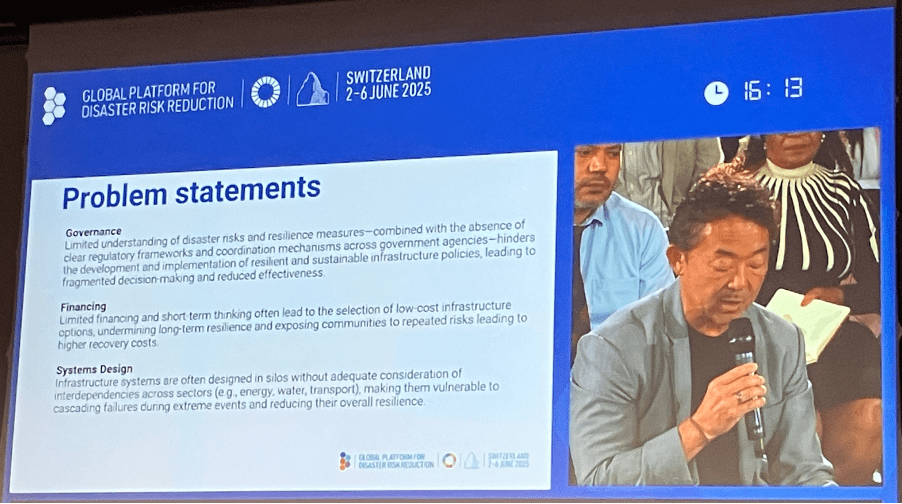
Kit Miyamoto facilitates a session on Infrastructure for a Resilient Future (UNDRR Global Platform Geneva, June 4, 2025). Photo credit: the author.

TLDR/Summary

  • Global disaster costs are exploding while responses lag: Direct losses have reached US$200 billion annually, but cascading effects arguably push the true cost to $2 trillion. Despite the comprehensive Sendai Framework adopted by 187 countries, disaster impacts are actually increasing globally.
  • The UN Office for Disaster Risk Reduction (UNDRR) Global Platform (Geneva, June 2–6) made some progress: Thousands gathered with genuine commitment, the World Bank has pivoted to prioritize 80% of disaster funding toward prevention, and there was acknowledgment that current frameworks need to be “more dynamic and powerful” by 2030.
  • We’re trapped in a systemic bind: The conference focused on early warning, coordination and engagement issues, specific hazards and financing, touching only lightly on the global stressors resulting from present day human systems that generate risks with increasing rapidity and intensity.
  • There was little discussion of exponential technologies that generate new vulnerabilities faster than we can assess or regulate them, while increasing global connectivity makes systems more fragile to cascading failures.
  • The meeting missed the deeper “metacrisis, ignoring the competitive and evolutionary dynamics between nations and corporations that prevent needed collective action. Individually rational decisions lead to collectively destructive outcomes. Disaster risk reduction remains inadequate due to short-term competitive pressures that reward immediate advantage over long-term survival.
  • Small islands illustrate the impossible position: Island nations face disaster costs up to 64% of GDP from single events, yet they can’t control the global climate, sea level rise or economic systems that generate many risks they face.
  • Real resilience requires transformation: Rather than just better disaster response, we need to change the fundamental incentive structures and governance mechanisms that generate cascading disasters in the first place.
  • The world’s current trajectory points to a “hard landing”: My assessment is that without addressing underlying drivers, the mismatch between accelerating risks and response capacity likely means a “hard landing” is ahead. That is, systemic reorganisation in coming decades with reduced global living standards.
  • Bottom Line: The UNDRR conference showed remarkable dedication to resilience, but until we address the systemic stressors generating risks faster than we can manage them, and the game-theoretic and evolutionary drivers of those stressors, then we’ll remain stuck in an increasingly dangerous reactive cycle.
  • In Part II of this ‘Tale of Two Conferences’ I’ll present a dash of hope from the second meeting I attended, the Accelerator for Systemic Risk Assessment (Paris, June 7–9), which countered some of the despair I felt following the UN Global Platform… Watch this space…

The 2025 UN Global Platform on Disaster Risk Reduction

The costs of disasters continue to spiral upward. In 2020 alone, direct disaster losses reached $200 billion annually, but when cascading and ecosystem impacts are included, the true cost balloons to an estimated $2 trillion. Meanwhile, risks are growing faster than our capacity to address them, disaster risk reduction financing remains woefully inadequate, and high-income countries are discovering they’re not immune—just weeks ago, a Swiss village was wiped off the face of the Earth by a glacier collapse.

Against this backdrop, the UNDRR 2025 Global Platform for Disaster Risk Reduction convened in Geneva, bringing together thousands of stakeholders to advance the Sendai Framework for Disaster Risk Reduction 2015–2030. The meeting culminated in an eight-point call to action.

I attended representing Islands for the Future of Humanity, a non-partisan New Zealand charity think tank, focused on enhancing understanding of global catastrophic risk and mitigation options, through technical research, blogs, collaborative webinars, and other resources available to all for free.

The UN conference structure was comprehensive: keynotes, plenaries, high-level sessions, and learning labs, all open to diverse stakeholders. Yet while the discussions were wide-ranging and often insightful, they revealed a critical blind spot that may undermine all our disaster risk reduction efforts: a failure to grapple with the deeper systemic forces, what some analysts call the “polycrisis” and the “metacrisis”, that are driving humanity’s accelerating risk trajectory.

Setting the Stage: Where We Stand

To understand what was missing, it’s worth reviewing where we stand.

The Sendai Framework, adopted by 187 countries in 2015, provides a comprehensive approach to reducing disaster risk through four priority areas:

  • Understanding disaster risk
  • Strengthening governance
  • Investing in resilience
  • Enhancing preparedness for “Build Back Better” recovery.

The aim is to meet seven global targets by 2030, including substantially reducing disaster mortality, economic losses, and damage to critical infrastructure.

The 2023 Sendai Midterm Review revealed mixed progress at best. While some advancement had been made since 2015, disaster impacts are actually increasing and setting back development gains globally. There’s a significant disconnect between policy development and actual practice, with disaster response still prioritised over prevention. Major shortfalls persist in disaster risk reduction funding, meaningful stakeholder inclusion, and international cooperation. COVID-19 exposed critical risk governance weaknesses and missed opportunities for “building back better.”

The recently adopted UN Pact for the Future (2024) acknowledges in its second paragraph that humanity is “confronted by rising catastrophic and existential risks” that could lead to “persistent crisis and breakdown.” It explicitly recognises nuclear war as an existential threat (p.12) and addresses biorisks, climate urgency, and complex global shocks. Yet implementation mechanisms remain underdeveloped.

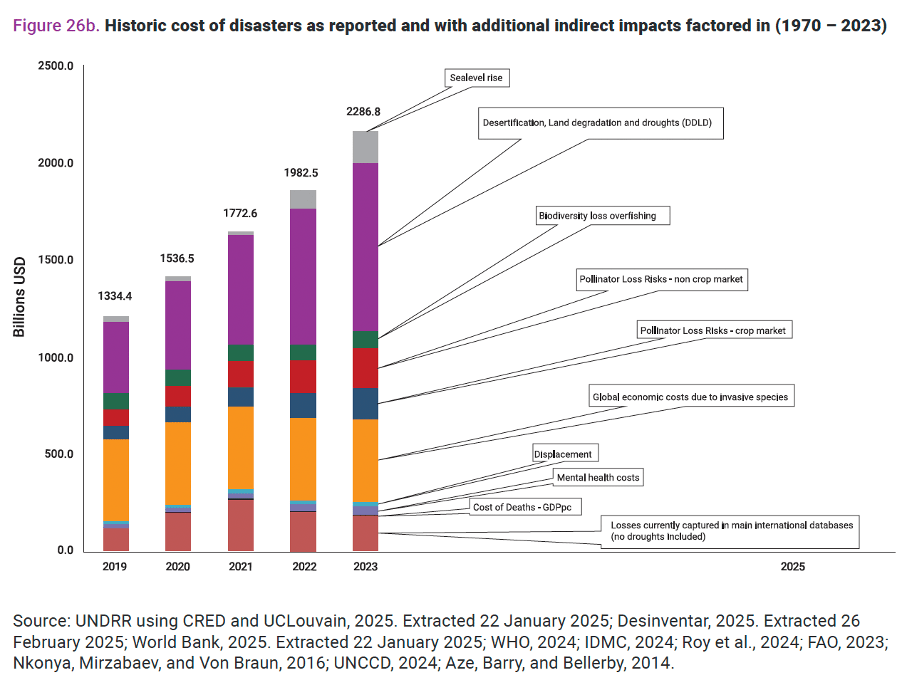
This year the 2025 UN Global Assessment Report on Disaster Risk Reduction (GAR) reported that five hazards—earthquakes, floods, storms, droughts, and heatwaves—drive 95% of economic losses (this of course omits pandemics, which result in more harm than all other disasters combined!). The report notes that the cost of disasters is rising year-on-year and that many impacts are not quantified by key international databases (see Figure).

Figure credit: UN GAR 2025

But these statistics don’t yet include the potential for truly catastrophic tail risks and the 2025 GAR report makes a crucial observation:

The greatest under-estimation of the potential future disaster costs is the blind spot in accounting for possible 1-in-100 or even 1-in-1,000-year events—those that, while having a low probability of occurring can cause catastrophic impacts when they do (p.27).

Our own research concurs with this sentiment and we have previously argued for such low probability high-impact scenarios to be formally included in national risk assessments. Expected annualised harms from catastrophic tails risks, on some analyses, are many fold higher than the sum of impacts of common disasters.

Finally, the new UNDRR Hazard Information Profiles 2025 attempt to standardise hazard classification but reveal telling omissions. While they include nuclear agents and radioactive materials as technological hazards, there’s no mention of nuclear war or nuclear winter, despite “armed conflict” being listed elsewhere. Pandemic risks are covered, as are catastrophic asteroid impacts and large volcanic eruptions, but there’s no discussion of food shortages or famines—despite historical evidence that major volcanic eruptions have triggered both through climate impacts.

The 2025 UNDRR Global Platform: Familiar Themes, Persistent Gaps

With the above context in mind, I attended the June 2–6 (Geneva, Switzerland) UNDRR 2025 Global Platform, which featured three preparatory events that set familiar themes:

  • The Early Warnings for All Multistakeholder Forum aimed to advance global early warning systems by 2027 but identified persistent gaps: under-resourced systems, lack of forecasting data, and financing shortfalls.
  • The Stakeholder Forum for Disaster Risk Recovery emphasised that stakeholders shouldn’t wait for ideal conditions to act, calling for fast, flexible, open-source data systems and the need to “build forward better” rather than just “build back better.”
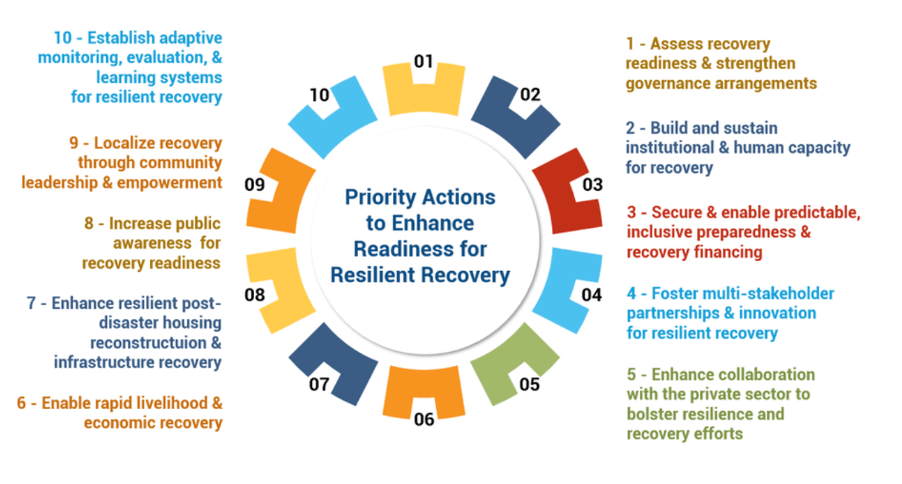
  • The World Resilience Recovery Forum launched a 10-point Action Plan, arguing we should stop prioritising speed of recovery over resilience.
The 10-Point Action Plan launched at the World Resilient Recovery Forum. Source: UNDRR 2025

These themes continued throughout the main conference. A panellist at the session on “Aligning the Sendai Midterm Review with the Pact for the Future” noted that by 2030, the world will need something more dynamic and powerful than current frameworks to meet emerging challenges. The emphasis on “risk-informed investment” was constant. We must stop creating risk through our investments as we build out complex infrastructure systems that create systemic vulnerabilities for those who depend on them.

Multiple sessions addressed financing, with the World Bank pivoting in recent times to providing 80% of disaster financing for risk reduction and preparedness and 0% to response without disaster risk reduction elements. This is a significant shift from 15 years ago when recovery was the focus. Yet the financing numbers discussed were manifestly disproportionate to the scale of the risks the world faces.

Infrastructure resilience received significant attention, with panellists discussing renewable energy transitions, governance transparency, universal accessibility, and nature-based solutions. Yet, evidence was cited that for every dollar invested in infrastructure, 50 cents is wasted due to organisational culture, corruption (or corporate greed/gaming), and similar inefficiencies. This is a sobering reminder that technical solutions alone are insufficient and systems and goals need to incentivise efficient behaviour (this may be particularly salient for the construction sector in my country of New Zealand).

A ‘Fishbowl’ discussion on resilient infrastructure at the UNDRR Global Platform 2025 (Image credit: the author)

The Systemic Risk Session: Missing the Mark

Perhaps most revealing was the session on “Understanding Systemic Risk.” Despite its promising title, the discussion largely focused on familiar territory: the need for cross-sector integration on risk, coordination mechanisms, strategic preparedness drills, incorporating Indigenous knowledge, and expanding beyond natural hazards to address social risks like health and food security.

Brendan Moon of the Australian National Emergency Management Agency described Australia’s National Coordination Mechanism that provides a model for genuine multi-stakeholder coordination that goes beyond information sharing to address responsibility and communication across sectors.

Brendan Moon explains Australia’s National Coordination Mechanism for disasters (Image credit: the author)

These are important topics, but they fundamentally missed what “systemic risk” actually means. The panellists discussed breaking down silos and improving coordination, necessary but insufficient responses to the deeper challenge of understanding why risks are accelerating faster than our capacity to manage them and failing to engage with the possibility that human systems could actually collapse under mounting stressors.

Ruth Richardson from the Accelerator for Systemic Risk Assessment (ASRA) provided one of the few insights that approached the real issue: We need to change the goals of our systems or we won’t overcome the problems. A food system should have the goal of providing nutritious food to everyone, not the goal of providing fast cheap food to whoever can pay.

She announced ASRA’s launch of STEER (still in beta), a system to assess systemic risks and guide action, calling for a radical increase in funding for this work. But even this may not dig deep enough into the polycrisis and metacrisis that is driving humanity’s predicament.

Do we face a Polycrisis?

Thomas Homer-Dixon, a systems theorist and founder of the Cascade Institute, frames the challenge as a debate between those who see our “polycrisis”—the interconnected set of global challenges from climate change to political instability to technological disruption—as merely “history happening” versus those who see it as the result of systemic flaws in our economic and political systems that are driving stressors that are inexorably leading to a dangerous disequilibrium in human systems.

Homer-Dixon identifies four meta-processes driving the polycrisis: increasing energy consumption, disruption to Earth’s energy balance, increasing human biomass, and increasing connectivity among human populations. These processes create conditions ripe for any future failures to cascade across highly connected, homogeneous systems. Exactly the kind of infrastructure networks we’re building out globally in terms of smart cities, global supply chains, food systems, or digital financial networks.

As connectivity increases without corresponding diversity in systems, we create systemic vulnerabilities. A pandemic can spread globally in weeks. A cyberattack can cascade across interconnected financial systems. Supply chain disruptions ripple through just-in-time production networks. Climate change affects agricultural systems worldwide simultaneously. Each trigger can propagate to a crisis and each crisis is a trigger for other crises.

This creates systemic risk.

Systemic Risk: the potential for multiple, increasingly severe, abrupt, differentiated yet interconnected, and potentially long-lasting and complex impacts on coupled natural and human systems – Accelerator for Systemic Risk Assessment

The great question is whether technological acceleration is net negative (contributing to these problems) or net positive (likely to solve them). This remains unknown, but what’s clear is that our current trajectory is unsustainable.

The Missing Metacrisis: Why Disaster Risk Reduction Can’t Keep Pace

The UNDRR Global Platform was largely focused on specific hazards, climate change adaptation, familiar themes of collaboration, community engagement, early warnings and financing. What wasn’t effectively discussed were the fundamental drivers of how humanity has ended up in a predicament where risks are increasing faster than our ability to respond. This a critical omission that undermines virtually all disaster risk reduction efforts.

Several analysts have previously identified this deeper pattern. Daniel Schmachtenberger describes what he terms a “metacrisis”. The metacrisis is characterised by systemic mechanisms underlying all other stressors and crises. Humanity is caught amid rivalrous dynamics where competition between actors (nations, corporations, individuals) prevents the coordination needed to address collective threats.  Exponential technological advancement creates new risks faster than we can assess or regulate them. Resource degradation accelerates while coordination failures prevent effective response. This has led to what Schmachtenberger calls a “sensemaking crisis”—we literally don’t see the problem at the right level of analysis and don’t understand it.

The result is a kind of systemic trap. If we continue on our current path, Schmachtenberger argues, we face either chaotic breakdown or totalitarian restriction of freedoms as authorities attempt to manage escalating crises. Neither outcome preserves what we value about human civilisation. The challenge is to find a “third attractor,” namely a path that avoids both outcomes through fundamental systemic change.

I did not hear this conversation at the UNDRR Global Platform – literally the world’s premiere meeting on disaster risk.

The problematic dynamic has been described metaphorically in terms of “Moloch” (a word sometimes used to describe an ancient bull-headed demon) – a situation where individually rational decisions lead to collectively irrational and destructive outcomes. Each actor, whether a nation, corporation, or individual, faces incentives that make immediate competitive advantage more important than long-term collective survival. It is a classic but nuanced game-theoretic bind, from which we may fail to escape.

Both Homer-Dixon and Schmachtenberger point to a crucial insight: elite institutions and individuals often lack the cognitive framework to understand these meta-level dynamics. They remain focused on specific problems rather than the systemic patterns that generate multiple problems simultaneously.

The Consequences of Missing the Metacrisis

This analytical blind spot has profound implications for disaster risk reduction. All the coordination mechanisms, financing innovations, data and technological solutions discussed at the UNDRR conference operate within a system that continues generating risks faster than we can manage them, driven by forces beyond any agent’s control. It’s like trying to bail out a boat without addressing the fact that someone is drilling new holes in the hull.

Consider the disconnect: we know that investing in disaster risk reduction provides returns of 15:1 in some cases (meaning that $1 invested in disaster risk reduction averts $15 of recovery costs down the line). Yet financing remains inadequate. We know that “building back better” after disasters makes communities more resilient, yet political pressures consistently favour rapid reconstruction over thoughtful less hasty rebuilding that transforms communities into resilient ones. We know that early warning systems save lives, yet they remain under-resourced in the places that need them most.

These aren’t primarily technical problems—they’re systemic ones. The same competitive dynamics that create short-term thinking in corporate boardrooms operate in political systems, international negotiations, and even disaster response. The actor who takes time to build resilience may lose out to the actor who prioritises immediate returns.

Aside: Return on Investment for Disaster Risk Reduction

I actually sat down and produced a simple calculator to illustrate this point while waiting between conference sessions. The default values represent my country’s (NZ) GDP and annual disaster losses. You can see immediately the benefits to GDP growth of investing in disaster risk reduction, rather than merely recovery and rebuilding. If governments want to find extra percentage points of GDP growth this is how. You can even impute your own assumptions about the frequency and impact of large catastrophes and find the ideal GDP spend on disaster risk reduction under those assumptions (default model assumptions are at the bottom – note this is just a toy and greatly simplifies complex dynamics).

Small Island Developing States: A Microcosm of Global Challenges

Our charity Islands for the Future of Humanity focuses on the vulnerabilities and resilience options of remote island nations in the face of global catastrophe. The aim is to disseminate non-partisan information that helps ensure three goals:

  1. That remote islands (including NZ and Australia) leverage their unique characteristics to protect the wellbeing of their populations (think successful Pacific Island border restrictions during Covid-19).
  2. That islands generating surplus develop resilient structures and systems to ensure continued trade in critical goods and services, such as life-saving food during global catastrophe.
  3. That remote islands develop global catastrophe resilience and mitigation mechanisms so that they might preserve complex integrated societies should major collapse impact the rest of the world.

In this context, I was interested in the UNDRR Global Platform’s session on Small Island Developing States (SIDS), which provided a particularly clear illustration of both the challenges and some potential solutions.

SIDS face disaster costs that can reach 64% of GDP for a single cyclone, an unsustainable burden that illustrates how existing systems fail to address truly systemic risks. There is no way that such impacts can be fully mitigated in cycles of disaster and perpetual recovery (note eg, my GDP impact calculator above), without the generative forces of polycrisis and metacrisis being addressed.

Cost of disasters in terms of GDP per annum (Figure credit: UNDRR 2025)

The Antigua and Barbuda Agenda for SIDS, introduced in 2024, attempts a more systemic approach. Rather than focusing only on disaster response, it aims to build resilient prosperity through enhanced financial access, climate action, and systematic monitoring frameworks. The emphasis on “trusting and using national systems”, rather than imposing external solutions, recognises that sustainable resilience must emerge from local capacity rather than outside intervention.

Yet even these SIDS initiatives operate within the global economic system that generates many of the risks they face. Small islands didn’t create climate change, but they bear disproportionate costs. They can build the most sophisticated early warning systems, but they can’t control global sea level rise or the hurricane patterns it affects.

This illustrates the fundamental challenge: effective disaster risk reduction increasingly requires addressing global systemic risks that no single actor can control.

The Path Forward: Thinking Beyond the Sendai Framework

As I reflected on the conference discussions, a troubling pattern emerged. Despite all the talk of coordination, collaboration, and systemic approaches, the fundamental drivers of accelerating risk remained largely unaddressed, even undiscussed.

This isn’t to dismiss the important work being done on specific disasters, early warning systems, or financing mechanisms. These efforts cost-effectively save lives and reduce suffering. But they operate within a larger system that continues generating risks faster than we can manage them.

One conference participant noted that, “the greatest risk we face today is failing to seize this chance to act boldly.”

I would argue that the greatest risk is failing to recognise the metacrisis drivers of the disaster risk that we face and continuing business and politics as usual while expecting different results.

As I noted above, one panellist at the 2025 UNDRR Global Platform was clear that by 2030, we’ll need something more dynamic and powerful than current frameworks to meet emerging challenges. This assessment is almost certainly correct, but it understates the magnitude of transformation required.

Given the widening mismatch between accelerating risks and our capacity to address their underlying drivers, the world is likely heading for what we might call a “hard landing.” Human systems will adapt, but with significant lag effects. This likely means a reduction in real GDP per capita globally and a drop in mean living standards across the coming decades, possibly accompanied by forced population decline from famine and other disasters as systems reorganise around new constraints.

This isn’t inevitable—there may be technological or social innovations that change the trajectory. But honest assessment suggests that our current approaches, however well-intentioned, are insufficient to address the scale and pace of change we’re experiencing.

The silver lining is that traumatic experiences can drive learning. The question is whether we can accelerate that learning process before the trauma becomes overwhelming.

Conclusion: Beyond Coordination to Transformation

The UNDRR 2025 Global Platform revealed both the commitment of participants and the limitations of current disaster risk reduction approaches. While the focus on coordination, breaking down silos, and scaling up financing addresses real needs, the conference revealed a critical blind spot: our failure to address the systemic forces generating risks faster than we can manage them.

Technical solutions can’t tackle the competitive dynamics, perverse incentives, and cognitive limitations that create what Schmachtenberger calls the metacrisis. Most participants genuinely want to build resilience, but they’re constrained by institutional and economic systems that make truly systemic solutions extremely difficult. It’s unclear whether any individual, organization, or state has sufficient agency to effect the needed changes.

Without frameworks for understanding these deeper patterns, disaster risk reduction remains reactive rather than transformative. We try to improve our responses to specific disasters while underlying dynamics continue accelerating overall risk.

This doesn’t mean abandoning current efforts, but embedding them within a larger understanding of systemic challenges. The real question isn’t whether we can coordinate better disaster responses, but whether we can transform the systems generating cascading disasters in the first place.

That transformation requires moving beyond technical fixes to address fundamental incentive structures, governance mechanisms, and cognitive frameworks shaping human systems. It’s more difficult than improving early warning systems or scaling financing, but may be the only approach that can actually reduce risk trajectories.

UNDRR Global Platform 2025 participants demonstrated remarkable dedication to resilience. The question is whether future conferences will grapple with the deeper systemic changes that such resilience requires.

Watch for Part II of this Tale of Two Conferences where I’ll present content from the Accelerator for Systemic Risk Assessment symposium (Paris, June 7-9). This will feature a dash of hope to counter the above despair…