The convergence of AI and biotechnology advances is fast becoming one of the most serious security challenges of our time.
A recent Time magazine piece highlighted a troubling blind spot in how this risk is being governed: while policymakers and frontier AI companies have taken steps to guard against pandemic-scale bioterrorism, the broader landscape of AI-enabled biological threats, particularly at the level of state actors, is receiving far less attention than it deserves.
The Nuclear Threat Initiative has recently published an AIxBio Horizon Scan.
This is in a geopolitical context where the President of the United States and his Secretary for War are seeking to dictate that frontier AI companies make their models available for waging war without human oversight.
In the video above, Prof Nick Wilson presents our introduction to this risk space, exploring how rapidly advancing AI capabilities are lowering the barriers to biological harm, and what a more comprehensive response might look like.
The world’s jurisdictions need to rapidly address this risk and act through prevention, international agreements, outbreak surveillance, and preparation for bio-catastrophe response. New Zealand needs to join a coalition of concerned nations and step up pressure.
The 16 minute talk titled “Anticipating and Managing Threats from Artificial Intelligence and Bioweapons” was presented in August 2025.
It was part of a University of Otago webinar series titled: “Imagining Past Pandemics and Preparing for the Future”.
New Zealand is debating building an LNG import terminal to address dry-year electricity shortages and price spikes, but this frames the problem too narrowly.
Our NZCat Project (2023) found NZ’s greatest energy risks come from global disruptions, like nuclear conflict or trade isolation, not just domestic generation variability.
LNG solves a first-order problem (dry-year shortfalls) while worsening a deeper one: it increases reliance on imported fuel and complex supply chains that are most likely to fail in a global crisis.
True resilience requires prioritising domestic, decentralised energy, including renewables, storage, electrification, biofuels, and geothermal, over globally integrated solutions.
Geothermal stands out as a good alternative: it provides firm, dispatchable power like LNG, but is entirely domestic and fuel supply-chain independent.
This is a fundamental strategic choice between a market-integrated energy model (optimise for cost) and a sovereign resilience model (optimise for survival under disruption), and these two approaches are incompatible.
The NZ public deserves a national debate on resilience trade-offs in the context of global catastrophic risk, and this should become a 2026 election issue.
Background
New Zealand is currently debating whether to build an LNG import terminal. The discussion is framed in familiar terms: declining domestic gas supply, rising electricity prices, and the need for firm generation to manage dry hydro years.
Within that framing, LNG is has arguable merits. It provides dispatchable fuel, reduces price volatility, and offers a form of “insurance” against low rainfall and low wind. On those terms, it is a plausible option.
But before deciding what infrastructure to build, it is worth asking a more fundamental question: What problem should we be trying to solve?
Is the objective to reduce electricity price spikes over the next decade? Or is it to ensure that New Zealand can meet basic energy needs under severe global disruption?
These are not the same question. And they lead to very different answers.
The NZCat Project
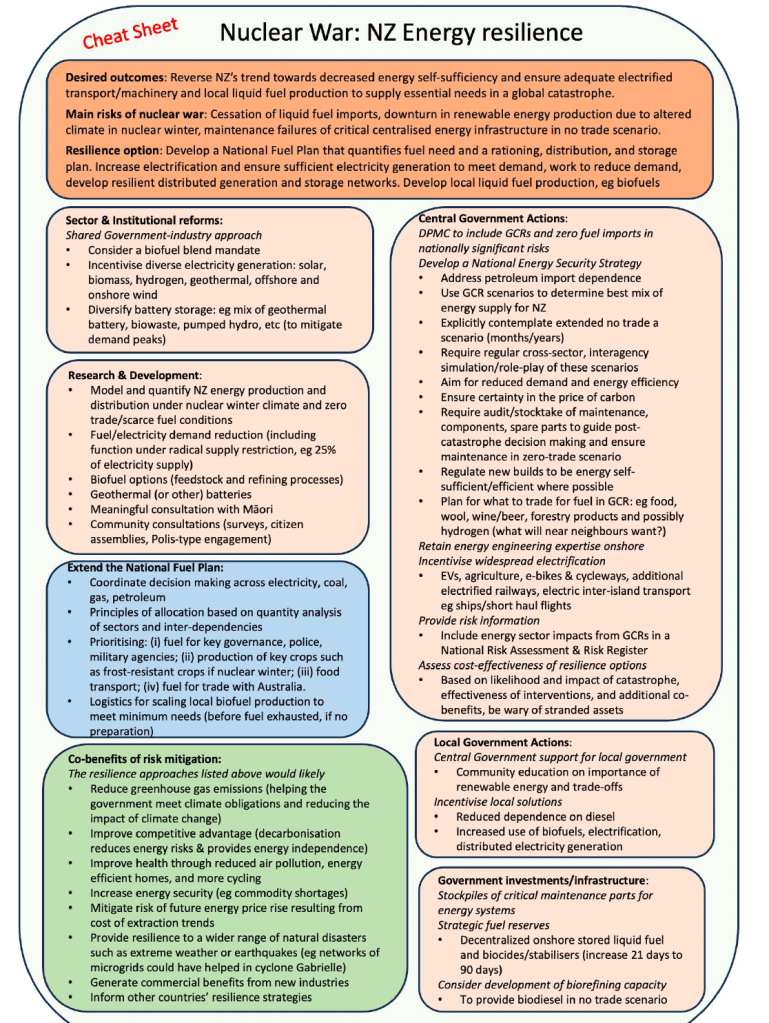
In 2023, we completed the Aotearoa NZ Catastrophe Resilience Project (NZCat) and studied New Zealand’s resilience to global catastrophic risks (GCRs), specifically including a Northern Hemisphere nuclear war scenario. With ongoing war in Ukraine, tensions in the Middle East, and a new accelerating nuclear arms race, this and other GCR scenarios become more salient. We’ve made this case at length in our recent Policy Quarterly article in response to the DPMC’s draft Long-term Insights Briefing on long-term resilience.
The NZCat project’s central finding was that the most severe risks to New Zealand do not originate locally. They arise from global system shocks that could disrupt trade, energy supply, and critical infrastructure simultaneously.
In that context, the dominant risk is not dry-year variability. It is extended trade isolation, potentially for months or years where imports are constrained or unavailable.
That changes the decision framework and we have previously described this problem and possible solutions for NZ’s liquid fuel security.
LNG: Solving one problem by worsening another
The current LNG proposal solves one problem, namely dry-year electricity shortages, but it does so by increasing dependence on imported fuel. It addresses variability in domestic generation by relying more heavily on the very system that is most likely to fail under global disruption.
Put simply, LNG solves one problem by worsening another.
The language of “insurance” is used frequently in the LNG debate, but it is worth being clear about what is being insured.
LNG provides insurance against short-term variability in hydro and wind. It is a hedge against a particular, well-understood risk within the electricity system.
But the NZCat work highlights a different class of risk entirely. These are low-probability, high-impact events that could disrupt multiple systems simultaneously, including energy, transport, food, and communications.
In those scenarios, the question is not whether electricity prices spike. It is whether the system continues to function at all.
Under that framing, insurance against collapse dominates marginal cost efficiency. The objective is no longer to optimise the system for price. It is to ensure that the system remains viable under extreme conditions.
This is where standard economic reasoning starts to break down. LNG may look rational under expected value calculations, where probabilities are weighted against costs. But it performs poorly under tail-risk minimisation, where avoiding catastrophic failure is the priority.
Another way to see this is to distinguish between first-order failures and system collapse. The current debate is focused on first-order failures: electricity shortages, price spikes, and generation gaps. LNG may be suited to addressing these. It provides firm capacity that can be dispatched when needed.
But the NZCat research emphasised cascading failures across interconnected systems. Energy is not an isolated sector. It underpins transport, food production, communications, and economic activity. If one system fails, others follow.
LNG addresses first-order failures, not system collapse. It does not solve the problem of fuel supply disruption. It does not address the vulnerability of global supply chains. And it does not reduce dependence on external systems. In some respects, it increases it. This is before even beginning to consider the implications for other priorities such as reduced climate emissions.
There is a deeper tension here between efficiency and resilience. Modern energy systems are optimised for efficiency. They rely on global supply chains, just-in-time delivery, and tightly integrated markets. These characteristics reduce costs (and increase gentailer profits) in normal conditions. But they also increase fragility.
LNG may be efficient in current markets. It allows New Zealand to access global gas supplies and smooth out variability in domestic generation. But it is not resilient under disruption. It depends on shipping, international markets, honouring of contracts, and complex infrastructure that may not function in a global crisis, particularly in an increasingly geopolitically fragmented world.
Resilience, by contrast, often looks inefficient. It involves redundancy, spare capacity, and local capability. It may require upfront costs and investment in systems that are not fully utilised in normal times. But these are precisely the features that allow a system to continue functioning under stress.
Viewed through a global catastrophic risk lens, LNG has three core problems
First, it deepens import dependence. LNG is reliant on international supply chains. If those supply chains are disrupted, the fuel is not available. This is not a theoretical concern. Trade disruption is a central feature of many catastrophic scenarios, for example shipping blockades in a China-Taiwan standoff or kinetic war.
Second, it introduces infrastructure fragility. LNG terminals are large, centralised, and complex. They require ongoing maintenance, specialised parts, and skilled personnel. These are all points of vulnerability in a disrupted environment.
Third, there is an opportunity cost. Capital invested in LNG is capital not invested in domestic energy systems. It is not spent on building local generation, storage, or resilience. That matters because resilience is cumulative. Every investment shapes the system we will have in a crisis.
If LNG is not the answer, what does a resilient energy system look like?
The NZCat report emphasised diversification and domestic capability. The goal is not to eliminate risk (this is impossible) but to reduce dependence on any single system and to ensure that basic needs (eg agriculture, food transport, clean water, heating) can be met under a wide range of scenarios.
This includes:
incentivising diverse electricity generation: solar, biomass, wind, and geothermal
diversifying storage: pumped hydro, batteries, and other technologies
increasing electrification to reduce reliance on liquid fuels
developing local fuel options such as biofuels
Minimising the risk of centralised failure with residential solar and battery installations as well as electricity grid islanding
The logic is straightforward. From an economic perspective, NZ domestic generation avoids ongoing fuel import costs and provides stable, long-lived assets. From an energy security perspective, it reduces exposure to global markets and supply chains. It creates systems that can operate independently if necessary.
Geothermal Energy
Within this framework, geothermal energy appears to stand out. Geothermal provides firm, dispatchable power. It is not dependent on weather in the way that hydro or wind are. And crucially, it is domestic. It does not rely on imported fuel.
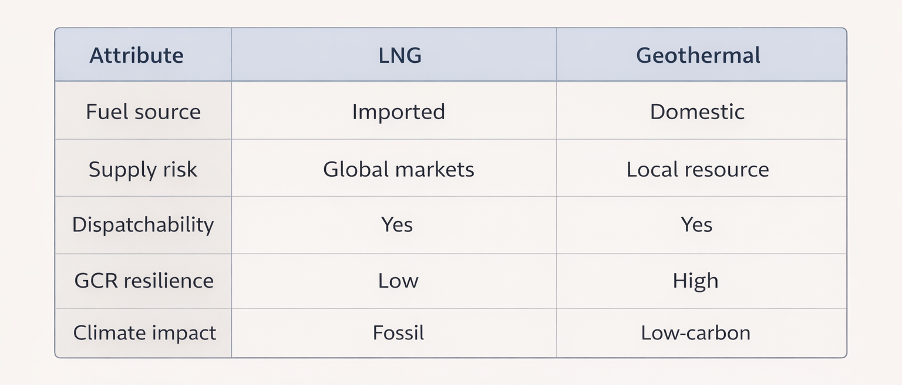
In the NZCat analysis, geothermal looks close to ideal for resilience. It combines reliability with independence from global supply chains. The contrast with LNG is stark:
Under a global catastrophic risk framing, geothermal is strictly superior for resilience. It provides the same functional role, namely firm generation, but without the dependency on external systems.
Including GCRs in the analysis changes how the LNG proposal looks
LNG shifts from being a straightforward solution to being a partial solution with important trade-offs. It reduces one type of risk while increasing another.
Energy security itself takes on a different meaning. It is no longer about access to global markets. It is about autonomy, ie the ability to operate without them.
Alternatives that may appear marginal in a narrow economic analysis become more attractive. Domestic renewables, storage, electrification, and local fuel production all contribute to a system that is more robust under disruption.
Infrastructure decisions become strategic rather than purely economic. The question is not just cost per megawatt-hour, but whether the system can function under stress.
Even the concept of insurance changes. LNG is insurance against variability in domestic generation. But resilience planning requires insurance against much larger disruptions, events that could affect multiple systems simultaneously. We have demonstrated the magnitude of these risks in a paper looking at Australia’s risk landscape when GCRs are considered, see an early preprint here.
At its core, the LNG debate reflects two different energy strategies. One is a market-integrated approach. It relies on global supply chains, flexible imports, and optimisation for cost. LNG might fit naturally within this model. The other is a sovereign resilience approach. It prioritises domestic capability, diversification, and the ability to operate independently. It is less efficient in normal conditions, but more robust under disruption and therefore more efficient in the longer term through iterated crisis.
These strategies are not fully compatible. Choosing one shapes the system in ways that make the other harder to achieve.
The LNG debate, then, is not just about a terminal. It is about how New Zealand thinks about risk. And I have not yet seen the government open this up for public debate. We need to discuss global risk as a nation and establish a value/goal consensus on resilience and trade-offs. Which political party will take this theme and run with it into the election?
If we optimise for expected outcomes (ie what is most likely to happen), and ignore critical goals like reducing climate emissions, then LNG may be a reasonable investment. It addresses known risks and fits within existing market structures.
But if we take seriously the increasing possibility of global disruption, where trade is constrained, systems are stressed, and multiple failures occur simultaneously, interacting in complex ways, then the priorities change.
Energy policy is part of a broader question
Can New Zealand maintain basic functions under extreme conditions?
In 2023, our NZCat work suggested that answering that question requires a different approach. It requires an all-hazards risk framework, planning for global catastrophe and trade disruption, and investment in domestic, resilient systems.
That does not necessarily rule out LNG. But it does mean that LNG should not be evaluated in isolation, and LNG starts to look seriously sub-optimal through this broader resilience lens.
Ultimately, the decision is not just about electricity prices in a dry year. It is about whether the system we build today will still work when conditions are no longer normal.
TLDR: Meta-crisis: the mechanisms that should solve problems are themselves deteriorating.
My Society for Risk Analysis ConferencePresentation
At the Australia New Zealand Society for Risk Analysis Conference in Christchurch on 29-30 Jan 2026 it was clear that systemic risk and polycrisis concepts are moving from the margins to the centre of risk analysis.
In my own presentation I uniquely connected these dynamics to cultural evolution and the degradation of societal evolvability (ie our ability to produce complex adaptations to mitigate global risk).
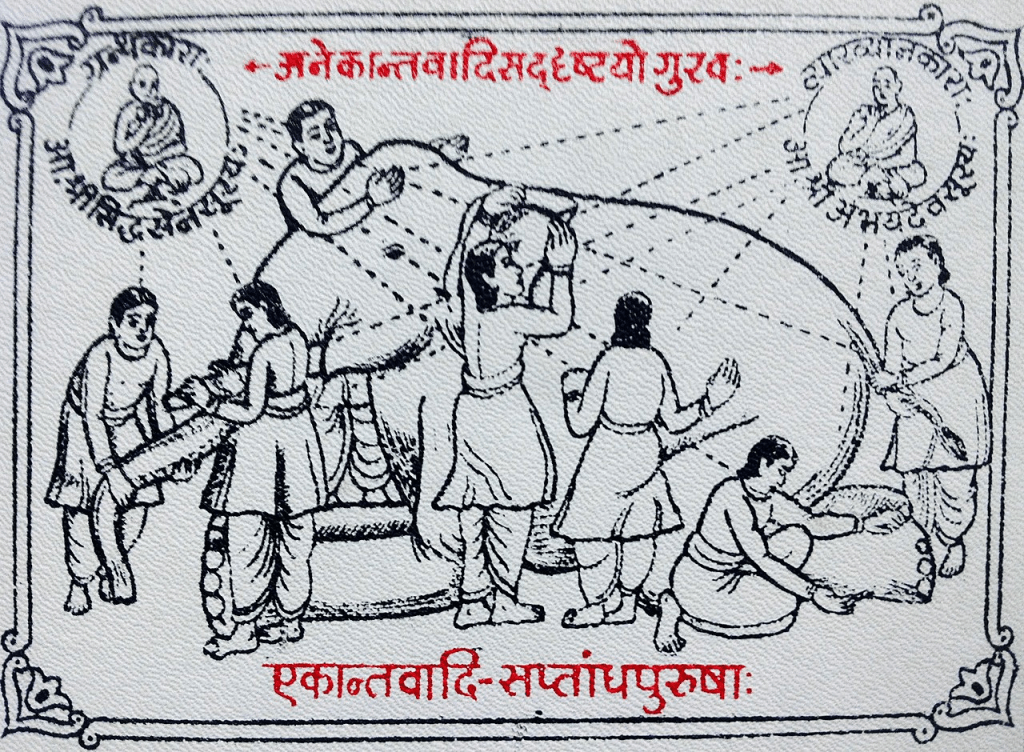
Global risk mitigation is like the parable of the blind monks and the elephant: each of at least six disciplines grasps a real part of the problem, but none sees or acts on the whole.
Current disaster risk reduction reveals we are systematically underprepared for rare-but-catastrophic events; global catastrophic risk research shows that some of these threats could overwhelm civilisation entirely. Yet national risk assessments indicate that governments mostly plan as if risks were local, isolated, and manageable, when in reality they are not.
Systemic risk and polycrisis research deepens the picture by showing that the world is not just facing many dangers, but rising, interacting stresses that can cascade across tightly coupled global systems. This means today’s risk landscape is not simply a series of external shocks, but a living, unstable system generating hazards from within itself.
But these frameworks still leave a crucial question unanswered: why do humans keep building such a fragile world?
In my talk I noted that the answer requires turning to human behaviour and cultural evolution. Human actions are shaped by biases, incentives, institutions, and evolved social dynamics that develop in response to built and inherited human environments.
These processes give rise to many strategies that are locally successful but globally disastrous. Over time, these dynamics can create maladaptive “trap states”, even worse, they can erode society’s very capacity to adapt.
Evolvability is the key
I contested that the notion of ‘evolvability’ becomes central. For societies to cope with an unpredictable future, humanity must avoid entrenchments and path-dependent maladaptation. There is need for the right kinds of variation, modularity, institutional and informational stability, and effective constraints on harmful “outlaw” strategies, or complex adaptations to mitigate risk cannot emerge. Yet arguably all of these are currently degrading on the global stage.
As a result, humanity is not just producing risks faster than it can manage them; it is undermining the mechanisms that would allow us to learn, adapt, and recover.
The meta-crisis
Formally, this is a meta-crisis. We are not only in a polycrisis where multiple risks are interacting resulting in threats greater than the sum of their parts, we are losing the capacity to evolve our way out of it, which means the core task is not merely risk reduction, but preservation of, and working with, the ingredients of human system evolvability itself.
Addressing global risk requires understanding and acting across all six of these (and other) fields together. This is likely to require integrative governance across risk disciplines and jurisdictions (a story for another day).
Systemic risk and polycrisis: the emerging norm of risk science
At the SRA conference, I was certainly not alone in diagnosing systemic risk as a critical theme in present-day risk analysis, and this was illustrated across many sessions, by a range of contributors.
Taken collectively, the Christchurch SRA conference suggests a clear shift in risk science away from isolated-hazard, probability–impact framing toward a more systemic conception of risk. Across keynotes, methodological talks, and applied case studies, speakers repeatedly foregrounded interdependence, cascades, emergence, polycrisis-like dynamics, and value pluralism.
Systemic risk thinking is no longer confined to niche complexity scholarship but is increasingly shaping both academic risk analysis and practical decision-making frameworks.
I suggest that even with this convergence on the nuance and interdependent complexity of risk, we will never escape a cascade of escalating global risk until we find ways to address the behavioural and evolutionary generative mechanisms of the situation the world is presently in.
We should build societies that are safe and resilient because they can evolve well, not because they try to predict everything or stay the same.
A focus on engineering and nudging ‘evolvability’ provides the potential for a broad-based structural solution to global risk. I’m planning deeper work on this issue…


 Adapt Research Ltd