Lessons for global catastrophic risk from the Arctic Circle Assembly 2026, beyond AI
TLDR/Summary
- The Arctic Circle Assembly (Reykjavík, Iceland, 8–10 October 2026) showed a region no longer insulated from the world. Nuclear risk, energy shocks after Hormuz, great-power posturing and Greenland were all on stage; New Zealand is not insulated either.
- Read my companion blog reporting on AI risk as discussed at the Assembly. With my own inferences about domination, utopia vs dystopia, and the possibility of societal collapse.
- The Atlantic Meridional Overturning Circulation (AMOC) was the Assembly’s clearest case of a catastrophic risk under deep uncertainty. The science cannot say when or whether it will tip, but every new line of evidence moves the risk the same way.
- AMOC is not only a current. Sea ice, ice algae, copepods and fish stocks are changing now, with consequences for carbon storage and for human food.
- Science is doing its job; decision-making under deep uncertainty is policy’s job. Policymakers waiting for certainty are applying the wrong test. No-regrets actions in food, fuel and preparedness pay off whatever the ocean does.
- Iceland shows how a risk reaches the agenda. A scientists’ letter, a ministerial report, the National Security Council, and well-crafted op-eds that offered a minister the chance to lead.
- Every system New Zealand depends on is a current that can tip. Geopolitics, supply chains, resources and social cohesion need the same continuous monitoring, long-term funding and Plan B that AMOC is getting.
- Iceland is counting its stocks; New Zealand should too. Iceland’s reports on fuel, feed and food reserves are the model, and its own history shows what happens to an island that cannot secure its shipping.
Introduction
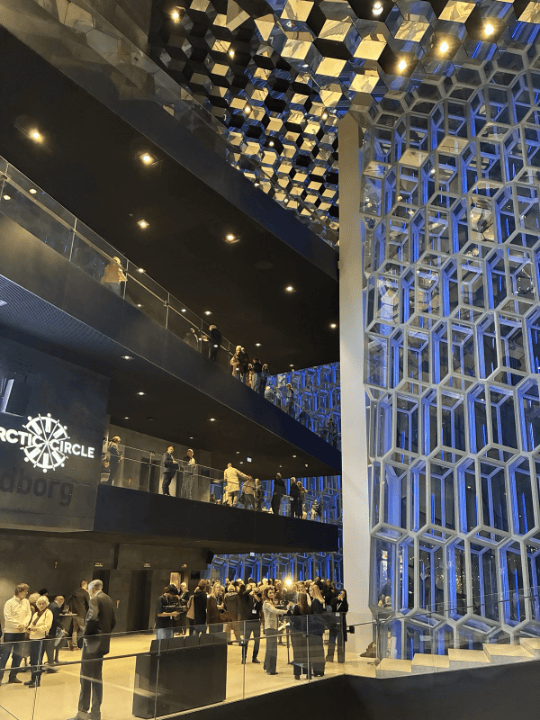
The Arctic Circle Assembly fills Reykjavík’s Harpa concert hall each October with hundreds of sessions. I sampled perhaps 5%: a Wednesday pre-event “Connected Ocean Observing: ARIA x Reykjavík Institute”, run by the UK’s Advanced Research and Invention Agency (ARIA) with the Reykjavík Institute, and the first two of three days, chosen through a global catastrophic risk lens.
This post is therefore partial. My companion post covers the AI sessions, including Tristan Harris’s plenary, the best session I attended. My thanks to Arctic Circle and its founder, former President Ólafur Ragnar Grímsson, for an event where anyone may ask a question. Here I survey the geopolitics and infrastructure sessions, then use AMOC as the main case. The test throughout is the one I applied at SRA Nordic last week: what lessons transfer to global catastrophic risk, and what should New Zealand learn?
The geopolitical weather
The day one plenary set the tone. Canada’s Foreign Minister Anita Anand spoke of sovereignty, respect for Arctic peoples, security, economy, and environment, and cited Prime Minister Mark Carney’s Davos case for “value-based realism”: with the threat environment changed, collaboration among like-minded states is now a necessity. That fits our view that cooperation on catastrophic risk evolves most readily at the regional level, since individual jurisdictions can’t manage cross-border risks alone. Greenland’s representatives set out their view of sovereignty and way of life in the face of US pressure. “Nothing about Greenland without Greenland.”
The US session, with the Governor of Alaska and the Chair of the US Arctic Research Commission, was about hard assets: ports, shipping lanes, icebreakers and missile defence, and partners to help pay for them. Some of the language was painful and misguided. More telling was the omission. Neither speaker mentioned climate change until asked by a member of the audience, and the answers deflected.
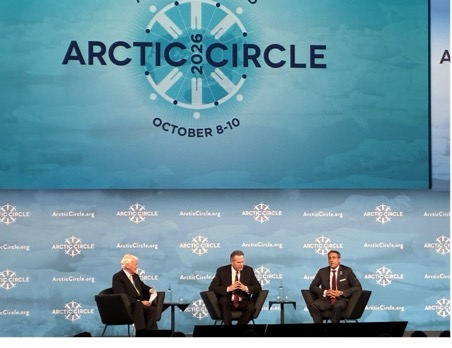
“Can the Arctic stay calm while the world burns?” took the cascading view and applied it to any far-flung region of the world. Lassi Heininen, a long-time scholar of Arctic politics, recalled that Reagan and Gorbachev met in Reykjavík 40 years ago this month and nearly agreed to abolish nuclear weapons.
Today no arms control treaty or serious negotiation is current, and with the stresses of climate change added, he is “bloody worried” about the risk of nuclear war. Francesco Sassi, a Norway-based energy analyst argued that security must now include energy security: after Hormuz, and a possible US export ban, Arctic oil and gas production could rise and new alliances form. Others traced Russia–China cooperation on pipelines, shipping and coast guard patrols.
The verdict was that the Arctic cannot be insulated from these shocks. Neither can New Zealand. Prices are not coming down, and politicians need a realist view, and to communicate expectations with society. Unfortunately the audience questions stayed with energy, not nuclear spillover, which is where the catastrophic tail sits.
Infrastructure that serves two purposes
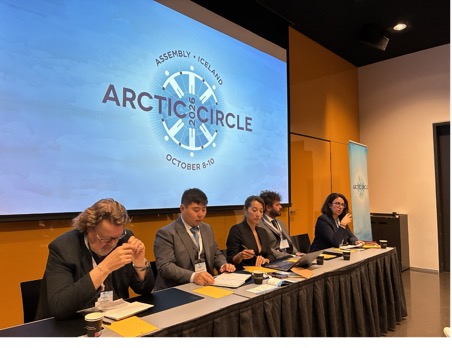
The session I would most like New Zealand’s regional councils to have seen was on dual-use infrastructure in Iceland’s West Fjords, a remote, sparsely populated region much like the West Coast where I live. Moderator Gylfi Ólafsson described how the community, as the security picture darkened, developed a shared vocabulary and a report to Parliament that prioritised local investments by cost, feasibility and dual use; search and rescue, roadside mobile coverage and fibre came out on top. But other investments in maritime upgrades, radar stations, submarine cable security, and a relocated airport are all topical. Brynja Huld Óskarsdóttir argued that dual-use infrastructure is the fastest route to defence resilience: it keeps people living there, and presence is both deterrence and capability. Patti Bruns (Arctic Mayors’ Forum) and Peter Clarkson (Mayor of Inuvik) agreed: there is no Arctic security without healthy Arctic communities.
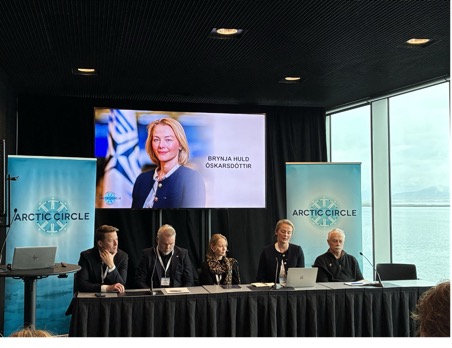
What was missing was food and liquid fuel, the two inputs that decide whether a remote community functions in a crisis. But the community process deserves as much attention as the list. New Zealand could take this approach independently, adopting NATO-style baseline resilience requirements without NATO, and building priorities through local citizen deliberation of the kind our charity Islands for the Future of Humanity are proposing to pilot in Reefton, NZ.
AMOC: what science can and cannot say
The Atlantic Meridional Overturning Circulation (AMOC) carries warm water north and is a large part of why north-west Europe and Iceland are so mild for their latitude. A sharp weakening would cool the North Atlantic even as the world warms, affecting weather, sea level, fisheries and agriculture across the hemisphere.
ARIA’s pre-event was the most candid account of uncertainty I heard all week. ARIA’s Forecasting Tipping Points programme (£114 million, led by Sarah Bohndiek and Gemma Bale) aims to build an early-warning system for the North Atlantic, combining established observing arrays with cheaper autonomous instruments and new models, and is now moving to its second phase.
Dr Graeme MacGilchrist (University of St Andrews) organised the science into four questions. Can AMOC collapse? Yes, in models, but rates and mechanisms are unclear. Has it? Evidence for past collapses is ambiguous. Is it changing now? The instrumental record is about 20 years, too short to say. Will it? Persistent model biases affect how sensitive the system is to forcing. Early warning, he said, is elegant theory that is not yet validated, and today’s observing system is a collection of projects with precarious funding.
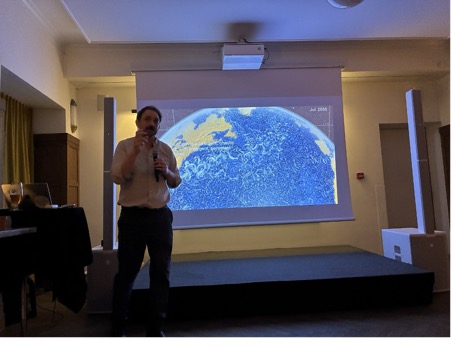
The next morning’s panel, organised by Iceland, the UK and the Netherlands, gave the same message more briefly. Femke de Jong (NIOZ) explained how few lines of instruments cross the Atlantic. Laura Jackson (UK Met Office) said the AMOC is likely to weaken through this century, with abrupt collapse unlikely before 2100, but a tipping point is plausible and a much weaker state could follow. Steingrímur Jónsson (Marine and Freshwater Research Institute, Iceland) argued for sustained monitoring. Other tipping points, such as the West Antarctic Ice Sheet, may occur first and interact.
Not just a current
A session on the Arctic marine food web showed that the changes are already under way. Geraint Tarling (British Antarctic Survey) explained how sea-ice algae and copepods drive a polar biological carbon pump, and how a seasonal lipid pump locks carbon away below 1,000 metres for centuries.
Loss of sea ice, invasion by Atlantic species and ocean acidification are weakening it, a triple whammy that feeds back into warming. Antje Boetius (Monterey Bay Aquarium Research Institute) described returning to sites where long filaments of ice algae once hung beneath the ice and finding none, replaced by swarms of gelatinous life. Sea ice now forms in different places and drifts faster and thinner, and multi-year ice, with its years-long ecosystems, is gone.
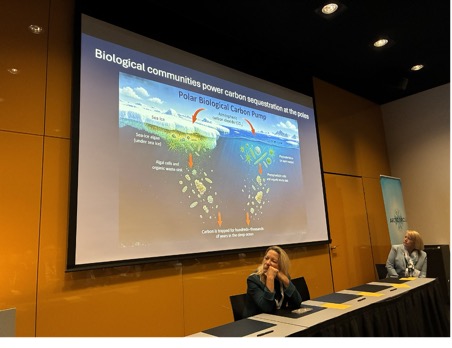
The lesson is that “AMOC risk” is not one variable. It is a coupled system of currents, ice, plankton and fish, ending in food prices, livelihoods and cod stocks. When I asked whether AMOC monitoring and biological monitoring are linked, the answer was that new devices make more possible. Ocean flora and plankton may be the canary in the AMOC mine, and North Atlantic monitoring should include them if it does not already.
The risk keeps moving one way
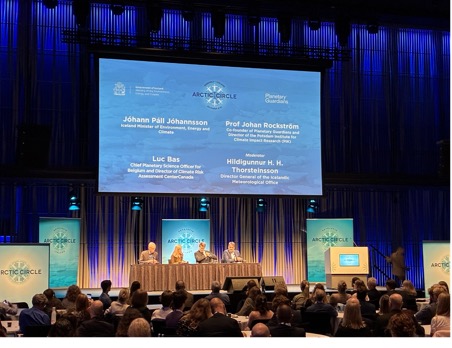
On day two Johan Rockström (Potsdam Institute for Climate Impact Research) called AMOC the “poster child” tipping point and noted that six of the climate system’s tipping elements are in the Arctic, with interactions we do not understand. Recent studies project limited weakening of 18–43% by 2100 on one approach, and 51 ± 8% under intermediate emissions when models are constrained by observations; others find collapse after 2100 in many models. Rockström has put the probability of a drastic slowdown or collapse at 10% or more. That is a non-trivial risk to habitability and human life on both sides of the Atlantic.
A later session asked whether a Chief Planetary Science Officer could help turn such science into policy. Luc Bas holds that role for Belgium. Rockström noted that the entire range of AMOC uncertainty has moved upwards. Even conservative estimates now carry real risk, and even the lower impacts are severe. This is a pattern across global risk: as evidence accumulates, the news from a human point of view mostly gets worse. Uncertainty is not a reason to expect the benign end.
Science is doing its job; now policy must do its own
At the morning panel, one diplomat opined that science takes a long time, which makes it hard for policymakers. That is the wrong framing. Scientists are providing what they can: the mechanisms, the evidence and the uncertainty around it. Deciding under that uncertainty is not a scientific problem. It is a policy skill, decision-making under deep uncertainty (DMDU), with established methods: robust strategies that perform acceptably across many futures, adaptive pathways with signposts and triggers, and stress-testing against scenarios.
Policymakers should be expected to have these technical skills. Iceland’s Minister Jóhann Páll Jóhannsson has said it plainly: “We cannot afford to wait for definitive, long-term research before acting.”
The answer under deep uncertainty is no-regrets action: measures worth taking whatever the ocean does. The UK speaker at ARIA’s session put it well: there will never be a government department for AMOC, but many bad things could happen, so build resilience across them. Food strategy, fuel stocks, fisheries adaptation and migration planning all qualify.
I note that this is the logic of our own NZCat project, which contemplated the impacts of a Northern Hemisphere nuclear war on Aotearoa/New Zealand. We concluded that many of the same consequences for societal systems exist across many global risks. Our mantra was “solve for nuclear winter, solve for all”: prepare vital systems for the severe case and you are prepared for most of the rest.
In peripheral discussions I learned how AMOC reached the top of Iceland’s agenda. In 2024, 44 scientists wrote to the Nordic Council of Ministers. The Icelandic Minister for the Environment, Energy, and Climate asked his department for a report, tabled it in Parliament and referred the issue to the National Security Council, which in 2025 added AMOC to its list of threats, the first climate phenomenon to be treated that way. Alongside this, a few people wrote careful op-eds that framed the issue as one of security, for food and livelihoods, and left space for someone to step up. The minister took it by the horns and became the hero of the story: a win for everyone. The lesson echoes Harris’s session and last week’s point about whoever frames a risk first. A few well-crafted pieces, repeated in every talk and article, do more than a stream of quick items.
The security framing is spreading. The minister wrote on AMOC in the second issue (Haust 2026) of Tímarit Vörðu, Iceland’s first journal of national security, launched at an event adjacent to the Assembly on 9 October by its editor Kristinn Árni L. Hróbjartsson.
The issue argued for the importance of Icelandic-flagged ships and low taxes on air and sea transport for transport security, so that commercial operators keep Iceland in their networks. It also asked where Iceland’s increased NATO commitment is actually going. The minister also argued that a security lens lifts climate out of left and right, rich and poor, and can build cross-class coalitions. That matches what we found in our survey of New Zealanders, where a majority favoured government plans for global catastrophic risks, and a dedicated agency.
Every stressed global system is a current
AMOC is a chaotic system that can tip, collapse, or decay without collapsing, and it is monitored only because people built the instruments, funding and institutions to watch it. The systems New Zealand depends on are currents too. Geopolitics, trade and shipping, fuel and fertiliser supply, critical minerals, the information environment and social cohesion can each tip, collapse or slowly degrade, and they interact.
We monitor almost none of them continuously with validated metrics and a view to tipping points. AMOC monitoring teaches four things. Watch constantly, with long-term dedicated funding, not a collection of short projects. Collaborate internationally, because no one country can see the whole system. Keep the information clean and shared. And prepare Plan A and Plan B, with triggers agreed in advance for moving from one to the other. That is the core of our proposals for New Zealand’s national risk assessment: an accountable entity, monitoring of complex and stressed global systems, a register that maps vulnerabilities to costed options, and realistic assumptions about resources, energy and geopolitics.
What resilience looks like: Iceland counts its stocks
Iceland is doing the unglamorous part. A 2022 task force in the Prime Minister’s Office found that no rules set minimum stocks of food or farm inputs and that nobody tracked how much food importers and retailers held.
Two follow-up reports for the government fill in the detail. The Agricultural University’s 2024 report on emergency stocks for food production ranks fuel first, then electricity, then imported feed: without fuel, stockpiles of everything else are of little use. It calls Iceland’s oil position “unacceptable” and recommends at least three months of fuel, feed and veterinary medicines, and spreading the timing of fertiliser imports, 85% of which now arrive between March and May.
The University of Iceland’s 2025 proposals set state stocks for three weeks to six months of isolation, and seven days for every household; Iceland grows about 1% of the grain its people eat, and its only grain mill closed in 2025. Both were presented to a government seminar in November 2025, alongside a public food security dashboard.
Iceland’s electricity is fully renewable and islanded, but its transport, fishing fleet and aviation depend on imported oil, with no mandatory stockholding yet in force.
These problems of island isolation are old. In 1262 Icelandic chieftains swore allegiance to the King of Norway, ending the Commonwealth. Exhausted by civil war, they asked in return for peace, law and reliable shipping, a promise of ships each summer.
An island that cannot secure its transport links eventually trades away its independence to someone who can.
This is a warning for New Zealand.
New Zealand imports all its refined liquid fuel, most of its fertiliser and much of its grain, and holds minimum fuel stocks of a few weeks. We have no mapped picture of national food stocks and no minister who owns food security. We should be doing what Iceland is doing, and at least as seriously. New Zealand needs a serious plan for rationing onshore diesel stocks across a year of disruption, and a national food security assessment and plan.
Lessons for New Zealand
- Judge policymakers on decisions under uncertainty, not on waiting for certainty. Science on AMOC, and most catastrophic risks, is doing what it can. Officials need DMDU skills and should use them.
- Lead with no-regrets actions. Fuel stocks and local supply (eg minimum local biodiesel production capacity), food and seed reserves, fertiliser timing and community resilience pay off across AMOC, nuclear winter, volcanic winter, pandemics and trade shocks.
- Monitor the currents we depend on. Fund continuous, long-term watching of geopolitics, supply chains, resources and social cohesion, with Plan B and triggers agreed in advance. With a zoomed out ‘big-picture’ view many of these are deteriorating with implications for what is going to be possible for governments to do.
- Count our stocks. Follow Iceland: map liquid fuel, feed, fertiliser, medicine and food holdings, legislate minimum levels, and give households clear guidance.
- Tell the story well, then repeat it. Iceland’s AMOC designation came from a well-framed narrative that let a minister lead. Risk communicators should aim for that, not unfocused volume.
Closing
I left Reykjavík struck by how far a small nation has come in a year on a risk it cannot control alone: watching it, framing it as a national security risk, and counting what it would need. New Zealand faces its own currents. The first step is to start observing them.

