By Matt Boyd and Nick Wilson
TLDR / Summary
- This year’s SRA-Europe Nordic Chapter conference (Reykjavík, 1–2 October 2026) was small, well run, and focused on risk in a time of transition across the Nordic–Baltic region.
- Two key lessons transfer to global catastrophic risk (GCR) mitigation: unfamiliar risks are framed by whoever speaks first, and national risk assessment should start from the critical functions society needs, not from a list of hazards.
- The Grindavík volcanic eruption is a live experiment in managed relocation. Iceland bought out a town at 2.6% of GDP. Every high-risk community needs a relocation plan in the drawer, and New Zealand will face the same questions.
- Resilience needs to be built into designs, from islanded grids to protecting Iceland’s saga-era norms, beats resilience bolted on after the shock. Developing volunteer capacity and norms around volunteer service can supplement resilience measures.
- Small nations can act. Our post-conference roundtable with Icelandic colleagues was about what Iceland and New Zealand can do, alone and together and it revealed a repertoire of options.
Introduction
Two weeks after Cambridge, Nick Wilson and I were in Reykjavík for the Society of Risk Analysis (SRA)-Europe Nordic Chapter conference, held at Edda, the Institute for Icelandic Studies, on 1–2 October. It is a different kind of meeting from the Cambridge Conference on Catastrophic Risk: a few dozen people, mostly in one room, and a theme of risk “in a time of transition” rather than global catastrophe as such. The organisers pulled a coherent programme out of a very diverse membership, and the intimacy meant conversations continued over coffee and dinner rather than ending at the microphone. Many thanks to Þórhallur Ingi Halldórsson for organising an excellent event.
Because this was not a global catastrophic risk (GCR) conference, this post is written through two lenses: what transfers to global catastrophic risk, and what Iceland is learning that New Zealand will need to know. Everything else is passed over quickly.
Geothermal energy and resilience framing
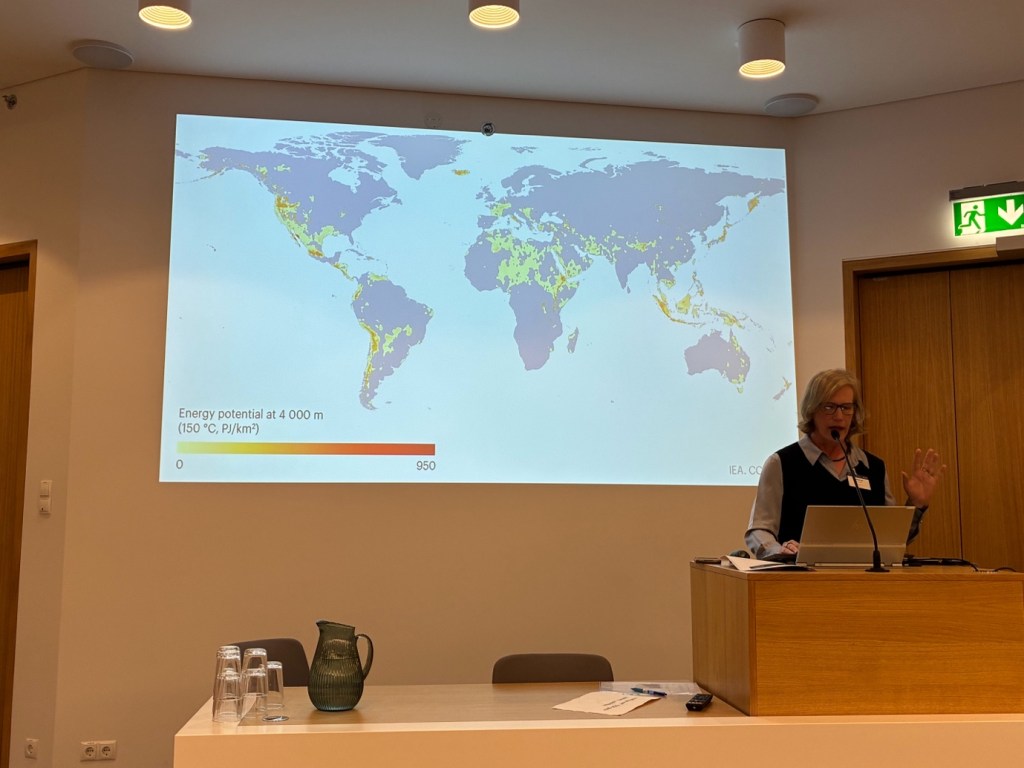
Katherine McComas (Cornell) opened with a keynote talk on risk perception and “next generation” geothermal. Conventional geothermal supplies less than 1% of global energy and is largely confined to places like Iceland or New Zealand with shallow geothermal sources, but enhanced geothermal systems (EGS) drill into hot rock at 4–7 km, where heat is almost universal. The technology is arriving faster than the acceptance research. For example Fervo’s Utah project has drilled to nearly 6 km and began delivering power to the grid this year. The heat can also be used in “district heating” systems and could help overcome dependence on fossil fuels.
The catch is induced seismicity, McComas’s specialism. Her surveys find most people know little about EGS; associations are mostly positive, but respondents also associate risks, with earthquakes top of the list. Because the technology is unfamiliar, impressions are easily destabilised, and whoever frames it first sets the template. UK respondents reached for links to “fracking”, and negative connotations, even when the survey never mentioned it. Trust, consistently, predicts acceptance.
Two things were left hanging. First, probability. An audience member asked what the actual risk of a damaging earthquake is, and the question deserves a direct answer. The 2017 Pohang earthquake in South Korea (magnitude 5.4, 82 injured, around US$290 million in damage) was found by a government commission to have been triggered by fluid injection at an EGS site 600 metres from the epicentre. Second, McComas’s own work is supported by DEEP, a European-US programme whose stated purpose is “de-risking” EGS. That is public money and legitimate research, but worth knowing when weighing a talk that leans towards acceptance. She pinned positive messages on anecdotes of an Icelandic colleagues association of earthquakes with “energy”, and mass crowd (dancing) induced seismic measurements, but these allusions lacked the robustness of her negative connotation survey results.
The key relevance for global risk, is her framing one. Nuclear winter, catastrophic grid loss and engineered pandemics are, for most citizens, as unfamiliar as deep geothermal. Suggested solutions are also unfamiliar, and people are easily misinformed about risk and resilience. The first credible framing wins, and if risk researchers do not supply it, someone else will.
Whose acceptance, whose transition?
The first plenary took the same question to wind power. Frederic Bouder (University of Stavanger) compared the Netherlands, where turbines proceeded despite debate over noise and flicker, with Norway, where opposition became a national zeitgeist once Sami communities asked what benefit they get from national grid infrastructure in their backyard. Social consensus, he argued, can no longer be assumed. Gisela Böhm (University of Bergen) found citizens’ mental models of the energy transition poorly aligned with policy (carbon capture ranks third in Dutch policy and near the bottom for the public), and Aistė Balžekienė (Kaunas University of Technology) found governance and participation deficits in the green and digital transitions across every Baltic country studied.
The roundtable focused on participation, noting that informing is not empowering, and telling people a concern is “made up” gets nowhere; engaging with the belief does. Finland’s choice of a nuclear waste site that was acceptable to its host community rather than technically optimal came up, as did Vilnius’s (Lithuania) first citizens’ assembly. This is the deliberative strand of our own governance plan, and it was good to hear it in a region where high social trust has arguably given governments an easy ride in the past.
In-built resilience
From the afternoon sessions on Day 1, we pick out four talks with wider application. Kari Mäki (Tampere University) turned resilience logic upside down: instead of hardening the whole electrical grid from the top, identify critical assets, match them with storage or backup, and build “resilience nodes” that operate normally but can island themselves and black start independently. This is the modular, decentralised design that our review of GCR resilience found to matter, and it applies directly to New Zealand’s long, thin grid that is exposed to diverse natural hazards as well as large scale risks such as solar storms and cyber-attacks, which would likely have heterogeneous impact across the nation.
Maija Nikkanen (University of Helsinki) is stress-testing Finland’s protein system against a “Disease X” pandemic scenario: collaboration across stakeholders in preparedness works only with shared understanding and trust, and views of the risk landscape diverge sharply between sectors. A talk on real estate risk and non-linear processes offered a line for all risk models: future risk is not only about shocks, it is also amplified by using poor or incomplete models of the risk.
Sigurður Emil Pálsson (University of Iceland) gave one of the most enjoyable talks. The historical Icelandic commonwealth had law and courts but no king and no enforcement, so order rested on reputation, kin and reciprocity, and resilience had to be social before it could be institutional. Traditional norms of being watchful in unfamiliar situations, using measured words that do not inflame conflict, and treating hospitality as survival infrastructure are critical lessons for any age. An eighteenth-century Icelandic household manual carries the same advice. This is evolved resilience, cultural adaptations selected and transmitted over centuries, exactly the inheritance our metacrisis paper argues modern societies are discarding without realising what they are throwing away. His practical point was that resilience protects function: what can be quickly restored is a less attractive target for disruption.
Michael Stieber (Harz University) described expectation gaps in Antarctic overwintering teams: harm comes when expectations collide with reality. We kept wondering how far this scales. If expectation gaps are a risk, governments that try “not to scare people” about catastrophe may be manufacturing exactly this kind of harmful gap between expectation of the future and future reality.
Total defence, democracy, and strategic islands
The security plenary asked whether the Nordic–Baltic turn to “total defence” could actually undermine the democratic values it exists to protect. Sara Bondesson (Lund University) listed the mechanisms: secrecy, limits on protest, blurred civil–military lines, centralised governance. Her project will work backwards from the values a society wants to hold in thirty years. Estonia, the discussion noted, is building military and civil defence together, which aligns them but may not serve resilience to non-military hazards.
Anna Moraczewska (Maria Curie-Skłodowska University) proposed Greenland and Gotland as “risk observatories” where systemic risks become visible first: climate acceleration, critical minerals extraction, military mobility, infrastructure stress. This idea has merit; it is the horizon-scanning function of anticipatory governance, which we support in the domain of global risk mitigation. But when asked why islands specifically feature as her bellwethers – her answer was that they are small and easy to study and vulnerable to early degradations. But a couple of sentinel sites is not sufficient. We need a wider array of observatories, island and otherwise, feeding a dashboard of global stress monitoring, resources, trade, energy use and availability, misinformation, political forms, and social indicators that say what they imply for society over one, ten and fifty years. A global array of information tracking where and how human systems are being tipped into systemic risk. We are monitoring atmospheric climate, we need to monitor all climates of global risk.
Grindavík and the importance of scenario planning
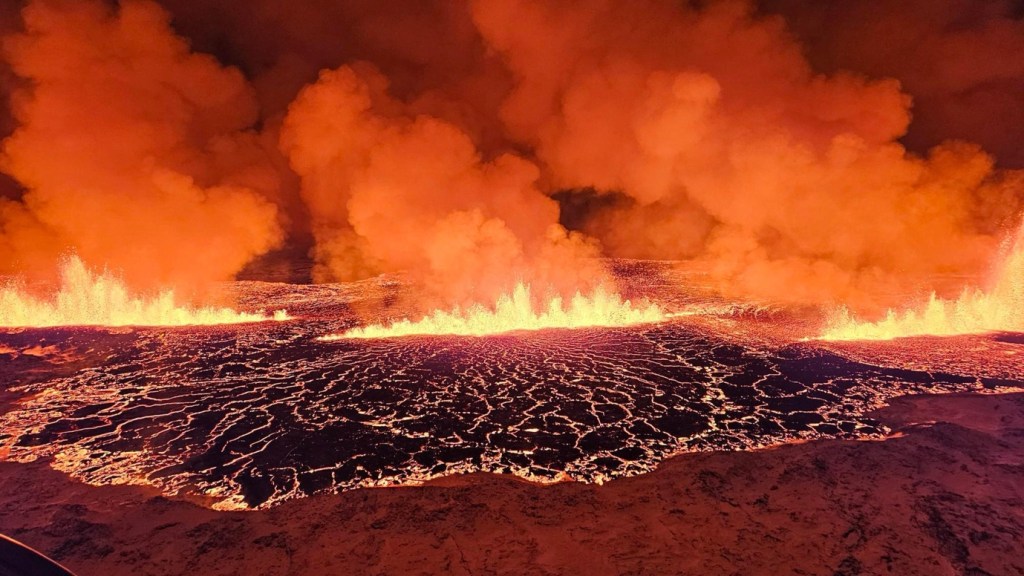
Matthias Kokorsch (University Centre of the Westfjords) gave the keynote to which New Zealanders should pay attention. In November 2023 Grindavík in Iceland, population about 3,800, was evacuated as magma moved beneath it and lava entered the town that January. The state bought out more than 90% of homes at a cost Kokorsch put at €820 million: about €2,000 per Icelander, €215,000 per Grindavík resident, and 2.6% of GDP.
The critical role of volunteers in a crisis was a recurring theme through the conference. Volunteers, released by their employers, contributed thousands of hours of support during the Grindavík crisis, and form the backbone of Iceland’s highly trained search and rescue services. Norms around volunteer obligations, training and resourcing, and release-from-work, can greatly enhance national resilience capabilities.
Two years on, a few dozen residents have returned to Grindavík, the school is being restored inside the hazard zone, but there is still no clear end state to this situation.
Evacuation is an event, Kokorsch said, but relocation is a process, and the hard questions are political, not scientific. Can a village be closed? Who decides, at what threshold, with how much public money? Icelanders disagree about whether the response was right, and disagreement is not along party lines. A house is easy to price; a community is not, and whether people see €820 million as a bailout or as reciprocity for potential future aid elsewhere shapes whether they think it was worth it. Then there is precedent. Having paid once, will the state be expected to pay again, and why should nature-driven loss of habitability trigger collective compensation when other losses, such as economic closures, stay private?
His conclusion was right. The Grindavík eruption forced a decision in a way that slow-onset change like sea level rise and recurrent flooding due to climate change never will. Every high-risk community should have a relocation plan in the drawer, built through dialogue before the crisis, so that planning preserves choices rather than predetermining abandonment. A good plan gives people more than five minutes and more than one option for leaving. Adda Þóreyjardóttir Smáradóttir (ÖRUGG) added what recovery assessments usually miss: for children the dominant harm is psychosocial, slow and cumulative, and much of it is produced by the recovery process itself.
New Zealand has its own version, in flood-prone towns after Cyclone Gabrielle and coastal communities facing managed retreat, and we have resolved none of Kokorsch’s questions. Who decides, at what threshold, and whether relocation is planned with communities or imposed on them are questions for citizen deliberation, before the next event rather than after.
Beyond immediate impacts of volcanoes and potentially severe disruptions to local communities, volcanoes also pose a global risk, with large magnitude eruptions showing statistical association with famines around the world and dynastic collapses. One of us (Nick) detailed our findings on these points in a presentation, combined with a case study from the Tambora eruption of 1815.
From hazards and events to systems and functions
The talk with the most direct lesson for national risk assessment came from Böðvar Tómasson (University of Iceland). Most national risk assessments start with events and end in a matrix, which hides the strength of knowledge behind each score, the tails, and the couplings that let one scenario cascade into another, and aims protection at infrastructures rather than the functions they serve. His alternative starts from basic needs, core values and vital societal functions, and asks what continuity of each requires. This is close to what we argued New Zealand’s National Risk Register should do, and to the vulnerability-first approach of the AGILE project presented in Cambridge and earlier this year at SRA-Alicante.
Islands as a hedge, and two roundtables
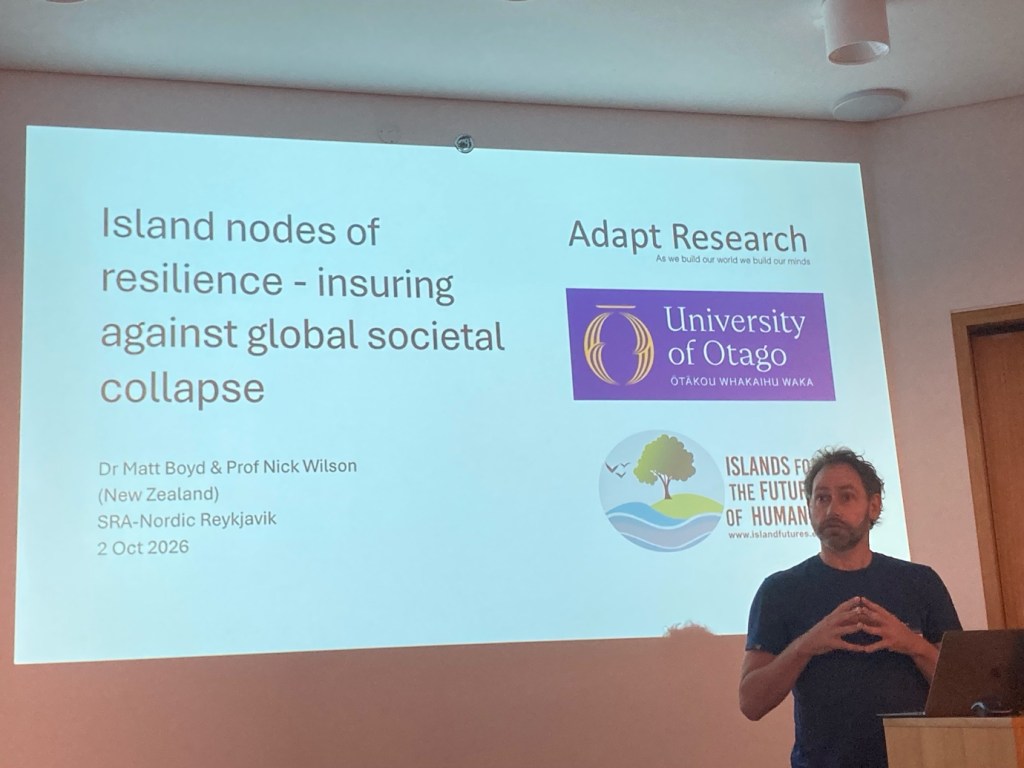
My own talk (Matt), argued that remote island nations may escape the direct impact of many global catastrophes, as the Covid-19 mortality record and volcanic- and nuclear war-cooling evidence suggest, yet remain particularly vulnerable through trade dependence. Food self-sufficiency is necessary but not sufficient when fuel, manufacturing and sectoral interdependence can drive an “ungraceful degradation” even where calories persist. Our proposal has been to prepare islands as nodes of persisting complexity, which protects their own populations and insures humanity’s ability to rebuild.
Following this talk I (Matt) took part in two panel discussions on the lessons from Grindavík as well as what small island nations like Iceland and New Zealand can do to mitigate global catastrophic risk. Key themes included the similarities between Iceland and New Zealand in terms of geology, social cohesion, remoteness and dependence on trade and international agreements. There is potential for much fruitful collaboration between Icelandic and New Zealand researchers, policymakers and practitioners on national and global risk.
Lessons for GCR, and for New Zealand
- Frame first. Unfamiliar risks are defined by whoever speaks first, trust decides acceptance, and good ideas can be pre-empted by messaging from those with vested interests. Catastrophic risk needs credible, early public framing. National risk assessments and vulnerability assessments, should not be secretive documents or processes.
- Assess functions, not events. Start national risk assessment from the societal functions that must continue, keep severe tail risk in the mix and lay out cascading impacts and couplings explicitly, mapping vulnerabilities to resilience building options.
- Put a relocation plan in the drawer. Grindavík shows that relocation is a political process with precedent effects. Plan it with communities before the hazard forces a five-minute evacuation decision.
- Build resilience into the design. Islanded grid nodes for energy and communications, and inherited social norms show that resilience already present outperforms resilience bolted on afterwards.
- Small nations can act effectively. Iceland and New Zealand are both remote, trade-dependent and hazard-exposed, but with relatively high social capital and the ability to act faster than large states. We left Reykjavík with the beginnings of a shared research agenda.

