
What New Zealand’s infrastructure community does well, and why its next widening should run beyond our shores
TLDR/Summary
- The National Lifeline Utilities Forum (Hamilton, 10–11 November 2026) showed a capable community moving from visibility to action. Asset registers, vulnerability assessments, mitigation tracking and fuel plans are maturing across sectors and regions.
- It’s never just one thing. Speaker after speaker described cascades: bridges lost at their approaches, cell sites lost to electricity failures, communities in disarray when information stops.
- A plan nobody has tested is just an assumption. The strongest talks found that plans exist but rest on untested assumptions about what other organisations will decide or provide.
- The frame still mostly stops at the coast and at short outages. In my presentation (audio and slides here), I argued that New Zealand’s largest risks arrive from offshore, last weeks, months, or longer, and may come with no outside help (Covid-19 demonstrated this).
- Food and international shipping are lifelines in all but name. Onshore stocks of diesel or fertiliser will not last; food production barely featured.
- Resilience is insurance, so someone has to decide how much to buy. That decision belongs with citizens, given a realistic picture of local hazards and the state of the world now and in the coming years.
- The next step is to plan for weeks and months, for shocks from beyond our shores, and with a public mandate.
Introduction
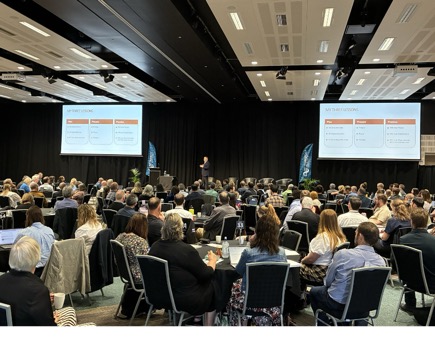
The National Lifeline Utilities Forum is the annual meeting of New Zealand’s infrastructure resilience community: utility engineers, emergency managers, regulators, scientists and councils, more than 200 of them this year at Claudelands in Hamilton. The theme was “Connected Systems, Shared Resilience”. The Emergency Management Act 2026 came into force in September, turning lifeline utilities into “essential infrastructure providers“. The government was in caretaker mode after the 7 November election. And this year’s Hormuz fuel shock had just given the system its first real test of supply resilience.
My thanks to the New Zealand Lifelines Council (NZLC), and to Co-Chair Lisa Roberts and the organising team, for a forum that is practical, collegial and open to an outsider’s challenge. I spoke in the interdependencies session, and report that talk below. My lens, as in my recent posts from SRA Nordic and the Arctic Circle Assembly, is what the forum shows about New Zealand’s readiness for global catastrophic risk, and how a community this capable could widen its frame.
Customers and communities: resilience starts with visibility
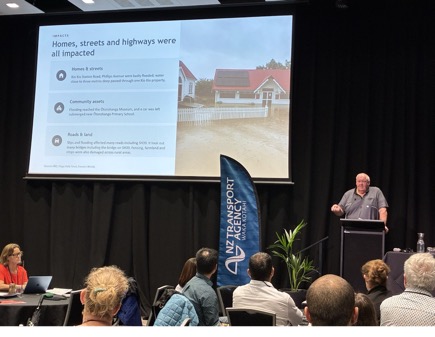
The opening remarks, quite properly for this audience, centred on outage and restoration times. The forum’s first session then widened the view to the people on the other end. Ōtorohanga Mayor Rodney Dow described declaring his first state of emergency in the February 2026 storms. Roads failed at the approaches to bridges, not the bridges themselves. People need to tell their story and be listened to. He recounted being flooded with offers of help, which needed a plan to coordinate. I would add the converse: in a large enough crisis, help will not come, and the plan needs to cover that too.
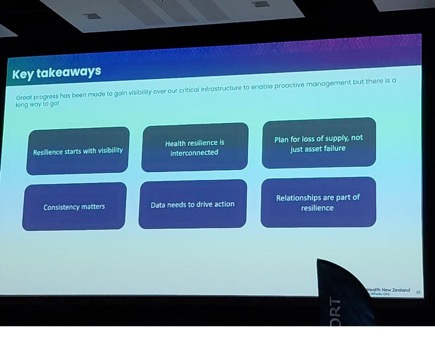
Stacey Marsh (Health NZ) described a national programme to see the health estate clearly: generator and uninterruptible power supply reviews, condition audits, contingent capacity and seismic work. Her six takeaways are also the argument I make about New Zealand as an island: the same logic should be deployed at the scale of a hospital, a sector, a region and the nation.
Kristen Pari (Te Nehenehenui) and Kyle Barnes (The Lines Company) showed marae solar shared peer to peer with kaumātua households, putting surplus generation to use rather than stranding it.
Government: duties, settings and who pays
Nic Blakeley (MBIE) gave a sensible tour of the risks: a volatile geopolitical order, supply chains strained by the Middle East conflict, cyberattacks (86 of 369 potentially nationally significant incidents last year had suspected state links), and technological disruption.
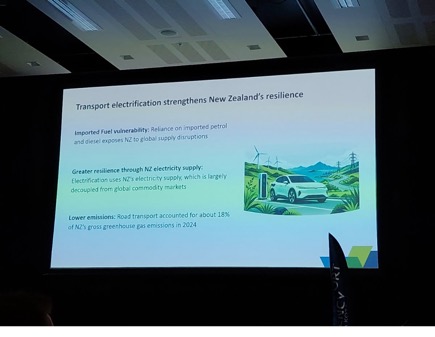
His answer included transport electrification, on the grounds that New Zealand’s electricity is largely decoupled from global markets.
That is true of generation. But the roll-out depends on copper, transformers and vehicles that are all imported and contested, and mining the materials burns diesel, as I set out in my post on AI and resource constraints. Electrification could reduce our exposure in the long run but there are serious risks, sustainability issues, and obstacles facilitating the build. All of this requires a realistic picture of the world is presented to citizens.
Jenna Rogers (NEMA) explained the new Emergency Management Act. Lifelines are now called ‘essential infrastructure providers’, with a definition that may widen to payments, data centres and groceries, with new sector response plans and assurance.
Providers must take all reasonable steps to ensure their continued functioning. The duty already reaches global catastrophic risk. But in a long global shock, continued functioning may be impossible and alternative functioning is what matters: a different, minimum service on different inputs.
UK professor Liz Varga’s principle of “resilience net gain” belongs here too: strengthening one asset must not weaken another, and each addition should raise the resilience of the whole system. This requires dialogue and collaborative resilience building.
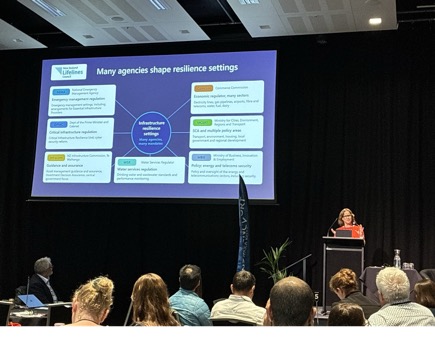
In place of the scheduled DPMC cyber talk, Lisa Roberts showed how many agencies shape resilience settings. Jeff Whitty (Te Waihanga) showed why public-sector asset management lags regulated utilities: revenue that does not come from users, mixed autonomy, limited transparency and few consequences when practice lags. The problem is incentives, not competence. Commerce Commission Chair John Small framed resilience as insurance, and coverage needs to be chosen with the customers who pay for it.
Beyond local hazards: my talk
My talk (audio; slides) began at Þingvellir in 1262, when Iceland’s chieftains swore allegiance to a Norwegian king in exchange for six ships a year. The ships came less often over time, and when Laki erupted in 1783 Icelanders starved waiting for them.
New Zealand has its own six ships, carrying diesel, fertiliser, seed, medicines, spare parts and data, and nobody has promised them to us. Most critical infrastructure thinking stops at the border, but our largest risks emerge offshore and cascade through tightly coupled global systems: nuclear war, severe pandemics, major eruptions, continent-scale cyber or grid failure, trade collapse.
Hormuz was the dress rehearsal. Last week’s Microsoft outages the matinee. Our No Place to Hide review of resilience to global catastrophic risks finds that past a point, connection stops being resilience and becomes fragility, and that New Zealand is one of very few places well placed to ride out a global catastrophe, but only if it prepares.
Diesel illustrates this point. The headline in March 2026 was “46 days” – meaning the amount of diesel available to New Zealand if further imports cease. In a paper under review, Mike Hodgkinson and I recalculated from the government’s own Fuel Security Study: at the lowest point in its data, only about eight days of diesel could be drawn without outages. Spread across a broad reading of the official priority bands, that lasts under 13 days.
Our NZCat report found that about 4,500 hectares of canola could be used to produce biodiesel to fuel the farming needed to feed the country with wheat: Plan B can be quantified in terms of liquid fuel, food, and other necessities.
In my presentation I made three asks:
- Widen the National Vulnerability Assessment to dependencies beyond our borders and to the material inputs of basic needs, including food.
- Plan around consequences, not hazards, counting stocks in drawable litres and days of supply, and agreeing in advance who gets what.
- Publish a national risk register with scenarios and likelihoods, mapped to consequences, then seek a public mandate for the Plan B mitigation options through citizens’ assemblies, as DPMC’s hazards Long-term Insights Briefing has endorsed.
The sector coordinating chairs’ panel followed. The telecoms chair asked central government to imagine life without our digital connections, noting that Starlink is offshore and unregulated and that two of our subsea cables land either side of a volcano.
Electricity reported procurement times of 7 to 12 years for large transmission cables. Water noted that a fifth of the population supplies its own water.
On AI, one chair said cyber threats keep him awake at night; another worried only about an economic bubble.
The NZLC also discussed the 2026 update of the National Vulnerability Assessment, and several good points were made. I would like to see its gaps red-teamed, especially the dependencies beyond our borders, and under the assumption that no outside help is available.
Science to practice
James Palmer (Earth Sciences NZ) kindly called my talk “a call to arms”. His examples were illuminating. Forestry slash formed “beaver dams” at bridges causing flooding in areas nobody had mapped as flood zones. The lesson is to ask what have you missed?
When the cell towers went down and nobody had a transistor radio, communities started to unravel, analogue communications and coordination are needed.
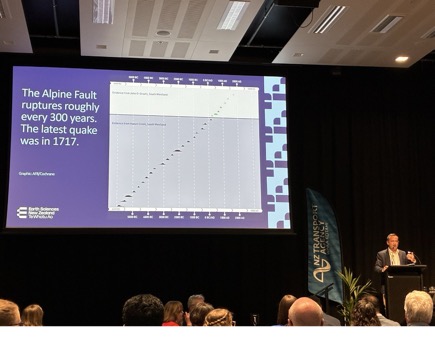
His chart of the Alpine Fault’s rupture record, roughly every 300 years and last in 1717, shows why a 75% chance of a major quake in the next 50 years is a planning assumption, not a forecast to debate. War, pandemics and societal breakdown have their own rhythms too, which is why I argued in my last post for monitoring the global “currents” as carefully as we monitor faults.
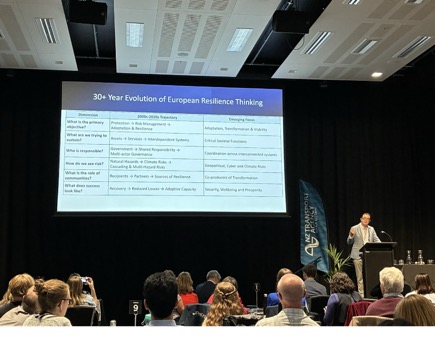
Iain White (University of Waikato) traced trends in 30 years of European resilience thinking: from protecting assets to sustaining critical societal functions, from natural hazards to geopolitical, cyber and cascading risks, and from communities as recipients to co-producers.
That is the trajectory I have reported from the European Urban Resilience Forum and SRA Europe. His word for it was evolution, and it is apt: our metacrisis work argues that good practice spreads only when the conditions for it to arise, spread and hold are in place.
Jo Horrocks (Natural Hazards Commission) made the same point from the funder’s side. Excellent science often fails to land, so start from the political decisions that will be consequential and work back, what information is needed to make those decisions? There’s your research project.
And do not leave uptake to chance: build demand, remove barriers, shape the conditions for action.
Talosaga Talosaga (Te Waihanga) used average annual loss to show how flood risk differs across the Waikato and changes over 50 years, a method that deserves use across all risks.
Liam Wotherspoon’s tour of the Natural Hazards and Resilience Platform was impressive, but hazards originating beyond our borders, such as a major volcanic eruption overseas, are not yet in scope, and could be global climate altering, or impact trade, supply, and global communications.
Climate, communities and recovery
Malcolm Johns (Genesis) urged preparing people for the unknown, not plans for every scenario. Karen Lavin (Climate Change Commission) put the forum’s refrain best: it’s never just one thing. Her sharper point was that adaptation is not keeping pace: we are acting, but more slowly than risk grows. Ian Sutton (One NZ) noted that 70% of cell-site outages are power outages, rising to 90% in severe weather, and that who mitigates them is contested between sectors.
We need cooperation not infighting, and cooperation needs to be incentivised by and for the benefit of all citizens.
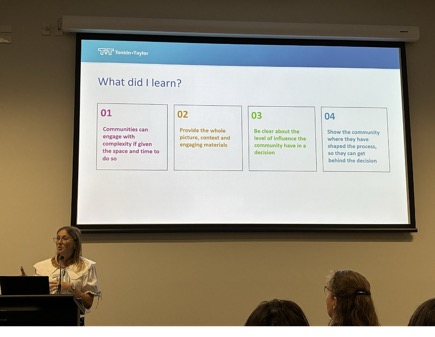
In the community session, Richard Ball (Emergency Management Canterbury) presented a tool for rating recovery severity. Morgan Waugh (Tonkin + Taylor) argued that data doesn’t make decisions; people do. Risk judgements rest on values and experience, community knowledge is evidence, and communities can engage with complexity if given space, time and the whole picture.
Richard Woods (WSP) described how a small iwi (Ngai Tai), recently settled with the Crown, uses intergenerational knowledge of the seasons to read change, with kai sovereignty central to their planning.
The concurrent technical session covered seismic standards, transmission hazards and Chorus’s work on assured fuel supply.
From strategy to action
The closing session contained what I considered the Forum’s most important talk. Danielle O’Shaughnessy (Waikato Lifeline Utilities Group) described turning a regional vulnerability assessment into 346 tracked mitigation projects, then asking the harder question: how prepared are we to respond together if critical infrastructure is disrupted for weeks to months? This framing steps towards the kind of global catastrophe mitigation New Zealand needs.
Organisations were confident about short internal responses, but relied on informal arrangements and on assumptions about what others would provide. Plans exist, but they have not been tested, and they remain organisation-centric. That matches what we found in NZCat, and the cross-silo lessons I brought back from the European Urban Resilience Forum in Rotterdam last year.
Top Energy described how Cyclone Gabrielle exposed a 56-page plan too unwieldy to use, replaced by one response hub and role cards that turn plans into actions.
I’m based in Reefton in the South Island, so I was particularly interested as Paul Gurney (West Coast Lifelines Group) described a fuel programme born of three mobile generators: an Alpine Fault rupture will cut all four roads into the region, so the fuel on hand is all there will be. The group has pre-positioned tanks, generator connections at service stations, emergency pumps and live tests, working through quirks of normal functioning such as the internet-dependence of petrol pumps. That is the right instinct. The next questions are how long that fuel lasts in practice, who gets how much, what happens to the farms and food production, and whether port upgrades at Westport could let the region accept tanker deliveries.
What was missing
The forum’s own lessons point beyond its current frame. “Plan for loss of supply, not just asset failure” and “weeks to months” lead directly to shocks from offshore, where nothing is damaged here but the inputs stop coming. Hazards beyond our borders were largely absent from the programme, apart from my talk and posters on space weather. So was Plan B: most discussion was of restoring normal service, not of running a reduced, different, survival level service for months.
Food was the clearest omission. The attendee list included supermarket and fuel companies, but I could find no one from food production, fertiliser or the Ministry for Primary Industries (MPI), and food has no sector coordinating chair. In a long global shock, high-yield land, seed, fertiliser, diesel and processing are critical infrastructure. Iceland is counting its emergency stocks of food, feed and fuel. We should be too and developing plans to pivot an export industry to the local market at the drop of a hat.
New Zealand needs a national food security strategy. And in the near future our ‘Reality of Food’ working group will be delivering a food security briefing to the incoming government that makes this case in detail.
Next comes resourcing and responsibility. Many speakers asked who pays, and how much resilience is enough. Providers bear the cost of resilience to rare global shocks now, others get the benefit later, and citizens carry the consequences if it fails. Revealed preference and cost-effectiveness cannot settle that. It is a values question, and it needs a public mandate.
Two-thirds of New Zealanders want government to plan for global catastrophe. Deliberative processes such as citizens’ assemblies, which I reported from Finland and Lithuania, let a representative group weigh the options and agree priorities. But they work only if citizens are given a realistic picture: local hazards like the Alpine Fault, and the state of the world, with its fragile supply chains, resource constraints and rising conflict.
Waugh’s lessons apply directly and our charity, Islands for the Future of Humanity, are actively seeking funding for a pilot community assembly on local resilience in Reefton, to develop an approach to this deliberation that would suit any region.
Lessons for New Zealand
- Widen the frame beyond our shores. The National Vulnerability Assessment should be red-teamed against global dependencies and the assumption that no outside help arrives.
- Plan for weeks and months, and for alternative functioning. Under the new Act, “continued functioning” should include a minimum Plan B service on different inputs and survival functions.
- Count our stocks in usable terms. Report diesel and other critical inputs as drawable supply against essential demand, quantify the need, and agree allocation in advance.
- Treat food as infrastructure. Bring food production, fertiliser and MPI into the lifelines system, with a sector coordinator. Our food is a lifeline for the world too, collaborate with regional neighbours.
- Decide how much resilience to buy with citizens. Give them a realistic picture of local hazards and the world, then let deliberation set priorities and scale.
Closing
I left Hamilton encouraged by how much good, practical work is happening, and by how warmly a room of engineers, emergency managers, and policymakers, received a talk about ships, wars and canola. The forum’s own lessons already point outward; the next step is to follow them.
Acknowledgment
Many thanks to the Recoverable Foundation and Biome Trust for their philanthropic support of Islands for the Future of Humanity, enabling participation at this Conference.


