
By Matt Boyd & Nick Wilson
TLDR/Summary
- A new Lancet Commission Report quantifies the amendable health loss from 17 threats according to potential prevention policy spanning 2025 to 2100.
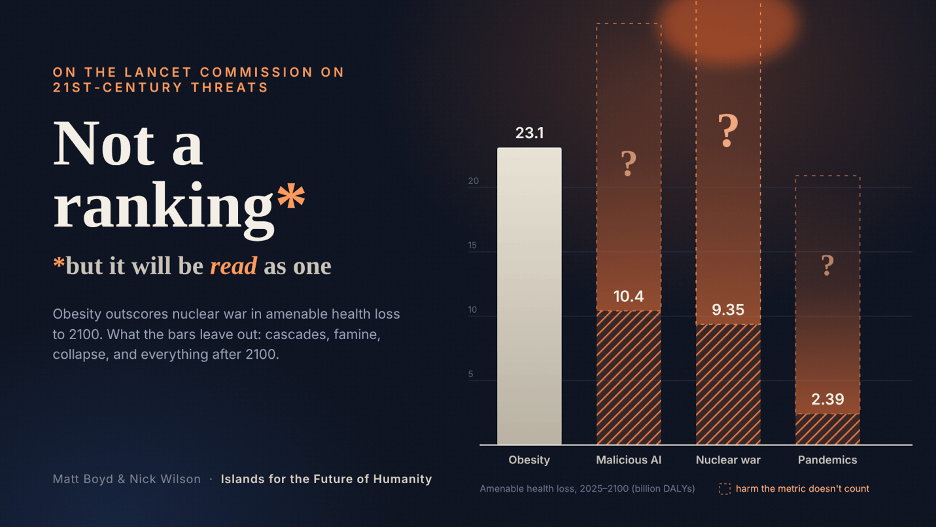
- Obesity (with amenable health loss of 23.1 billion DALYs) beats nuclear war (9.35 billion), which ties with poor mental health. The authors say it is not a ranking, but it will be read as one.
- The figures for nuclear war and malicious use of AI rest on subjective forecasts, yet sit on the same chart as estimates built from decades of data on threats such as obesity and smoking.
- The metric is health only. Obesity does not destroy ports, power grids or trade, or harm the biosphere. Nuclear war would, and that harm would extend far beyond the blast zone to potentially the whole planet and beyond 2100.
- Harms from pandemics, AI and nuclear war are all probably larger than the Commission suggests. Famine is barely treated as a health threat. Major volcanic eruptions (eg, Tambora in 1815 which caused famines) and solar storms are dismissed or missing.
- Every scenario assumes business-as-usual to 2100. Yet if we take models such as Limits to Growth even slightly seriously, the next few decades look very different.
- The Commission appropriately recommends threat-ready health systems, breakthrough innovation, and an annual Monitor of threats. But we also recommend that future Monitor reports show the strength of knowledge behind each estimate, report catastrophes’ probability and consequence separately from the other threats, stress-test failures of trade and energy, and add monetised harm.
Health research is mostly the study of disease: what makes people sick, and how to prevent and treat it. Our recent work sits elsewhere, in global catastrophic risk: nuclear war, extreme pandemics, volcanic winters, solar storms and artificial intelligence (AI). These could disrupt civilisation itself. The two fields rarely meet. The new Lancet Commission on 21st century global threats to health is innovative because it brings them together. It puts nuclear war and what it calls “malicious use of AI” on the same scale as obesity and smoking related harm. But the way it compares these very different risks could easily be misread, with consequences the authors clearly do not intend.
What the Lancet Commission did
The Commission, led by Christopher Murray (IHME) and Natalia Kanem (UNFPA), published its major Report in October 2026. It defines a “threat” broadly, as among the largest causes of future health loss that policy can change, so slowly developing harms like obesity count, not just sudden shocks.
For each threat it builds a plausible worst and a plausible best future, usually anchored in real experience. The worst case typically assumes a country follows the worst trajectory actually seen since 1990 among countries at a similar level of income and development. The best case assumes it follows the best. The gap between the two, summed from 2025 to 2100 and measured in disability-adjusted life years (DALYs), is the “amenable” burden: the health loss that policy could plausibly avert.
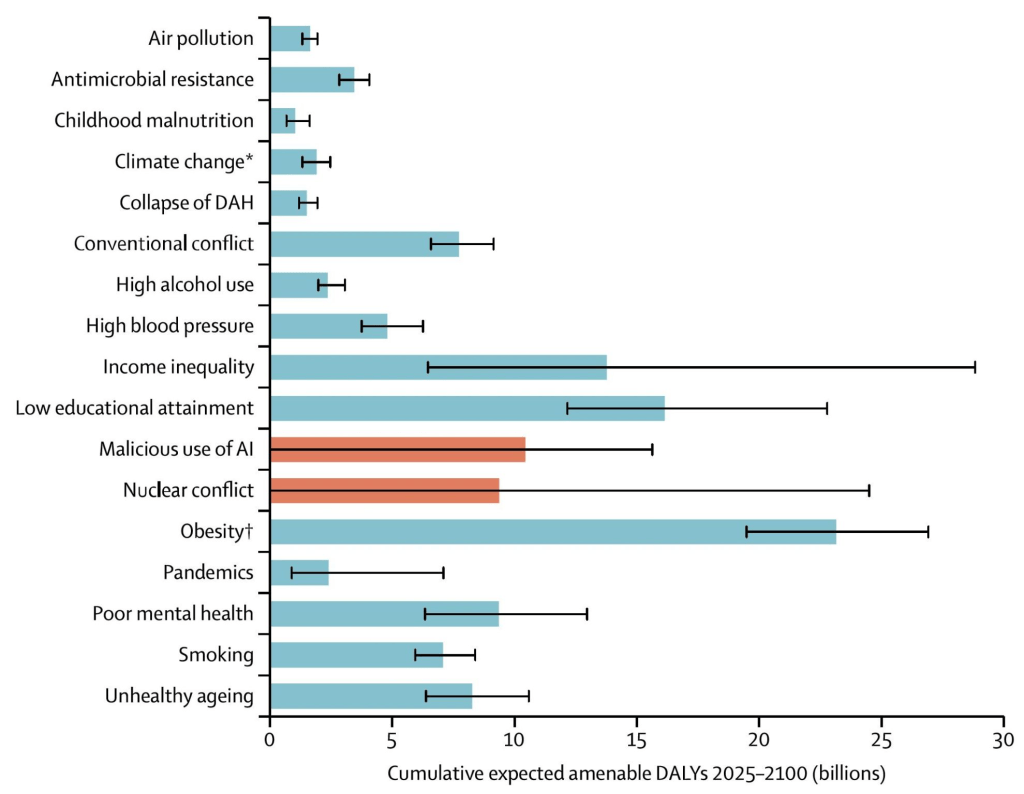
The headline results, in billions of amenable DALYs:
- Obesity (high BMI, poor diet, low physical activity): 23.1
- Low educational attainment: 16.1
- Income inequality: 13.8
- Malicious use of AI (including AI-enabled bioweapons, infrastructure failures and loss of control): 10.4
- Nuclear war with nuclear famine: 9.35
- Poor mental health: 9.35
- Conventional conflict: 7.71
- Pandemics: 2.39
- Climate change: 1.89
For scale, Covid-19 caused about 0.5 billion DALYs. The Commission appropriately recommends threat-ready health systems, breakthrough innovation, and an annual Monitor of threats reporting to the G20 group of countries.
What it gets right
The Report puts catastrophic risk on the global health agenda and names “short-termism and localism” as obstacles to good risk governance. It is candid about its limits, and the Monitor is a sensible answer to cycles of panic and neglect.
Its cross-cutting “enablers” also overlap strongly with our own recent review of seven catastrophic risks, No place to hide? (Jehn et al, 2026):
- Shared: good governance, reduce inequality, resilient food systems.
- Only in the Commission: trust, health-system financing, universal health coverage, human rights.
- Only in No place to hide: decentralisation and self-sufficiency (in energy, food and trade), and geographic isolation.
The missing factors in the Commission’s work are those that matter when global supply chains fail.
Comparing obesity with nuclear war: a risk-analysis problem
The authors stress that their summary bar chart “is not a ranking of policy priority”. But the axis displaying level of harm invites such ranking, and busy decision-makers will see bars, not caveats.
However, potential problems arise through method. Each threat is scored by expected value (probability multiplied by harm). That works for chronic disease, but for rare catastrophes it hides most of what matters.
The numbers are built differently. The estimates for nuclear war and malicious use of AI have no well-established statistical model behind them (in contrast to obesity etc). They come from a 2022 forecasting tournament, in which superforecasters and domain experts gave probabilities of global catastrophe and extinction by 2100. The nuclear worst case takes the 95th percentile of those forecasts. The AI worst case uses a different rule (the median plus three median absolute deviations). Both set the best case to zero. The uncertainty intervals for both run from zero upwards.
Strength of knowledge is largely invisible. Contemporary risk science describes risk as consequences plus uncertainty. Uncertainty includes how much we really know. Obesity’s estimate rests on data from 204 countries. Nuclear war’s rests on forecasters’ judgements about 2100, a horizon over which super-forecasting has never been tested. The chart presents both bars side-by-side (albeit they are colour coded and have error bars but these features might not be readily appreciated).
Tail risk is averaged away. The Commission considered giving extra weight to catastrophic outcomes and rejected it. It also rejected reporting probability and consequence separately, because users “might struggle” with two dimensions. That may underrate decision-makers and their officials. Insurers, engineers and defence planners treat rare, irreversible catastrophes differently, because they cascade and destroy the capacity to respond and recover.
Threat size is not urgency. The reverse also holds. A threat with a smaller burden can deserve urgent action if there are simple, obvious things to do now. Many equity, access and pricing problems (such as unaffordable but low-cost essential medicines, or tobacco and alcohol that are under-regulated) are easy to fix with tools we already have. Priority needs tractability, cost and timing, not just size.
Health is not the same as harm
The Commission measures health only: not wellbeing, future generations beyond 2100, economic loss, infrastructure damage, or harm to the biosphere. That is fair for a health report, but it tilts comparisons between threats.
Obesity does not sink ships, burn ports or bring down power grids. Nuclear war, severe solar storms and AI-enabled cyberattacks can. Those losses cause uncounted health harm: if trade in medicines collapses, people with heart disease or diabetes die far from any blast. Each threat is modelled alone, so these cascades never enter the numbers.
A companion comment by Stephen Morrison (CSIS) worries that the Report will struggle to reach finance ministers and heads of state. Our own recent work in progress suggests that harm, not just health, is the lens they need. In a comparative risk assessment for Australia (Graham et al, 2026)*, we put fatalities, asset losses and lost economic output into a single monetary measure. On that basis, AI catastrophe (AU$ 7.8 billion a year) and pandemics (AU$ 7.3 billion) each roughly matched all of Australia’s cyclones, bushfires and floods combined. In the worst 1% of years, catastrophic risks dominated: AU$ 5.8 trillion for AI and 1.6 trillion for nuclear war, against 118 billion for the worst traditional hazard.
Just as disease is not all of health, health is not all of potential human harm. A health-only lens misses the societal perspective, and risks steering resources towards what is easiest to count. An “amenable DALY” is also an “amenable financial harm”, and the Monitor will report to a G20 finance task force.
DALYs also only count harm to people who exist. About half of the amenable burden for low education comes from fewer births, not healthier lives. As another companion Review notes, minimising DALYs “favours an empty future”. Such a metric cannot weigh human survival.
Blind spots
Pandemics may be much worse. The Commission extrapolates 400 years of pandemic history, with pandemic size held fixed. Forward-looking work by Madhav et al estimates a 2–3% annual chance of a Covid-scale pandemic, and 2.5 million deaths a year on average from respiratory pandemics alone. They call that a lower bound. Yet engineered pandemics and bioterrorism appear only inside the Commission’s malicious-use-of-AI estimate.
AI harms may also be larger, and broader. Despite its name, the Commission’s “malicious use of AI” covers three pathways: AI-designed bioweapons, failures of or attacks on AI-dependent infrastructure, and loss of control of advanced AI. But only two extreme outcomes are counted: catastrophe (at least 10% of humanity dies) and extinction, using forecasts made in 2022, before recent rapid gains in capability. Lesser but still huge potential harms, such as cyberattacks on health systems or mass economic disruption with a rise in inequality, are not counted. The authors concede that treating loss of control as amenable to policy may exaggerate their estimate. On balance, we think the omissions matter more.
Nuclear war is a cascade, not a casualty count. Physical modelling by Xia et al (2022) suggests a large US–Russia war could kill over 5 billion people through nuclear winter induced famine, assuming food trade stops. The Commission suggests resilient foods as a partial remedy. That could help survivors outside the attacked areas, but mitigation also has to cover trade, fuel, fertiliser, electricity and medicines. The nuclear figure counts deaths in forecasters’ broad outcome categories, but none of the knock-on effects on other threats, so it too probably understates the harm. Some of these arguments also apply to the Commission’s conventional conflict category – given how such conflict can cascade into multiple other problems (eg, disruptions to basic services in Ukraine and malnutrition in Gaza).
Famine barely counts as a health threat. The climate analysis includes heat stress deaths (its largest pathway), air pollution, floods, storms, malaria and dengue. Crop failure enters only indirectly. Drought, migration and famine are excluded, because “famine is a sociopolitical phenomenon”. Famine is not a threat in its own right anywhere in the Report: childhood malnutrition is chronic undernutrition, and famine appears only after nuclear war.
Yet famine is amenable to policy whatever its cause. Our new analysis of 38 major volcanic eruptions (preprint pending) reveals that famine rates have historically risen by about 60–70% after them, with more famine after bigger eruptions. Eruptions act together with weak reserves, inadequate relief efforts, conflict and trade restrictions, which are exactly what policy can change.
Volcanoes and the sun. The Commission dismisses supervolcanoes as too rare to mitigate. But Cassidy and Mani (2022) estimate a one-in-six chance of at least a Tambora-scale eruption this century, and the same resilient foods that would help after nuclear war would help after a volcanic winter. Severe solar storms are not mentioned at all.
Business-as-usual to 2100?
The Commission’s biggest assumption goes unstated: that the world carries on. Because “plausible” is defined by what countries have experienced since 1990, the method cannot produce a discontinuity. Growth, energy, trade and medicine supply all continue, and life expectancy rises every year to 2100.
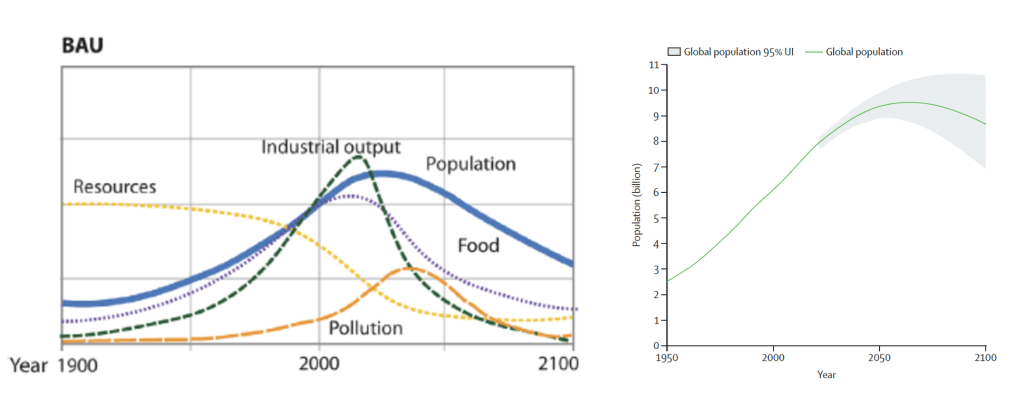
The seminal Limits to Growth (Meadows et al, 1972) suggested otherwise. Recent comparisons with real data by Herrington (2021) and Nebel et al (2023) found the world tracking its business-as-usual run, with a turning point around 2024–2030 and sharp declines in energy availability, material production and life expectancy.
The Lancet’s global population model (below right) peaks at about 9 billion mid-century and pulls back to 8 billion by 2100. The Limits to Growth model (below left) peaks today, and halves by 2100. Such scenarios and assumptions make a big difference to health priorities.
If resource limits, trade disruption or a major shock arrive in the next few decades, health priorities likely change dramatically. Medicine and vaccine supply chains, food security, primary care, infection control and local manufacturing all move up the priority list. Catastrophe preparedness pays dividends twice, buffering slower decline too.
There is an additional argument we are sceptical of, for an AI-fuelled techno-utopia which inverses the limits to growth trajectories. This scenario would likewise reframe the Commission’s model, in substantially different ways.
Where the Commission meets the Global Catastrophic Risks and Effective Altruism worlds
Comparing very different causes on an amendable health loss scale is not new. Health economists do it (eg, Pharmac, and New Zealand’s BODE3 programme), and so does Effective Altruism (EA).
EA asks how to do the most good with limited resources, and its organisations (eg, GiveWell, Open Philanthropy and 80,000 Hours) rank causes on three factors:
- Importance: how much harm the problem causes or could cause;
- Tractability: how much progress extra effort would buy;
- Neglectedness: how few resources already go to it.
EA’s priorities are global health and development, animal welfare, and catastrophic risks. 80,000 Hours currently puts AI, engineered pandemics and great power conflict (including nuclear war) near the top.
The Commission measures mainly importance. Its “amenable” gap is a rough proxy for tractability, but without costs. It uses neglectedness only informally: heart disease and some cancers were left off the list because they are already well funded.
Who is getting it off course? Probably both, in opposite directions.
- The Commission likely underestimates catastrophic risk. It ignores future generations (beyond 2100), non-health harm and cascades, harm to the biosphere and other living beings, and averages away the tail.
- EA likely underweights the vast, slow burdens the Commission highlights: obesity, low education, inequality and mental health. EAs would say these are not neglected or tractable priorities per dollar, which is now testable.
- Both largely assume business-as-usual, with AI as the only major source of discontinuity and a major uncertainty at that.
The two world views already overlap: the Commission’s companion Review draws on population ethics and was part-funded by Open Philanthropy. Yet we could find no discussion of the Report on the EA Forum by 1 Nov 2026. We think practice communities such as EA and catastrophic-risk researchers should formally engage with it.
Conclusions: how to read the Commission’s Report
The Commission’s work is serious, ambitious and welcome. Our worry is that reports travel without their caveats. If it is read as “obesity is a bigger threat than nuclear war”, it could pull attention away from the catastrophic risks that probably matter most in the coming decades.
The Commission’s work is an estimate of the health loss that policy could avert by 2100, in a world that carries on roughly as it has since 1990. It is grounded in data for chronic threats and in judgement for nuclear war and AI.
But it is not a ranking of priorities across all these threats or a guide to the cost-effectiveness of threat reduction. Nor is it a measure of economic, social or harm to the biosphere, or of harm to future generations, and it does not test for collapse or cascades.
Future Monitor reports could show the strength of knowledge behind each estimate, report catastrophes’ probability and consequence separately from the other threats (like obesity), stress-test failures of trade and energy, and add monetised harm. There are real risk-science lessons here for everyone.
* The linked preprint is an old version that does not yet include the AI results, we can share the latest version with anyone interested.
Learn more about our work, or donate to support further analysis, at Islands for the Future of Humanity.

