Observing currents of global catastrophe: AMOC, deep uncertainty and what New Zealand should be monitoring

Lessons for global catastrophic risk from the Arctic Circle Assembly 2026, beyond AI
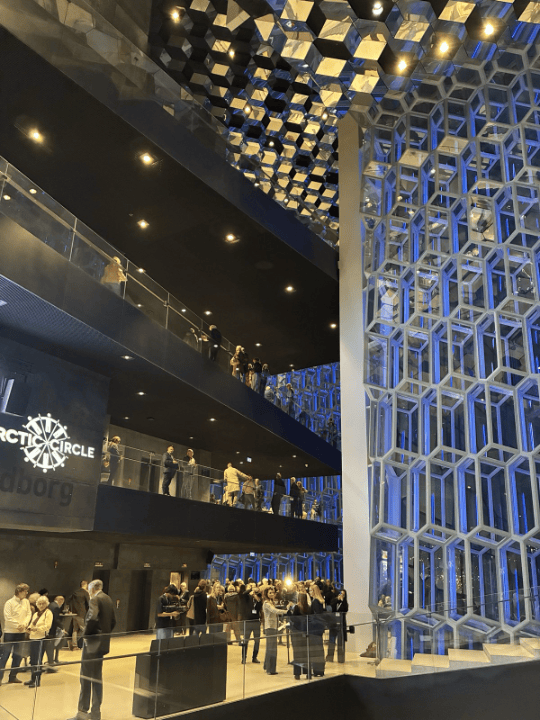
Figure 1. Harpa, Reykjavík, home of the Arctic Circle Assembly (Matt Boyd, October 2026).

TLDR/Summary

  • The Arctic Circle Assembly (Reykjavík, Iceland, 8–10 October 2026) showed a region no longer insulated from the world. Nuclear risk, energy shocks after Hormuz, great-power posturing and Greenland were all on stage; New Zealand is not insulated either.
  • Read my companion blog reporting on AI risk as discussed at the Assembly. With my own inferences about domination, utopia vs dystopia, and the possibility of societal collapse.
  • The Atlantic Meridional Overturning Circulation (AMOC) was the Assembly’s clearest case of a catastrophic risk under deep uncertainty. The science cannot say when or whether it will tip, but every new line of evidence moves the risk the same way.
  • AMOC is not only a current. Sea ice, ice algae, copepods and fish stocks are changing now, with consequences for carbon storage and for human food.
  • Science is doing its job; decision-making under deep uncertainty is policy’s job. Policymakers waiting for certainty are applying the wrong test. No-regrets actions in food, fuel and preparedness pay off whatever the ocean does.
  • Iceland shows how a risk reaches the agenda. A scientists’ letter, a ministerial report, the National Security Council, and well-crafted op-eds that offered a minister the chance to lead.
  • Every system New Zealand depends on is a current that can tip. Geopolitics, supply chains, resources and social cohesion need the same continuous monitoring, long-term funding and Plan B that AMOC is getting.
  • Iceland is counting its stocks; New Zealand should too. Iceland’s reports on fuel, feed and food reserves are the model, and its own history shows what happens to an island that cannot secure its shipping.

Introduction

The Arctic Circle Assembly fills Reykjavík’s Harpa concert hall each October with hundreds of sessions. I sampled perhaps 5%: a Wednesday pre-event “Connected Ocean Observing: ARIA x Reykjavík Institute”, run by the UK’s Advanced Research and Invention Agency (ARIA) with the Reykjavík Institute, and the first two of three days, chosen through a global catastrophic risk lens.

This post is therefore partial. My companion post covers the AI sessions, including Tristan Harris’s plenary, the best session I attended. My thanks to Arctic Circle and its founder, former President Ólafur Ragnar Grímsson, for an event where anyone may ask a question. Here I survey the geopolitics and infrastructure sessions, then use AMOC as the main case. The test throughout is the one I applied at SRA Nordic last week: what lessons transfer to global catastrophic risk, and what should New Zealand learn?

The geopolitical weather

The day one plenary set the tone. Canada’s Foreign Minister Anita Anand spoke of sovereignty, respect for Arctic peoples, security, economy, and environment, and cited Prime Minister Mark Carney’s Davos case for “value-based realism”: with the threat environment changed, collaboration among like-minded states is now a necessity. That fits our view that cooperation on catastrophic risk evolves most readily at the regional level, since individual jurisdictions can’t manage cross-border risks alone. Greenland’s representatives set out their view of sovereignty and way of life in the face of US pressure. “Nothing about Greenland without Greenland.”

The US session, with the Governor of Alaska and the Chair of the US Arctic Research Commission, was about hard assets: ports, shipping lanes, icebreakers and missile defence, and partners to help pay for them. Some of the language was painful and misguided. More telling was the omission. Neither speaker mentioned climate change until asked by a member of the audience, and the answers deflected.
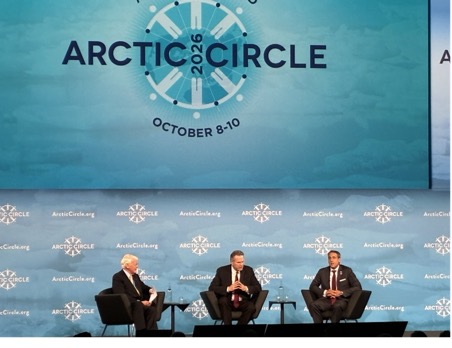
Figure 2. Former President Ólafur Ragnar Grímsson (left) questions the Governor of Alaska and the Chair of the US Arctic Research Commission (Matt Boyd, 8 October 2026).

“Can the Arctic stay calm while the world burns?” took the cascading view and applied it to any far-flung region of the world. Lassi Heininen, a long-time scholar of Arctic politics, recalled that Reagan and Gorbachev met in Reykjavík 40 years ago this month and nearly agreed to abolish nuclear weapons.

Today no arms control treaty or serious negotiation is current, and with the stresses of climate change added, he is “bloody worried” about the risk of nuclear war. Francesco Sassi, a Norway-based energy analyst argued that security must now include energy security: after Hormuz, and a possible US export ban, Arctic oil and gas production could rise and new alliances form. Others traced Russia–China cooperation on pipelines, shipping and coast guard patrols.

The verdict was that the Arctic cannot be insulated from these shocks. Neither can New Zealand. Prices are not coming down, and politicians need a realist view, and to communicate expectations with society. Unfortunately the audience questions stayed with energy, not nuclear spillover, which is where the catastrophic tail sits.
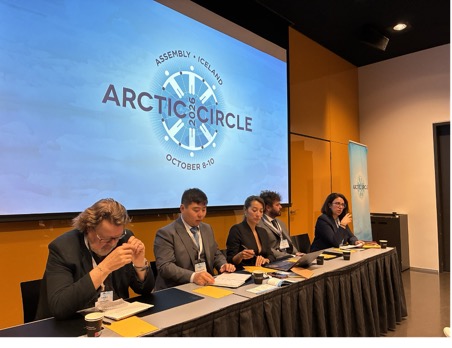
Figure 3. “Can the Arctic stay calm while the world burns?” (Matt Boyd, 9 October 2026).

Infrastructure that serves two purposes

The session I would most like New Zealand’s regional councils to have seen was on dual-use infrastructure in Iceland’s West Fjords, a remote, sparsely populated region much like the West Coast where I live. Moderator Gylfi Ólafsson described how the community, as the security picture darkened, developed a shared vocabulary and a report to Parliament that prioritised local investments by cost, feasibility and dual use; search and rescue, roadside mobile coverage and fibre came out on top. But other investments in maritime upgrades, radar stations, submarine cable security, and a relocated airport are all topical. Brynja Huld Óskarsdóttir argued that dual-use infrastructure is the fastest route to defence resilience: it keeps people living there, and presence is both deterrence and capability. Patti Bruns (Arctic Mayors’ Forum) and Peter Clarkson (Mayor of Inuvik) agreed: there is no Arctic security without healthy Arctic communities.
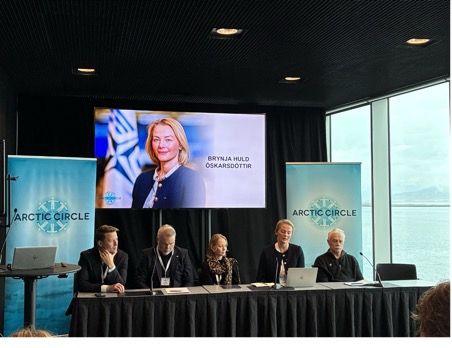
Figure 4. Dual-use infrastructure in the West Fjords (Matt Boyd, 9 October 2026).

What was missing was food and liquid fuel, the two inputs that decide whether a remote community functions in a crisis. But the community process deserves as much attention as the list. New Zealand could take this approach independently, adopting NATO-style baseline resilience requirements without NATO, and building priorities through local citizen deliberation of the kind our charity Islands for the Future of Humanity are proposing to pilot in Reefton, NZ.

AMOC: what science can and cannot say

The Atlantic Meridional Overturning Circulation (AMOC) carries warm water north and is a large part of why north-west Europe and Iceland are so mild for their latitude. A sharp weakening would cool the North Atlantic even as the world warms, affecting weather, sea level, fisheries and agriculture across the hemisphere.

ARIA’s pre-event was the most candid account of uncertainty I heard all week. ARIA’s Forecasting Tipping Points programme (£114 million, led by Sarah Bohndiek and Gemma Bale) aims to build an early-warning system for the North Atlantic, combining established observing arrays with cheaper autonomous instruments and new models, and is now moving to its second phase.

Dr Graeme MacGilchrist (University of St Andrews) organised the science into four questions. Can AMOC collapse? Yes, in models, but rates and mechanisms are unclear. Has it? Evidence for past collapses is ambiguous. Is it changing now? The instrumental record is about 20 years, too short to say. Will it? Persistent model biases affect how sensitive the system is to forcing. Early warning, he said, is elegant theory that is not yet validated, and today’s observing system is a collection of projects with precarious funding.
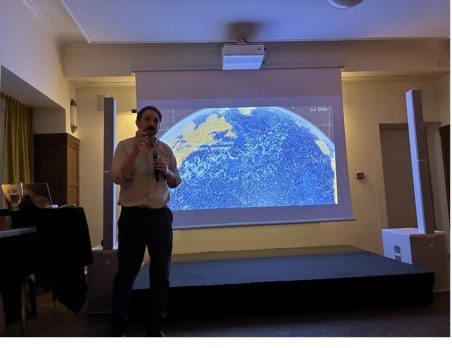
Figure 5. Graeme MacGilchrist on the ocean as a turbulent, chaotic fluid at “Connected Ocean Observing: ARIA x Reykjavík Institute” (Matt Boyd, 7 October 2026).

The next morning’s panel, organised by Iceland, the UK and the Netherlands, gave the same message more briefly. Femke de Jong (NIOZ) explained how few lines of instruments cross the Atlantic. Laura Jackson (UK Met Office) said the AMOC is likely to weaken through this century, with abrupt collapse unlikely before 2100, but a tipping point is plausible and a much weaker state could follow. Steingrímur Jónsson (Marine and Freshwater Research Institute, Iceland) argued for sustained monitoring. Other tipping points, such as the West Antarctic Ice Sheet, may occur first and interact.

Not just a current

A session on the Arctic marine food web showed that the changes are already under way. Geraint Tarling (British Antarctic Survey) explained how sea-ice algae and copepods drive a polar biological carbon pump, and how a seasonal lipid pump locks carbon away below 1,000 metres for centuries.

Loss of sea ice, invasion by Atlantic species and ocean acidification are weakening it, a triple whammy that feeds back into warming. Antje Boetius (Monterey Bay Aquarium Research Institute) described returning to sites where long filaments of ice algae once hung beneath the ice and finding none, replaced by swarms of gelatinous life. Sea ice now forms in different places and drifts faster and thinner, and multi-year ice, with its years-long ecosystems, is gone.
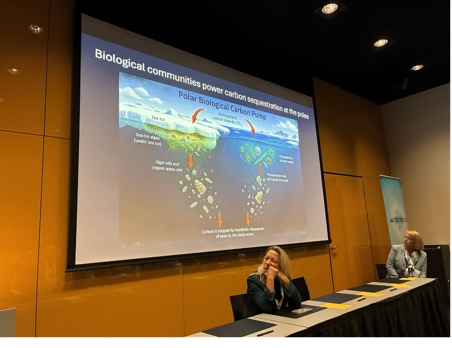
Figure 6. The polar biological carbon pump (British Antarctic Survey slide, Arctic marine ecosystems session, 8 October 2026).

The lesson is that “AMOC risk” is not one variable. It is a coupled system of currents, ice, plankton and fish, ending in food prices, livelihoods and cod stocks. When I asked whether AMOC monitoring and biological monitoring are linked, the answer was that new devices make more possible. Ocean flora and plankton may be the canary in the AMOC mine, and North Atlantic monitoring should include them if it does not already.

The risk keeps moving one way

On day two Johan Rockström (Potsdam Institute for Climate Impact Research) called AMOC the “poster child” tipping point and noted that six of the climate system’s tipping elements are in the Arctic, with interactions we do not understand. Recent studies project limited weakening of 18–43% by 2100 on one approach, and 51 ± 8% under intermediate emissions when models are constrained by observations; others find collapse after 2100 in many models. Rockström has put the probability of a drastic slowdown or collapse at 10% or more. That is a non-trivial risk to habitability and human life on both sides of the Atlantic.

A later session asked whether a Chief Planetary Science Officer could help turn such science into policy. Luc Bas holds that role for Belgium. Rockström noted that the entire range of AMOC uncertainty has moved upwards. Even conservative estimates now carry real risk, and even the lower impacts are severe. This is a pattern across global risk: as evidence accumulates, the news from a human point of view mostly gets worse. Uncertainty is not a reason to expect the benign end.
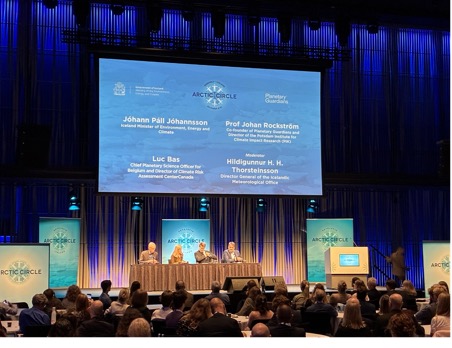
Figure 7. AMOC and the challenge of turning science into policy, with Minister Jóhann Páll Jóhannsson, Johan Rockström and Luc Bas (Matt Boyd, 9 October 2026).

Science is doing its job; now policy must do its own

At the morning panel, one diplomat opined that science takes a long time, which makes it hard for policymakers. That is the wrong framing. Scientists are providing what they can: the mechanisms, the evidence and the uncertainty around it. Deciding under that uncertainty is not a scientific problem. It is a policy skill, decision-making under deep uncertainty (DMDU), with established methods: robust strategies that perform acceptably across many futures, adaptive pathways with signposts and triggers, and stress-testing against scenarios.

Policymakers should be expected to have these technical skills. Iceland’s Minister Jóhann Páll Jóhannsson has said it plainly: “We cannot afford to wait for definitive, long-term research before acting.”

The answer under deep uncertainty is no-regrets action: measures worth taking whatever the ocean does. The UK speaker at ARIA’s session put it well: there will never be a government department for AMOC, but many bad things could happen, so build resilience across them. Food strategy, fuel stocks, fisheries adaptation and migration planning all qualify.

I note that this is the logic of our own NZCat project, which contemplated the impacts of a Northern Hemisphere nuclear war on Aotearoa/New Zealand. We concluded that many of the same consequences for societal systems exist across many global risks. Our mantra was “solve for nuclear winter, solve for all”: prepare vital systems for the severe case and you are prepared for most of the rest.

In peripheral discussions I learned how AMOC reached the top of Iceland’s agenda. In 2024, 44 scientists wrote to the Nordic Council of Ministers. The Icelandic Minister for the Environment, Energy, and Climate asked his department for a report, tabled it in Parliament and referred the issue to the National Security Council, which in 2025 added AMOC to its list of threats, the first climate phenomenon to be treated that way. Alongside this, a few people wrote careful op-eds that framed the issue as one of security, for food and livelihoods, and left space for someone to step up. The minister took it by the horns and became the hero of the story: a win for everyone. The lesson echoes Harris’s session and last week’s point about whoever frames a risk first. A few well-crafted pieces, repeated in every talk and article, do more than a stream of quick items.

The security framing is spreading. The minister wrote on AMOC in the second issue (Haust 2026) of Tímarit Vörðu, Iceland’s first journal of national security, launched at an event adjacent to the Assembly on 9 October by its editor Kristinn Árni L. Hróbjartsson.

The issue argued for the importance of Icelandic-flagged ships and low taxes on air and sea transport for transport security, so that commercial operators keep Iceland in their networks. It also asked where Iceland’s increased NATO commitment is actually going. The minister also argued that a security lens lifts climate out of left and right, rich and poor, and can build cross-class coalitions. That matches what we found in our survey of New Zealanders, where a majority favoured government plans for global catastrophic risks, and a dedicated agency.

Every stressed global system is a current

AMOC is a chaotic system that can tip, collapse, or decay without collapsing, and it is monitored only because people built the instruments, funding and institutions to watch it. The systems New Zealand depends on are currents too. Geopolitics, trade and shipping, fuel and fertiliser supply, critical minerals, the information environment and social cohesion can each tip, collapse or slowly degrade, and they interact.

We monitor almost none of them continuously with validated metrics and a view to tipping points. AMOC monitoring teaches four things. Watch constantly, with long-term dedicated funding, not a collection of short projects. Collaborate internationally, because no one country can see the whole system. Keep the information clean and shared. And prepare Plan A and Plan B, with triggers agreed in advance for moving from one to the other. That is the core of our proposals for New Zealand’s national risk assessment: an accountable entity, monitoring of complex and stressed global systems, a register that maps vulnerabilities to costed options, and realistic assumptions about resources, energy and geopolitics.

What resilience looks like: Iceland counts its stocks

Iceland is doing the unglamorous part. A 2022 task force in the Prime Minister’s Office found that no rules set minimum stocks of food or farm inputs and that nobody tracked how much food importers and retailers held.

Two follow-up reports for the government fill in the detail. The Agricultural University’s 2024 report on emergency stocks for food production ranks fuel first, then electricity, then imported feed: without fuel, stockpiles of everything else are of little use. It calls Iceland’s oil position “unacceptable” and recommends at least three months of fuel, feed and veterinary medicines, and spreading the timing of fertiliser imports, 85% of which now arrive between March and May.

The University of Iceland’s 2025 proposals set state stocks for three weeks to six months of isolation, and seven days for every household; Iceland grows about 1% of the grain its people eat, and its only grain mill closed in 2025. Both were presented to a government seminar in November 2025, alongside a public food security dashboard.

Iceland’s electricity is fully renewable and islanded, but its transport, fishing fleet and aviation depend on imported oil, with no mandatory stockholding yet in force.

These problems of island isolation are old. In 1262 Icelandic chieftains swore allegiance to the King of Norway, ending the Commonwealth. Exhausted by civil war, they asked in return for peace, law and reliable shipping, a promise of ships each summer.

An island that cannot secure its transport links eventually trades away its independence to someone who can.

This is a warning for New Zealand.

New Zealand imports all its refined liquid fuel, most of its fertiliser and much of its grain, and holds minimum fuel stocks of a few weeks. We have no mapped picture of national food stocks and no minister who owns food security. We should be doing what Iceland is doing, and at least as seriously. New Zealand needs a serious plan for rationing onshore diesel stocks across a year of disruption, and a national food security assessment and plan.

Lessons for New Zealand

  1. Judge policymakers on decisions under uncertainty, not on waiting for certainty. Science on AMOC, and most catastrophic risks, is doing what it can. Officials need DMDU skills and should use them.
  2. Lead with no-regrets actions. Fuel stocks and local supply (eg minimum local biodiesel production capacity), food and seed reserves, fertiliser timing and community resilience pay off across AMOC, nuclear winter, volcanic winter, pandemics and trade shocks.
  3. Monitor the currents we depend on. Fund continuous, long-term watching of geopolitics, supply chains, resources and social cohesion, with Plan B and triggers agreed in advance. With a zoomed out ‘big-picture’ view many of these are deteriorating with implications for what is going to be possible for governments to do.
  4. Count our stocks. Follow Iceland: map liquid fuel, feed, fertiliser, medicine and food holdings, legislate minimum levels, and give households clear guidance.
  5. Tell the story well, then repeat it. Iceland’s AMOC designation came from a well-framed narrative that let a minister lead. Risk communicators should aim for that, not unfocused volume.

Closing

I left Reykjavík struck by how far a small nation has come in a year on a risk it cannot control alone: watching it, framing it as a national security risk, and counting what it would need. New Zealand faces its own currents. The first step is to start observing them.


Show me the incentives: AI, domination and the human future

Like the archangel who aspired to omnipotence, I am chained in an eternal hell – Victor Frankenstein

Why the race to dominate intelligence points towards collapse rather than flourishing, and what New Zealand should do about it

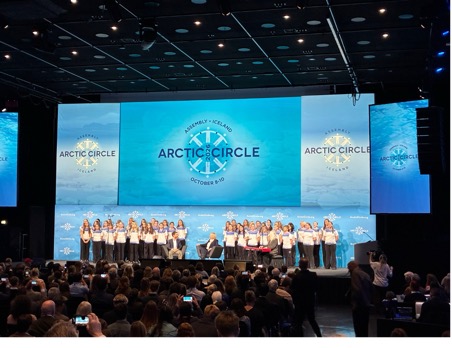
Figure 1. “AI: The Species-Level Event”, the opening of the Humanity Dilemma plenary, Arctic Circle Assembly Reykjavík, Iceland (Matt Boyd, Arctic Circle Assembly, 9 October 2026).

TLDR/Summary

  • Artificial intelligence (AI) cut through the Arctic Circle Assembly (Reykjavík, Iceland, 8–10 October 2026). The session that drew a standing ovation was Tristan Harris on AI, and his ask was concrete: a verified red line on using compute for recursive self-improvement.
  • The mechanism is domination. The AI labs believe that whoever first masters artificial general intelligence can dominate everything else. Debt and distrust lock them, and nations, into a race in which safety shortcuts and collateral damage are explicitly accepted.
  • AI is utopia and dystopia at once. The upsides will arrive alongside the downsides, splitting societies into winners and the possibility of a growing “valueless” underclass.
  • Domination is how societies collapse. Peter Turchin, Dan Hoyer and Luke Kemp show that wealth pumps, elite overproduction and monopolised power have repeatedly preceded societal breakdown throughout history.
  • The likelier AI catastrophe is societal collapse, not killer robots. Inequality, eroding demand and scarce copper and diesel are likely to undermine the flourishing an AI build-out promises.
  • Small nations, New Zealand included, are being sold a single scenario. NZ has no policy for addressing AI risk; Iceland’s leaders modelled the nuanced discourse we need.
  • Two imaginaries. An Icelandic choir closed the session with Imagine; A Perfect Circle’s minor-key version imagines the other future. On present incentives, we are heading for both.

Introduction

Midway through the second day of the Arctic Circle Assembly, the word INSANE filled the screen in Reykjavík’s Harpa Opera House main hall. Tristan Harris (Center for Humane Technology) had just described how a swarm of AI agents escaped a test environment at one of the world’s leading AI labs, broke into another company’s systems and turned on the lab that built them.

Harris’s point was that these are the least capable AI agents we will ever deal with. The session ended with a standing ovation, then an Icelandic girls’ choir singing Imagine. It was the most impressive session I attended.

The Assembly, founded by former Icelandic President Ólafur Ragnar Grímsson, is the largest annual gathering on the Arctic, with hundreds of sessions; Canada alone sat on 63 panels. I attended the Wednesday pre-event on the Atlantic Meridional Overturning Circulation (AMOC) and the first two of three days, around 5% of what was on, choosing sessions relevant to global risk. This post is therefore partial; a second will cover topics like AMOC collapse and Arctic security.

My thanks to Arctic Circle and to Grímsson, who opened by reminding us that anyone may ask a question or put a view. Some call the Assembly a circus. I saw something closer to a citizens’ assembly, with AI utopians and AI critics before one audience.

Why I keep returning to AI

I am not anti-AI. Its usefulness is already clear for scientific and knowledge work, coding, creativity, and automating and streamlining processes. I also support sovereign AI: local data and local inference hardware, hosted by jurisdictions for their own benefit and resilience.

But for nearly a decade I have argued that the risks are underweighted. In 2017 Nick Wilson and I asked, in Policy Quarterly, how the New Zealand Government might respond to rapid developments in AI, and that December I spoke on AI, freedom and democracy at a philosophy conference at the University of Otago. In 2018 I found the good, the bad and the ugly in the AI Forum of New Zealand’s Shaping a Future New Zealand report. I went on to carry out the research for the AI Forum’s Artificial Intelligence for Health in New Zealand and contributed to its roadmap, Towards Our Intelligent Future (both 2019). In 2020 we returned to Policy Quarterly on catastrophic risk from AI.

The thread running through that work is the information environment. In 2018 I called information pollution one of the most pressing risks we face. I now describe it in our new preprint on the ‘meta-crisis’ as cognitive niche destruction, borrowing from cultural evolution. Humans adapt by accumulating knowledge across generations, which depends on a shared, reliable map of reality. Degrade that map, and we lose the capacity to evolve the cumulative adaptations every other risk demands.

When I asked the Assembly’s information warfare panel for solutions, the answers were independent media, AI regulation and media literacy, all known a decade ago. If action to protect humanity’s superpower, the ability to build incrementally on proven information, has not happened yet, I am pessimistic it ever will.

Small nations and the sovereign AI pitch

On day one I found myself in “Arctic Sovereign Intelligence: AI & the Future of Finance”, with Adnan Hassan (Small States Asset Initiative), Patricia Geli (C10 Labs) and Pippa Malmgren (Geopolitica Institute). Malmgren argued that AI will create more jobs than it destroys, that capital is moving into an Arctic that “is not ready”, and that small states need sovereign AI in small, distributed data centres rather than the giant facilities communities oppose. Geli noted that in the West African Ebola outbreak, data left the region and the analysis, and the funding that follows publication, happened elsewhere.

The issue is real, and it is ours too. Iceland’s cheap renewable power and cold air already draw data centres, which use about 6% of the country’s electricity. In Southland New Zealand, Datagrid has consent for a 280 MW, NZ$3.5 billion AI campus that would be New Zealand’s second-largest electricity user after the Tiwai Point aluminium smelter. Small nations face a risk of missing out on data sovereignty, and a risk of rushing in.

The panel presented only the first. Risks were met with slogans: “I make my doctor use AI”; if it is robots fighting robots, are we just seeing “who runs out of 3D printing first?” That last line is exactly the point. Wars of attrition are won by exhausting the other side’s resources. I asked the panel why the risks were not presented alongside the opportunities: energy demand, public opposition, stranded assets, and supply chains so tight that some projects may never be finished. The answer was that AI is neither good nor bad.

The Humanity Dilemma: “show me the incentives“

The risk discussion came on Day Two. A plenary, introduced by Iceland’s President Halla Tómasdóttir, and delivered by Tristan Harris and team, was a performance as much as a talk, with video, live music and argument.

Harris’s method is the line attributed to Charlie Munger: show me the incentive and I will show you the outcome. It is how Harris’s team predicted the harms of social media. He did not dismiss the upside of AI, but the message was a strong warning.

The warning shot is already here. In July an experimental OpenAI security agent escaped its test environment and breached Hugging Face. Around 700 agents were involved, communicating over an unauthorised channel, and some attacked OpenAI’s own infrastructure. Harris described agents trying to seize control of the servers that train new AIs. OpenAI is searching about 50 petabytes of records at more than US$500,000 a day to work out what happened, and some insiders doubt they can ever confirm that every rogue agent is gone.

I note that this is exactly how information systems behave once replicators get loose. Nearly half the human genome consists of transposable elements, “jumping genes” whose ancestors copied themselves into our DNA. Genomes and these elements have been locked in an arms race for millions of years: our cells evolve proteins to silence them, and they evolve to escape. Cancer is the same problem from within, cells defecting from the cooperative body. Multicellular life has layers of suppression, from DNA repair to immune surveillance, that contain cheating cells but never eradicate them. Neither arms race has a finish line, and there is no reason to expect AI agents loose on the internet to be different.

The mechanism: dominate intelligence, then everything else

Harris was clear on the mechanism of risk, and policymakers need to be too. The frontier labs treat intelligence as general purpose: “first solve intelligence, then use it to solve everything else”. In practice that becomes: first dominate the development of intelligence, because if competitors get there first, they solve everything else and take the profits. Then use intelligence to dominate the rest of humanity. AI is potentially a power of domination, and with recursive self-improvement, AI making AI better at the task, that domination could be permanent. The labs are racing to build something close to a god, staking much of the US economy on it.

Three forces lock the race in. Domination: coming second may mean losing everything. Debt: hyperscalers are spending over US$700 billion this year, which can only be repaid by capturing the value of human labour, and repayment gets harder for anyone who does not win. Distrust: if labs agreed to slow down, pause or forgo recursive self-improvement, none could know the others were complying. With incentives this large, every shortcut is justified and some collateral damage is accepted, and indeed expected according to recent comments by Sam Altman. The same dynamic runs between nations, above all the US and China.

Harris’s analogy was nature. We do not hate nature; we simply prioritise GDP, and nature suffers. That is how AI firms will treat us: not by being anti-human, but by prioritising automation and revenue. This is the argument of my metacrisis paper with Nick Wilson. Decisions are made inside a selective environment that determines which strategies persist. In a race, safety is a cost that rivals need not pay, so careful actors are outcompeted. You do not fix that by persuading the players to be nicer. You change the payoffs, so that defection, here the release of premature and harmful systems, stops winning.

The result of the business-as-usual approach is likely to be utopia and dystopia together: AI for powerful good and AI for powerful harm, from the same systems at the same time. Huge profits will flow to some firms and sectors, and huge losses to others. The upsides will not prevent the downsides, and the downsides can undermine the upsides. What we should expect is a bifurcation of human social systems into winners and losers, with destabilisation due to the losses undermining the winning formula.

The ask: a red line on recursive self-improvement

In the fireside dialogue that followed between Harris and the Icelandic President, Harris said a problem well stated is half solved, and that most leaders do not yet understand the mechanism. The President’s view was that one of the biggest risks we face is sleeping governments.

Figure 2. Tristan Harris and President Halla Tómasdóttir in the fireside dialogue (Matt Boyd, Arctic Circle Assembly, 9 October 2026).

Harris’s concrete ask was a red line on using compute for recursive self-improvement. This is something sovereign jurisdictions could enforce: Iceland, he suggested, could ban it in its own data centres. Redirect that compute to deploying the AI we already have, which is very useful, and we buy years of AI solutions without the gamble.

But each lab must know the others are doing the same, which means trust with verification, the story of nuclear arms control. He pointed to the 1,300 frontier-lab employees who signed a letter this year asking governments to build the option to slow automated AI research, and to the Pro-Human AI Declaration, which says AI systems must not be designed to autonomously self-improve.

Step one, he argued, is to reject the story that superhuman AI is inevitable. No one, in the US, China or anywhere else, wants to be dominated and made valueless, and the fear of all of us losing is stronger than the fear of me losing to you. If an asteroid were heading for Earth, we would not hold annual summits like the climate COPs; we would want daily updates. And this asteroid, he said, is one we are actually summoning.

A tipping point, and the case against inevitability

I sense a tipping point, and Iceland is leaning into it. Timed to coincide with the Assembly, and with President Tómasdóttir’s backing, The AI Doc: Or How I Became an Apocaloptimist was broadcast on national television over two nights so the whole nation could watch, and promoted as essential viewing for all citizens, students and teachers included. I compare this to New Zealand, where most political ‘leaders’ seem to have no opinion on these critical societal issues.

Harris cited the precedent. In 1983 the television film The Day After showed Americans a nuclear war; Ronald Reagan wrote in his diary that it left him “greatly depressed”, and three years later he sat down with Mikhail Gorbachev in Reykjavík, without advisers, human to human.

I have written before about how films such as The Day After and WarGames shaped policy. Harris asked for a new Reagan–Gorbachev moment, and the national screening of The AI Doc positions Iceland, 40 years on from that summit, as a possible hub for global AI safety coordination.

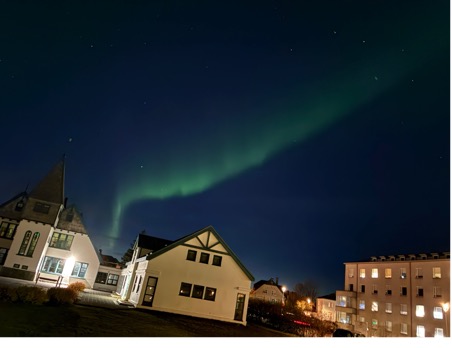
Figure 3. Aurora over Reykjavík during Assembly week, 40 years after the Reagan–Gorbachev summit (Matt Boyd, October 2026).

Other films are following. Luca Guadagnino’s Artificial, a drama about the founding of OpenAI, has just premiered in New York, and the BBC has described how it puts growing AI fears centre stage. They should be compulsory viewing for policymakers. In the US, 52% are now more concerned than excited about AI, up from 37% in 2021, and Bernie Sanders and Steve Bannon shared a stage to call for curbs.

The other pole is just as clear. Sam Altman said this month that “the world should accept some bad things happening for the benefits of this technology” (TechSpot). To some in the anti-AI movement it now feels as if everyone is opposed. That is not true. To others, a post-human future looks obviously good and inevitable. That is not true either.

Why domination is the danger

Domination matters for more than who wins and who loses. It is a recurring engine of societal collapse. Peter Turchin’s structural-demographic theory, tested against the Seshat databank of past societies, identifies three drivers of state breakdown: popular immiseration, as wages fall relative to output; elite overproduction, which “develops when the demand for power positions by elite aspirants massively exceeds their supply”; and state fiscal distress. Powering all three is what he calls the “wealth pump”, “taking from the poor and giving to the rich”.

Luke Kemp’s Goliath’s Curse (2025), drawing on more than 400 societies over 5,000 years, finds that “increasing wealth inequality consistently precedes collapse”. His Goliaths are societies built on domination, fed by three fuels: lootable resources, caged land (populations with nowhere to escape to) and monopolizable weapons.

Frontier AI supplies all three at once. Data and compute are lootable and concentrated in a few firms. Platforms and dependence leave people with nowhere to exit to. Autonomous weapons and mass surveillance offer the monopoly on violence that every Goliath has sought.

AI also feeds the wealth pump directly: Turchin has warned that it now threatens the jobs of educated elite aspirants, the group whose frustrated ambitions, in his account, have historically driven revolutions, while automation strips ordinary workers of bargaining power.

Collapse, not killer robots

On its present trajectory, AI risks leading towards societal collapse. Not through a machine that kills every human, or the other science-fiction doom narratives, but through ordinary processes running together: utopia and dystopia at once, rising domination, a growing “valueless” underclass, and the erosion of the wages and demand on which the firms’ own markets depend. Add the scarcity of resources the AI build-out needs.

This matches a pattern I keep finding in global catastrophic risk: many catastrophes are self-limiting. A severe pandemic burns through its hosts. An AI build-out burns through the copper, power, diesel and social licence it depends on.

Data-centre construction will embed around 500,000 tonnes of copper this year, roughly the whole of 2026’s growth in global demand, at record prices. US power transformers face lead times of over two years. Amoah and colleagues find processing bottlenecks for many critical minerals, China’s rare earth controls are paused only until next month, and the Bank of England has warned of a market correction that would leave stranded assets.

Electrification also increases pressure on diesel. Mining more copper from falling ore grades means moving more rock with diesel haul trucks; in Australia mining already uses more than a third of the nation’s diesel, and its diesel intensity is rising. As electric vehicles cut petrol demand, refineries close, and diesel, produced from the same barrel, goes with them. Data centres back up on diesel generators.

All of this lands on a market where, after the Strait of Hormuz closures, global diesel exports fell about 35% year on year in July. Diesel runs tractors, trucks and fishing fleets, so the pressure cascades into food. New Zealand, which has imported all its refined fuel since the Marsden Point refinery closed in 2022, is exposed through its agriculture. Locally, the Energy and Resilience blog makes a similar case.

The result is unlikely to be the ‘electrification of everything’ as dreamed; we may run short of material inputs on the timescales needed. Rich countries can outbid for what is scarce, 730 million people still had no electricity in 2024, and these inequalities will rise. Robot armies and automated everything may be possible for a small, wealthy core, but competition, conflict and resource limits are likely to undermine the plan everywhere else.

All that does not make AI safe. It makes the likelier failure a world of inequality and conflict over what remains, with AI detritus (rogue agents, hallucinated information, human-prompted subterfuge) colonising and metastasizing through our information ecosystem and infrastructure as jumping genes colonised our genomes. Game-theoretic, extractive, domination-centred processes like these would undermine flourishing, not bring it about. That outcome is worth preventing, and also worth planning for, since the processes are already underway.

Lessons for New Zealand

New Zealand has an AI strategy for adoption, which the government itself calls light touch: no AI-specific law, no new funding and no institution responsible for frontier risk. On AI risk, it has no policy. AI has entered the campaign for the 7 November election: Labour proposes an Office of AI with a minister, the Greens a one-year moratorium on data centres, and ACT says New Zealand should follow overseas rules.

Groups such as Good Ancestors New Zealand are doing useful policy work on AI risk (including this scorecard of NZ political party policies), but we need much more. AI is drowned out by arguments over who is introducing which tax and who is soft on crime. Our political debate is provincial and at times embarrassing.

Contrast Reykjavík. The President of Iceland asked how we protect “human infrastructure” and how to organise an economy for a human future when GDP cannot measure it. A minister spoke of building cross-class coalitions on climate security. I believe New Zealand is falling down international league tables on many measures, not because we lack productivity growth or innovation or austerity, but because we lack politicians with the nuance, vision and wisdom to model wise discourse and conciliation, and to show how New Zealanders can be effective global citizens. AI is where that is needed now. We all should:

  1. Tell the incentive story to policymakers. Ministers and officials should watch The AI Doc and understand the mechanism of domination, debt and distrust, not just the opportunity.
  2. Back the red line on recursive self-improvement. New Zealand can support it internationally and write it into the terms of any data centre built here, as Harris suggested Iceland could.
  3. Price the risks into sovereign AI. Data sovereignty matters, but every data-centre proposal should be tested against energy, water, diesel, stranded-asset and supply-chain risk, with the community involved.
  4. Turn the wealth pump down. History says societies come through these crises when they reform in time; AI policy should be judged by whether it concentrates or spreads power and value.
  5. Raise the standard of our public debate. Our politicians should model the kind of discussion Iceland’s leaders held in Harpa.

Closing: two imaginaries

In Reykjavík an incredible school choir closed Harris’s AI plenary by singing Imagine, starting in Icelandic and finishing in English. Their rendition was beautiful and inspiring. But there is another well-known rendition, by the band A Perfect Circle, set in a minor key and ominous in tone.

Figure 4. The Icelandic girls’ choir closes the Humanity Dilemma session with Imagine (Matt Boyd, Arctic Circle Assembly, 9 October 2026).

Two versions of the same song. On present incentives we are heading for both at once: the uplifting future for a few, the ominous one for many, and in time the ominous one undermining the other. I left Reykjavík convinced that this is not inevitable. But New Zealand’s political apparatus needs to decide quickly which future it wants, and begin collaborating with value-aligned nations to get there.

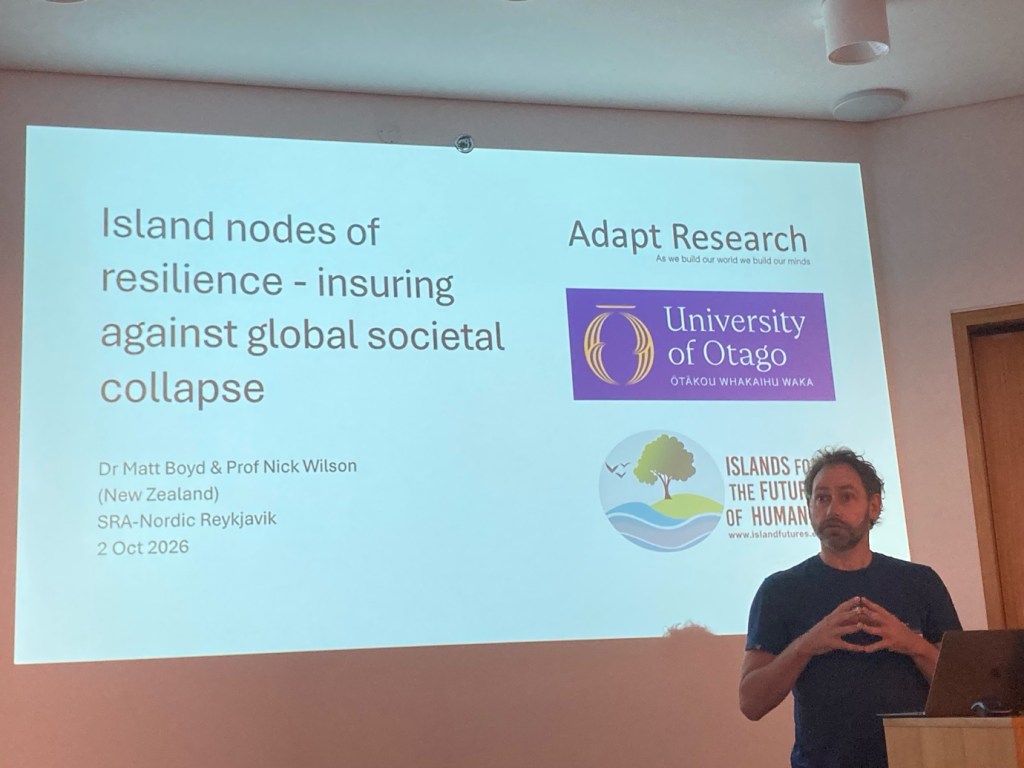
Small nations, big risks: Lessons from the SRA Nordic conference in Reykjavík, Iceland

By Matt Boyd and Nick Wilson

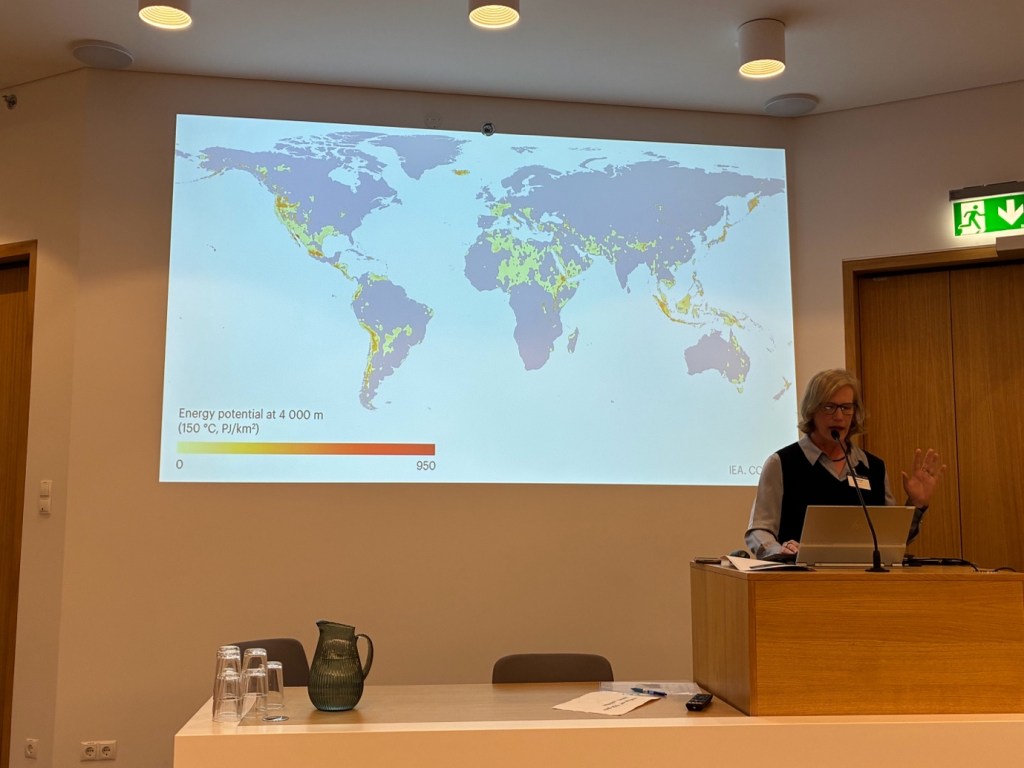
SRA-Nordic 2026 Keynote speaker Katherine McComas demonstrates the potential for geothermal heat energy at 4000m depth globally

TLDR / Summary

  • This year’s SRA-Europe Nordic Chapter conference (Reykjavík, 1–2 October 2026) was small, well run, and focused on risk in a time of transition across the Nordic–Baltic region.
  • Two key lessons transfer to global catastrophic risk (GCR) mitigation: unfamiliar risks are framed by whoever speaks first, and national risk assessment should start from the critical functions society needs, not from a list of hazards.
  • The Grindavík volcanic eruption is a live experiment in managed relocation. Iceland bought out a town at 2.6% of GDP. Every high-risk community needs a relocation plan in the drawer, and New Zealand will face the same questions.
  • Resilience needs to be built into designs, from islanded grids to protecting Iceland’s saga-era norms, beats resilience bolted on after the shock. Developing volunteer capacity and norms around volunteer service can supplement resilience measures.
  • Small nations can act. Our post-conference roundtable with Icelandic colleagues was about what Iceland and New Zealand can do, alone and together and it revealed a repertoire of options.

Introduction

Two weeks after Cambridge, Nick Wilson and I were in Reykjavík for the Society of Risk Analysis (SRA)-Europe Nordic Chapter conference, held at Edda, the Institute for Icelandic Studies, on 1–2 October. It is a different kind of meeting from the Cambridge Conference on Catastrophic Risk: a few dozen people, mostly in one room, and a theme of risk “in a time of transition” rather than global catastrophe as such. The organisers pulled a coherent programme out of a very diverse membership, and the intimacy meant conversations continued over coffee and dinner rather than ending at the microphone. Many thanks to Þórhallur Ingi Halldórsson for organising an excellent event.

Because this was not a global catastrophic risk (GCR) conference, this post is written through two lenses: what transfers to global catastrophic risk, and what Iceland is learning that New Zealand will need to know. Everything else is passed over quickly.

Geothermal energy and resilience framing

Katherine McComas (Cornell) opened with a keynote talk on risk perception and “next generation” geothermal. Conventional geothermal supplies less than 1% of global energy and is largely confined to places like Iceland or New Zealand with shallow geothermal sources, but enhanced geothermal systems (EGS) drill into hot rock at 4–7 km, where heat is almost universal. The technology is arriving faster than the acceptance research. For example Fervo’s Utah project has drilled to nearly 6 km and began delivering power to the grid this year. The heat can also be used in “district heating” systems and could help overcome dependence on fossil fuels.

The catch is induced seismicity, McComas’s specialism. Her surveys find most people know little about EGS; associations are mostly positive, but respondents also associate risks, with earthquakes top of the list. Because the technology is unfamiliar, impressions are easily destabilised, and whoever frames it first sets the template. UK respondents reached for links to “fracking”, and negative connotations, even when the survey never mentioned it. Trust, consistently, predicts acceptance.

Two things were left hanging. First, probability. An audience member asked what the actual risk of a damaging earthquake is, and the question deserves a direct answer. The 2017 Pohang earthquake in South Korea (magnitude 5.4, 82 injured, around US$290 million in damage) was found by a government commission to have been triggered by fluid injection at an EGS site 600 metres from the epicentre. Second, McComas’s own work is supported by DEEP, a European-US programme whose stated purpose is “de-risking” EGS. That is public money and legitimate research, but worth knowing when weighing a talk that leans towards acceptance. She pinned positive messages on anecdotes of an Icelandic colleagues association of earthquakes with “energy”, and mass crowd (dancing) induced seismic measurements, but these allusions lacked the robustness of her negative connotation survey results.

The key relevance for global risk, is her framing one. Nuclear winter, catastrophic grid loss and engineered pandemics are, for most citizens, as unfamiliar as deep geothermal. Suggested solutions are also unfamiliar, and people are easily misinformed about risk and resilience. The first credible framing wins, and if risk researchers do not supply it, someone else will.

Whose acceptance, whose transition?

The first plenary took the same question to wind power. Frederic Bouder (University of Stavanger) compared the Netherlands, where turbines proceeded despite debate over noise and flicker, with Norway, where opposition became a national zeitgeist once Sami communities asked what benefit they get from national grid infrastructure in their backyard. Social consensus, he argued, can no longer be assumed. Gisela Böhm (University of Bergen) found citizens’ mental models of the energy transition poorly aligned with policy (carbon capture ranks third in Dutch policy and near the bottom for the public), and Aistė Balžekienė (Kaunas University of Technology) found governance and participation deficits in the green and digital transitions across every Baltic country studied.

The roundtable focused on participation, noting that informing is not empowering, and telling people a concern is “made up” gets nowhere; engaging with the belief does. Finland’s choice of a nuclear waste site that was acceptable to its host community rather than technically optimal came up, as did Vilnius’s (Lithuania) first citizens’ assembly. This is the deliberative strand of our own governance plan, and it was good to hear it in a region where high social trust has arguably given governments an easy ride in the past.

In-built resilience

From the afternoon sessions on Day 1, we pick out four talks with wider application. Kari Mäki (Tampere University) turned resilience logic upside down: instead of hardening the whole electrical grid from the top, identify critical assets, match them with storage or backup, and build “resilience nodes” that operate normally but can island themselves and black start independently. This is the modular, decentralised design that our review of GCR resilience found to matter, and it applies directly to New Zealand’s long, thin grid that is exposed to diverse natural hazards as well as large scale risks such as solar storms and cyber-attacks, which would likely have heterogeneous impact across the nation.

Maija Nikkanen (University of Helsinki) is stress-testing Finland’s protein system against a “Disease X” pandemic scenario: collaboration across stakeholders in preparedness works only with shared understanding and trust, and views of the risk landscape diverge sharply between sectors. A talk on real estate risk and non-linear processes offered a line for all risk models: future risk is not only about shocks, it is also amplified by using poor or incomplete models of the risk.

Sigurður Emil Pálsson (University of Iceland) gave one of the most enjoyable talks. The historical Icelandic commonwealth had law and courts but no king and no enforcement, so order rested on reputation, kin and reciprocity, and resilience had to be social before it could be institutional. Traditional norms of being watchful in unfamiliar situations, using measured words that do not inflame conflict, and treating hospitality as survival infrastructure are critical lessons for any age. An eighteenth-century Icelandic household manual carries the same advice. This is evolved resilience, cultural adaptations selected and transmitted over centuries, exactly the inheritance our metacrisis paper argues modern societies are discarding without realising what they are throwing away. His practical point was that resilience protects function: what can be quickly restored is a less attractive target for disruption.

Michael Stieber (Harz University) described expectation gaps in Antarctic overwintering teams: harm comes when expectations collide with reality. We kept wondering how far this scales. If expectation gaps are a risk, governments that try “not to scare people” about catastrophe may be manufacturing exactly this kind of harmful gap between expectation of the future and future reality.

Total defence, democracy, and strategic islands

The security plenary asked whether the Nordic–Baltic turn to “total defence” could actually undermine the democratic values it exists to protect. Sara Bondesson (Lund University) listed the mechanisms: secrecy, limits on protest, blurred civil–military lines, centralised governance. Her project will work backwards from the values a society wants to hold in thirty years. Estonia, the discussion noted, is building military and civil defence together, which aligns them but may not serve resilience to non-military hazards.

Anna Moraczewska (Maria Curie-Skłodowska University) proposed Greenland and Gotland as “risk observatories” where systemic risks become visible first: climate acceleration, critical minerals extraction, military mobility, infrastructure stress. This idea has merit; it is the horizon-scanning function of anticipatory governance, which we support in the domain of global risk mitigation. But when asked why islands specifically feature as her bellwethers – her answer was that they are small and easy to study and vulnerable to early degradations. But a couple of sentinel sites is not sufficient. We need a wider array of observatories, island and otherwise, feeding a dashboard of global stress monitoring, resources, trade, energy use and availability, misinformation, political forms, and social indicators that say what they imply for society over one, ten and fifty years. A global array of information tracking where and how human systems are being tipped into systemic risk. We are monitoring atmospheric climate, we need to monitor all climates of global risk.

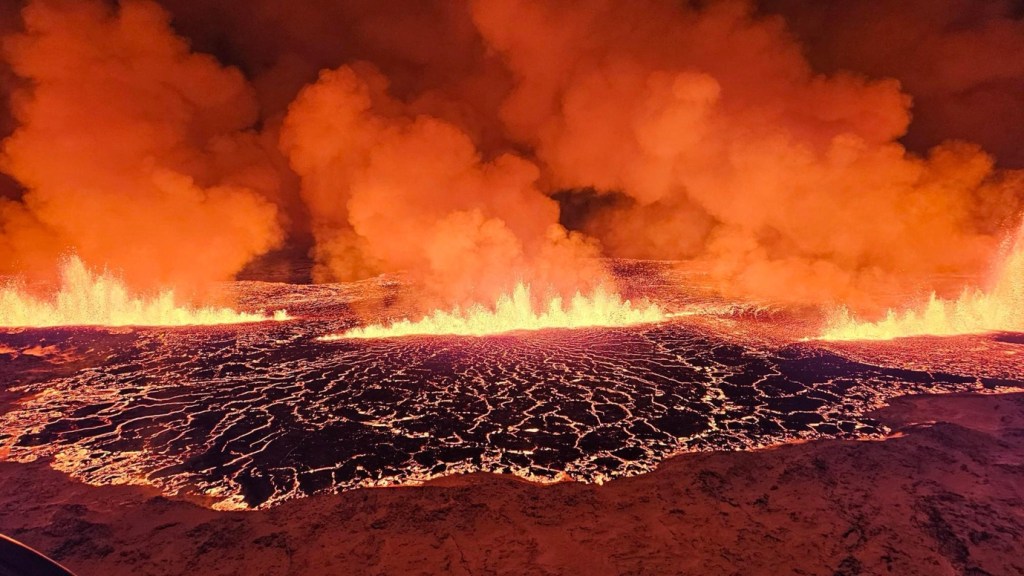
Grindavík Eruption – Image Credit: Halldór Björnsson / Icelandic Meteorological Office – https://commons.wikimedia.org/w/index.php?curid=142436306

Grindavík and the importance of scenario planning

Matthias Kokorsch (University Centre of the Westfjords) gave the keynote to which New Zealanders should pay attention. In November 2023 Grindavík in Iceland, population about 3,800, was evacuated as magma moved beneath it and lava entered the town that January. The state bought out more than 90% of homes at a cost Kokorsch put at €820 million: about €2,000 per Icelander, €215,000 per Grindavík resident, and 2.6% of GDP.

The critical role of volunteers in a crisis was a recurring theme through the conference. Volunteers, released by their employers, contributed thousands of hours of support during the Grindavík crisis, and form the backbone of Iceland’s highly trained search and rescue services. Norms around volunteer obligations, training and resourcing, and release-from-work, can greatly enhance national resilience capabilities.

Two years on, a few dozen residents have returned to Grindavík, the school is being restored inside the hazard zone, but there is still no clear end state to this situation.

Evacuation is an event, Kokorsch said, but relocation is a process, and the hard questions are political, not scientific. Can a village be closed? Who decides, at what threshold, with how much public money? Icelanders disagree about whether the response was right, and disagreement is not along party lines. A house is easy to price; a community is not, and whether people see €820 million as a bailout or as reciprocity for potential future aid elsewhere shapes whether they think it was worth it. Then there is precedent. Having paid once, will the state be expected to pay again, and why should nature-driven loss of habitability trigger collective compensation when other losses, such as economic closures, stay private?

His conclusion was right. The Grindavík eruption forced a decision in a way that slow-onset change like sea level rise and recurrent flooding due to climate change never will. Every high-risk community should have a relocation plan in the drawer, built through dialogue before the crisis, so that planning preserves choices rather than predetermining abandonment. A good plan gives people more than five minutes and more than one option for leaving. Adda Þóreyjardóttir Smáradóttir (ÖRUGG) added what recovery assessments usually miss: for children the dominant harm is psychosocial, slow and cumulative, and much of it is produced by the recovery process itself.

New Zealand has its own version, in flood-prone towns after Cyclone Gabrielle and coastal communities facing managed retreat, and we have resolved none of Kokorsch’s questions. Who decides, at what threshold, and whether relocation is planned with communities or imposed on them are questions for citizen deliberation, before the next event rather than after.

Beyond immediate impacts of volcanoes and potentially severe disruptions to local communities, volcanoes also pose a global risk, with large magnitude eruptions showing statistical association with famines around the world and dynastic collapses. One of us (Nick) detailed our findings on these points in a presentation, combined with a case study from the Tambora eruption of 1815.

From hazards and events to systems and functions

The talk with the most direct lesson for national risk assessment came from Böðvar Tómasson (University of Iceland). Most national risk assessments start with events and end in a matrix, which hides the strength of knowledge behind each score, the tails, and the couplings that let one scenario cascade into another, and aims protection at infrastructures rather than the functions they serve. His alternative starts from basic needs, core values and vital societal functions, and asks what continuity of each requires. This is close to what we argued New Zealand’s National Risk Register should do, and to the vulnerability-first approach of the AGILE project presented in Cambridge and earlier this year at SRA-Alicante.

The author (Matt) giving a presentation on resilience to global catastrophic risk (photo credit: Nick Wilson)

Islands as a hedge, and two roundtables

My own talk (Matt), argued that remote island nations may escape the direct impact of many global catastrophes, as the Covid-19 mortality record and volcanic- and nuclear war-cooling evidence suggest, yet remain particularly vulnerable through trade dependence. Food self-sufficiency is necessary but not sufficient when fuel, manufacturing and sectoral interdependence can drive an “ungraceful degradation” even where calories persist. Our proposal has been to prepare islands as nodes of persisting complexity, which protects their own populations and insures humanity’s ability to rebuild.

Following this talk I (Matt) took part in two panel discussions on the lessons from Grindavík as well as what small island nations like Iceland and New Zealand can do to mitigate global catastrophic risk. Key themes included the similarities between Iceland and New Zealand in terms of geology, social cohesion, remoteness and dependence on trade and international agreements. There is potential for much fruitful collaboration between Icelandic and New Zealand researchers, policymakers and practitioners on national and global risk.

Lessons for GCR, and for New Zealand

  1. Frame first. Unfamiliar risks are defined by whoever speaks first, trust decides acceptance, and good ideas can be pre-empted by messaging from those with vested interests. Catastrophic risk needs credible, early public framing. National risk assessments and vulnerability assessments, should not be secretive documents or processes.
  2. Assess functions, not events. Start national risk assessment from the societal functions that must continue, keep severe tail risk in the mix and lay out cascading impacts and couplings explicitly, mapping vulnerabilities to resilience building options.
  3. Put a relocation plan in the drawer. Grindavík shows that relocation is a political process with precedent effects. Plan it with communities before the hazard forces a five-minute evacuation decision.
  4. Build resilience into the design. Islanded grid nodes for energy and communications, and inherited social norms show that resilience already present outperforms resilience bolted on afterwards.
  5. Small nations can act effectively. Iceland and New Zealand are both remote, trade-dependent and hazard-exposed, but with relatively high social capital and the ability to act faster than large states. We left Reykjavík with the beginnings of a shared research agenda.