The Reality of Food working group asks the next government to make someone responsible for feeding New Zealand
TLDR/Summary
We have released a new briefing to the incoming government on national food security. It comes from the Reality of Food working group, part of the Reality of Everything collaboration (read the media release)
The core problem is complacency. New Zealand exports food, so it is assumed to be food secure. But no minister or agency is responsible for national food security, and no one monitors it.
Food is critical, but critically dependent. National production rests on imported diesel, fertiliser, agrichemicals, seed and machine parts, and on fragile distribution and payment systems.
Our closest partners treat food as national security. The UK has assessed ecosystem collapse as a threat to its food system and has told households to stock food ahead of a record El Niño and the threat of cyberattacks.
New Zealand could feed itself through even a severe global catastrophe, but only with prior planning (see the NZCat Report). We recommend a National Food Vulnerability Assessment, a National Food Security Strategy and a minister accountable for both.
A briefing for the incoming government
The Reality of Food has released National Food Security: A Briefing to the Incoming Government. A media release accompanies it. The briefing is addressed to the incoming ministers for agriculture, environment, emergency management, energy and economic growth, climate change, health, social development, Māori development and finance. That list is itself the point. Food security cuts across at least nine portfolios, and no single one is accountable for it.
The timing is deliberate. Coalition negotiations after the 7 November election are still under way. A new government sets its priorities in its first months, and this is the moment to put national food security on the list.
Where the briefing comes from
The briefing was prepared by the Reality of Food working group, a spin-off of the Reality of Everything collaboration. Its symposium in Wellington in June brought policymakers, politicians, researchers, business and community groups together to take stock of climate, biodiversity, energy, water, food, the economy and health. We reported on it here, and offered a field guide to its key terms: global catastrophic risk, systemic risk, polycrisis and metacrisis.
The working group brings together several New Zealand organisations working on global risk and resilience. The briefing is supported by Reality of Everything, Wise Response, Islands for the Future of Humanity and Adapt Research. Internationally, the Alliance to Feed the Earth in Disasters (ALLFED) has done much of the foundational work on feeding people through global catastrophes. It was not part of this briefing, but its research runs through the field.
Special thanks go to Dr Catherine Knight, convenor of the Reality of Everything symposium. Catherine’s energy and persistence got both the symposium and the food working group off the ground, and she has been making the case for national food security for years, including on her Substack, An Uncommon Land.
Complacency in a destabilising world
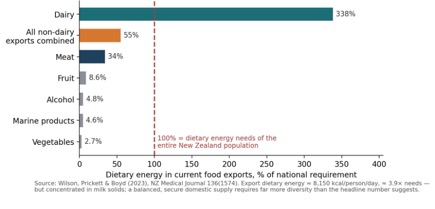
New Zealand often claims that it “feeds 40 million people”. That figure is a theoretical maximum. It needs uninterrupted imports and unrealistic crop choices, and in practice our surplus is almost entirely milk solids. Bread wheat, rice, sugar and edible oils are largely imported, mostly from one or two countries.
Figure 1. New Zealand’s food export surplus is almost all dairy: dietary energy in current food exports as a percentage of national requirement (Reality of Food working group, from Wilson, Prickett & Boyd 2023, New Zealand Medical Journal).
Meanwhile, for many households, food emergency is already everyday life. In the year to July 2025, 21.4% of children lived in households where food ran out often or sometimes, rising to 32.3% of Māori and 44.3% of Pasifika children.
Food prices are rising faster than general inflation.
Unusually among comparable nations, New Zealand produces no regular report on the state of its food security.
Food is critical, and critically dependent
Food is the most basic of needs, but it is not a self-contained system. It depends on almost everything else. Our farms run on imported diesel, about 300 million litres a year for off-road agricultural uses alone, and statutory onshore stocks equate to about 21 days of normal national use.
Yields depend on imported nitrogen and phosphate fertiliser, agrichemicals, seed and machinery parts. Food reaches households through a handful of distribution centres, by road, and through payment systems that depend on offshore data infrastructure. Lose any of these inputs and the surplus does not survive.
This is the systemic risk lens we apply to all our work. In 2026 the Strait of Hormuz disruptions squeezed the diesel and fertiliser that New Zealand’s food system cannot do without, and a record El Niño now threatens yields worldwide. As I described at the National Lifeline Utilities Forum two weeks ago, islands are at severe risk in trade isolation scenarios.
The global context: our partners treat food as security
The briefing draws on the United Kingdom’s recent assessments. In January the UK published Global biodiversity loss, ecosystem collapse and national security, a Joint Intelligence Committee and Defra assessment that warns ecosystem collapse threatens UK food security.
In September, the UK Environment Secretary urged households to stock up on food ahead of what forecasters are calling an unprecedented El Niño, after the National Audit Office found the government had done too little to strengthen food system resilience. Cyber risks to the food system have been on display recently with attacks on refrigeration in Europe.
The US Global Catastrophic Risk Management Act of 2022 likewise treats food as a core part of protecting the population in a major crisis. New Zealand has no equivalent.
New Zealand could feed itself, but only with planning
Our own research gives grounds for hope, on a condition. The Aotearoa NZ Catastrophe Resilience Project (NZCat) and associated papers found that even a severe nuclear winter, cutting domestic yields by 61%, would leave diverted export production at about 150% of national dietary energy needs. Our 2026 review, No Place to Hide, confirms New Zealand and Australia as the countries most resilient across the widest range of catastrophe pathways. It also concludes that resilience is a policy choice, not geographic fate.
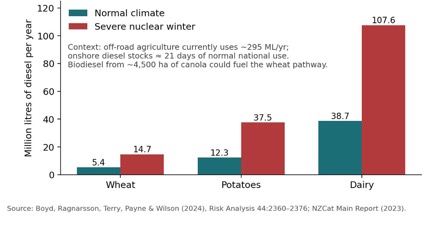
But this surplus may not survive unplanned isolation. Without imported fertiliser alone, yields fall by 20–40%. But the fixes are cheap. As we set out in an earlier post, crop choice matters. Feeding the population with wheat grown in optimal locations needs about 5.4 million litres of diesel a year, against 38.7 million litres for dairy. Biodiesel from about 4,500 hectares of canola could fuel the wheat pathway entirely. Frost-resistant crops can be optimised for nuclear winter. And in a Palmerston North case study, urban and near-urban agriculture could feed the whole city with minimal imported fuel, a strong argument for protecting versatile soils near our cities. What is needed is a sufficiency analysis for food security.
Figure 2. Annual diesel needed to feed New Zealand by production pathway, normal climate and severe nuclear winter (Reality of Food working group, from Boyd et al. 2024, Risk Analysis, and the NZCat report).
What the briefing recommends
The briefing sets out five actions that could be completed within one to two years:
Commission a National Food Vulnerability Assessment. Stress-test imported staples, inputs, processing, distribution, workforce and energy dependencies against zero-trade, no-imported-fuel and climate-shock scenarios, and publish the results. This is consistent with our recommended approach to national risk generally.
Develop a National Food Security Strategy. Aim for secure, nutritious, affordable food for everyone, in ordinary times and in disruption, with a statutory three-yearly food security report as in the UK.
Make a minister accountable for food security, including catastrophe response. Alongside this, establish a commissioner or similar office for catastrophic risk across food, fuel, fertiliser, energy and communications.
Protect sovereignty over critical food-system infrastructure. Oversee processing, seed, milling, cool chains and shipping. Extend the National Fuel Plan to a no-import scenario that prioritises food, and build minimal biodiesel capability.
Enable household and local resilience from the centre. Run a national campaign for 10–14 days of household food and water, with support for those on low incomes, and back community food initiatives, local markets and healthy fisheries as a food resource.
Most of these measures pay off in ordinary shocks such as storms, shipping disruption and price spikes, well before any catastrophe. As our 2025 survey found, most New Zealanders want the government to plan for global catastrophe. This briefing shows where that planning should start.
Closing
Few nations could be a food refuge for their people in humanity’s worst moments. New Zealand can be, but only if a government chooses to plan for it. We hope the incoming one does.
What New Zealand’s infrastructure community does well, and why its next widening should run beyond our shores
The National Lifeline Utilities Forum at Claudelands, Hamilton (Matt Boyd, 11 November 2026).
TLDR/Summary
The National Lifeline Utilities Forum (Hamilton, 10–11 November 2026) showed a capable community moving from visibility to action. Asset registers, vulnerability assessments, mitigation tracking and fuel plans are maturing across sectors and regions.
It’s never just one thing. Speaker after speaker described cascades: bridges lost at their approaches, cell sites lost to electricity failures, communities in disarray when information stops.
A plan nobody has tested is just an assumption. The strongest talks found that plans exist but rest on untested assumptions about what other organisations will decide or provide.
The frame still mostly stops at the coast and at short outages. In my presentation (audio and slides here), I argued that New Zealand’s largest risks arrive from offshore, last weeks, months, or longer, and may come with no outside help (Covid-19 demonstrated this).
Food and international shipping are lifelines in all but name. Onshore stocks of diesel or fertiliser will not last; food production barely featured.
Resilience is insurance, so someone has to decide how much to buy. That decision belongs with citizens, given a realistic picture of local hazards and the state of the world now and in the coming years.
The next step is to plan for weeks and months, for shocks from beyond our shores, and with a public mandate.
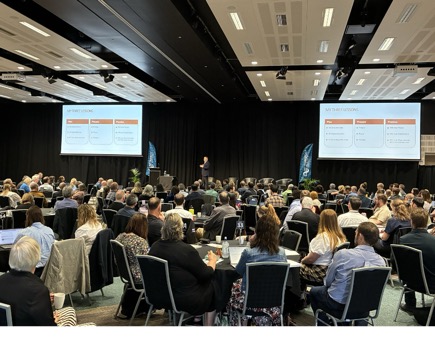
The National Lifeline Utilities Forum is the annual meeting of New Zealand’s infrastructure resilience community: utility engineers, emergency managers, regulators, scientists and councils, more than 200 of them this year at Claudelands in Hamilton. The theme was “Connected Systems, Shared Resilience”. The Emergency Management Act 2026 came into force in September, turning lifeline utilities into “essential infrastructure providers“. The government was in caretaker mode after the 7 November election. And this year’s Hormuz fuel shock had just given the system its first real test of supply resilience.
My thanks to the New Zealand Lifelines Council (NZLC), and to Co-Chair Lisa Roberts and the organising team, for a forum that is practical, collegial and open to an outsider’s challenge. I spoke in the interdependencies session, and report that talk below. My lens, as in my recent posts from SRA Nordic and the Arctic Circle Assembly, is what the forum shows about New Zealand’s readiness for global catastrophic risk, and how a community this capable could widen its frame.
Customers and communities: resilience starts with visibility
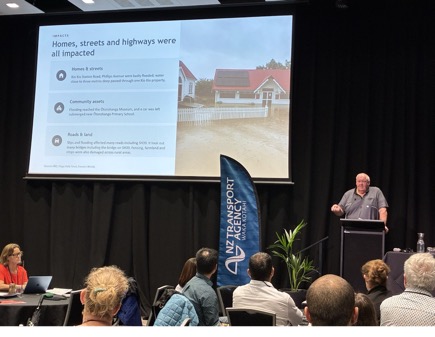
The opening remarks, quite properly for this audience, centred on outage and restoration times. The forum’s first session then widened the view to the people on the other end. Ōtorohanga Mayor Rodney Dow described declaring his first state of emergency in the February 2026 storms. Roads failed at the approaches to bridges, not the bridges themselves. People need to tell their story and be listened to. He recounted being flooded with offers of help, which needed a plan to coordinate. I would add the converse: in a large enough crisis, help will not come, and the plan needs to cover that too.
Figure 1. Ōtorohanga Mayor Rodney Dow on the February 2026 storms (Matt Boyd, 10 November 2026).
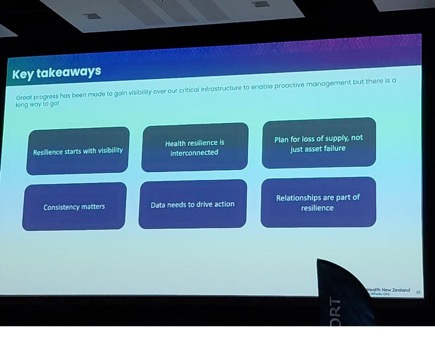
Stacey Marsh (Health NZ) described a national programme to see the health estate clearly: generator and uninterruptible power supply reviews, condition audits, contingent capacity and seismic work. Her six takeaways are also the argument I make about New Zealand as an island: the same logic should be deployed at the scale of a hospital, a sector, a region and the nation.
Figure 2. Six takeaways from Health NZ’s work on infrastructure resilience (Stacey Marsh, Health NZ, 10 November 2026).
Kristen Pari (Te Nehenehenui) and Kyle Barnes (The Lines Company) showed marae solar shared peer to peer with kaumātua households, putting surplus generation to use rather than stranding it.
Government: duties, settings and who pays
Nic Blakeley (MBIE) gave a sensible tour of the risks: a volatile geopolitical order, supply chains strained by the Middle East conflict, cyberattacks (86 of 369 potentially nationally significant incidents last year had suspected state links), and technological disruption.
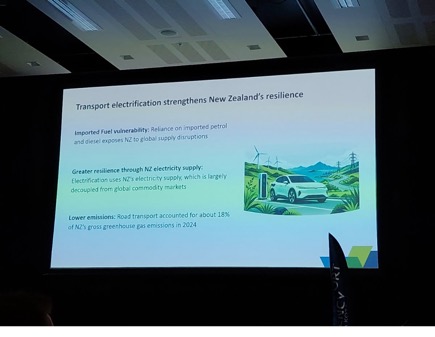
His answer included transport electrification, on the grounds that New Zealand’s electricity is largely decoupled from global markets.
That is true of generation. But the roll-out depends on copper, transformers and vehicles that are all imported and contested, and mining the materials burns diesel, as I set out in my post on AI and resource constraints. Electrification could reduce our exposure in the long run but there are serious risks, sustainability issues, and obstacles facilitating the build. All of this requires a realistic picture of the world is presented to citizens.
Figure 3. MBIE’s case for transport electrification as resilience (Nic Blakeley, MBIE, 10 November 2026).
Jenna Rogers (NEMA) explained the new Emergency Management Act. Lifelines are now called ‘essential infrastructure providers’, with a definition that may widen to payments, data centres and groceries, with new sector response plans and assurance.
Providers must take all reasonable steps to ensure their continued functioning. The duty already reaches global catastrophic risk. But in a long global shock, continued functioning may be impossible and alternative functioning is what matters: a different, minimum service on different inputs.
UK professor Liz Varga’s principle of “resilience net gain” belongs here too: strengthening one asset must not weaken another, and each addition should raise the resilience of the whole system. This requires dialogue and collaborative resilience building.
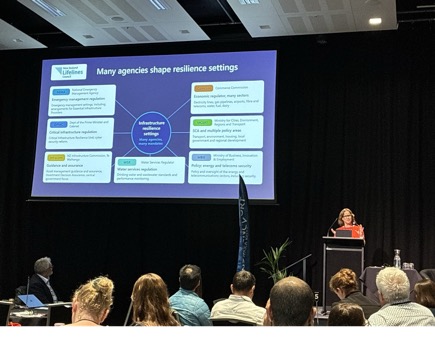
In place of the scheduled DPMC cyber talk, Lisa Roberts showed how many agencies shape resilience settings. Jeff Whitty (Te Waihanga) showed why public-sector asset management lags regulated utilities: revenue that does not come from users, mixed autonomy, limited transparency and few consequences when practice lags. The problem is incentives, not competence. Commerce Commission Chair John Small framed resilience as insurance, and coverage needs to be chosen with the customers who pay for it.
Figure 4. Many agencies, many mandates (Lisa Roberts, New Zealand Lifelines Council, 10 November 2026).
Beyond local hazards: my talk
My talk (audio; slides) began at Þingvellir in 1262, when Iceland’s chieftains swore allegiance to a Norwegian king in exchange for six ships a year. The ships came less often over time, and when Laki erupted in 1783 Icelanders starved waiting for them.
New Zealand has its own six ships, carrying diesel, fertiliser, seed, medicines, spare parts and data, and nobody has promised them to us. Most critical infrastructure thinking stops at the border, but our largest risks emerge offshore and cascade through tightly coupled global systems: nuclear war, severe pandemics, major eruptions, continent-scale cyber or grid failure, trade collapse.
Hormuz was the dress rehearsal. Last week’s Microsoft outages the matinee. Our No Place to Hide review of resilience to global catastrophic risks finds that past a point, connection stops being resilience and becomes fragility, and that New Zealand is one of very few places well placed to ride out a global catastrophe, but only if it prepares.
Diesel illustrates this point. The headline in March 2026 was “46 days” – meaning the amount of diesel available to New Zealand if further imports cease. In a paper under review, Mike Hodgkinson and I recalculated from the government’s own Fuel Security Study: at the lowest point in its data, only about eight days of diesel could be drawn without outages. Spread across a broad reading of the official priority bands, that lasts under 13 days.
Our NZCat report found that about 4,500 hectares of canola could be used to produce biodiesel to fuel the farming needed to feed the country with wheat: Plan B can be quantified in terms of liquid fuel, food, and other necessities.
In my presentation I made three asks:
Widen the National Vulnerability Assessment to dependencies beyond our borders and to the material inputs of basic needs, including food.
Plan around consequences, not hazards, counting stocks in drawable litres and days of supply, and agreeing in advance who gets what.
Publish a national risk register with scenarios and likelihoods, mapped to consequences, then seek a public mandate for the Plan B mitigation options through citizens’ assemblies, as DPMC’s hazards Long-term Insights Briefing has endorsed.
The sector coordinating chairs’ panel followed. The telecoms chair asked central government to imagine life without our digital connections, noting that Starlink is offshore and unregulated and that two of our subsea cables land either side of a volcano.
Electricity reported procurement times of 7 to 12 years for large transmission cables. Water noted that a fifth of the population supplies its own water.
On AI, one chair said cyber threats keep him awake at night; another worried only about an economic bubble.
The NZLC also discussed the 2026 update of the National Vulnerability Assessment, and several good points were made. I would like to see its gaps red-teamed, especially the dependencies beyond our borders, and under the assumption that no outside help is available.
Science to practice
James Palmer (Earth Sciences NZ) kindly called my talk “a call to arms”. His examples were illuminating. Forestry slash formed “beaver dams” at bridges causing flooding in areas nobody had mapped as flood zones. The lesson is to ask what have you missed?
When the cell towers went down and nobody had a transistor radio, communities started to unravel, analogue communications and coordination are needed.
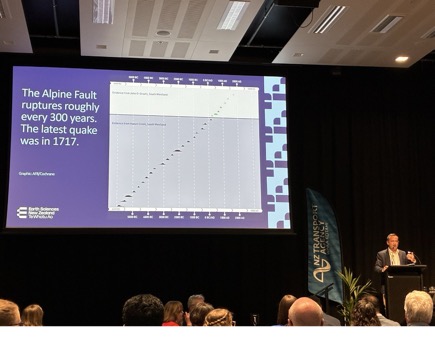
His chart of the Alpine Fault’s rupture record, roughly every 300 years and last in 1717, shows why a 75% chance of a major quake in the next 50 years is a planning assumption, not a forecast to debate. War, pandemics and societal breakdown have their own rhythms too, which is why I argued in my last post for monitoring the global “currents” as carefully as we monitor faults.
Figure 5. The Alpine Fault ruptures roughly every 300 years (James Palmer, Earth Sciences NZ; graphic AF8/Cochrane, 10 November 2026).
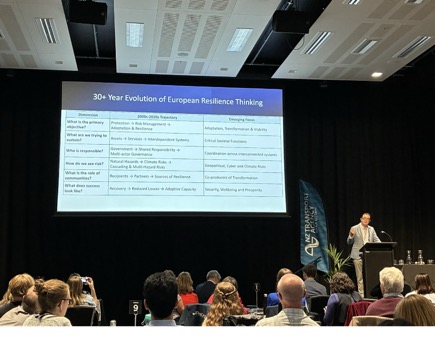
Iain White (University of Waikato) traced trends in 30 years of European resilience thinking: from protecting assets to sustaining critical societal functions, from natural hazards to geopolitical, cyber and cascading risks, and from communities as recipients to co-producers.
That is the trajectory I have reported from the European Urban Resilience Forum and SRA Europe. His word for it was evolution, and it is apt: our metacrisis work argues that good practice spreads only when the conditions for it to arise, spread and hold are in place.
Figure 6. Thirty years of European resilience thinking (Iain White, University of Waikato, 10 November 2026).
Jo Horrocks (Natural Hazards Commission) made the same point from the funder’s side. Excellent science often fails to land, so start from the political decisions that will be consequential and work back, what information is needed to make those decisions? There’s your research project.
And do not leave uptake to chance: build demand, remove barriers, shape the conditions for action.
Talosaga Talosaga (Te Waihanga) used average annual loss to show how flood risk differs across the Waikato and changes over 50 years, a method that deserves use across all risks.
Liam Wotherspoon’s tour of the Natural Hazards and Resilience Platform was impressive, but hazards originating beyond our borders, such as a major volcanic eruption overseas, are not yet in scope, and could be global climate altering, or impact trade, supply, and global communications.
Climate, communities and recovery
Malcolm Johns (Genesis) urged preparing people for the unknown, not plans for every scenario. Karen Lavin (Climate Change Commission) put the forum’s refrain best: it’s never just one thing. Her sharper point was that adaptation is not keeping pace: we are acting, but more slowly than risk grows. Ian Sutton (One NZ) noted that 70% of cell-site outages are power outages, rising to 90% in severe weather, and that who mitigates them is contested between sectors.
We need cooperation not infighting, and cooperation needs to be incentivised by and for the benefit of all citizens.
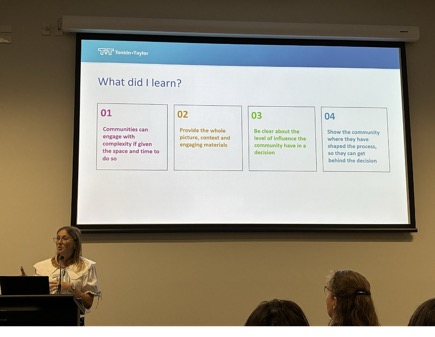
In the community session, Richard Ball (Emergency Management Canterbury) presented a tool for rating recovery severity. Morgan Waugh (Tonkin + Taylor) argued that data doesn’t make decisions; people do. Risk judgements rest on values and experience, community knowledge is evidence, and communities can engage with complexity if given space, time and the whole picture.
Richard Woods (WSP) described how a small iwi (Ngai Tai), recently settled with the Crown, uses intergenerational knowledge of the seasons to read change, with kai sovereignty central to their planning.
The concurrent technical session covered seismic standards, transmission hazards and Chorus’s work on assured fuel supply.
Figure 7. Lessons on community engagement (Morgan Waugh, Tonkin + Taylor, 11 November 2026).
From strategy to action
The closing session contained what I considered the Forum’s most important talk. Danielle O’Shaughnessy (Waikato Lifeline Utilities Group) described turning a regional vulnerability assessment into 346 tracked mitigation projects, then asking the harder question: how prepared are we to respond together if critical infrastructure is disrupted for weeks to months? This framing steps towards the kind of global catastrophe mitigation New Zealand needs.
Organisations were confident about short internal responses, but relied on informal arrangements and on assumptions about what others would provide. Plans exist, but they have not been tested, and they remain organisation-centric. That matches what we found in NZCat, and the cross-silo lessons I brought back from the European Urban Resilience Forum in Rotterdam last year.
Top Energy described how Cyclone Gabrielle exposed a 56-page plan too unwieldy to use, replaced by one response hub and role cards that turn plans into actions.
I’m based in Reefton in the South Island, so I was particularly interested as Paul Gurney (West Coast Lifelines Group) described a fuel programme born of three mobile generators: an Alpine Fault rupture will cut all four roads into the region, so the fuel on hand is all there will be. The group has pre-positioned tanks, generator connections at service stations, emergency pumps and live tests, working through quirks of normal functioning such as the internet-dependence of petrol pumps. That is the right instinct. The next questions are how long that fuel lasts in practice, who gets how much, what happens to the farms and food production, and whether port upgrades at Westport could let the region accept tanker deliveries.
What was missing
The forum’s own lessons point beyond its current frame. “Plan for loss of supply, not just asset failure” and “weeks to months” lead directly to shocks from offshore, where nothing is damaged here but the inputs stop coming. Hazards beyond our borders were largely absent from the programme, apart from my talk and posters on space weather. So was Plan B: most discussion was of restoring normal service, not of running a reduced, different, survival level service for months.
Food was the clearest omission. The attendee list included supermarket and fuel companies, but I could find no one from food production, fertiliser or the Ministry for Primary Industries (MPI), and food has no sector coordinating chair. In a long global shock, high-yield land, seed, fertiliser, diesel and processing are critical infrastructure. Iceland is counting its emergency stocks of food, feed and fuel. We should be too and developing plans to pivot an export industry to the local market at the drop of a hat.
New Zealand needs a national food security strategy. And in the near future our ‘Reality of Food’ working group will be delivering a food security briefing to the incoming government that makes this case in detail.
Next comes resourcing and responsibility. Many speakers asked who pays, and how much resilience is enough. Providers bear the cost of resilience to rare global shocks now, others get the benefit later, and citizens carry the consequences if it fails. Revealed preference and cost-effectiveness cannot settle that. It is a values question, and it needs a public mandate.
Two-thirds of New Zealanders want government to plan for global catastrophe. Deliberative processes such as citizens’ assemblies, which I reported from Finland and Lithuania, let a representative group weigh the options and agree priorities. But they work only if citizens are given a realistic picture: local hazards like the Alpine Fault, and the state of the world, with its fragile supply chains, resource constraints and rising conflict.
Waugh’s lessons apply directly and our charity, Islands for the Future of Humanity, are actively seeking funding for a pilot community assembly on local resilience in Reefton, to develop an approach to this deliberation that would suit any region.
Lessons for New Zealand
Widen the frame beyond our shores. The National Vulnerability Assessment should be red-teamed against global dependencies and the assumption that no outside help arrives.
Plan for weeks and months, and for alternative functioning. Under the new Act, “continued functioning” should include a minimum Plan B service on different inputs and survival functions.
Count our stocks in usable terms. Report diesel and other critical inputs as drawable supply against essential demand, quantify the need, and agree allocation in advance.
Treat food as infrastructure. Bring food production, fertiliser and MPI into the lifelines system, with a sector coordinator. Our food is a lifeline for the world too, collaborate with regional neighbours.
Decide how much resilience to buy with citizens. Give them a realistic picture of local hazards and the world, then let deliberation set priorities and scale.
Closing
I left Hamilton encouraged by how much good, practical work is happening, and by how warmly a room of engineers, emergency managers, and policymakers, received a talk about ships, wars and canola. The forum’s own lessons already point outward; the next step is to follow them.
Many thanks to the Recoverable Foundation and Biome Trust for their philanthropic support of Islands for the Future of Humanity, enabling participation at this Conference.
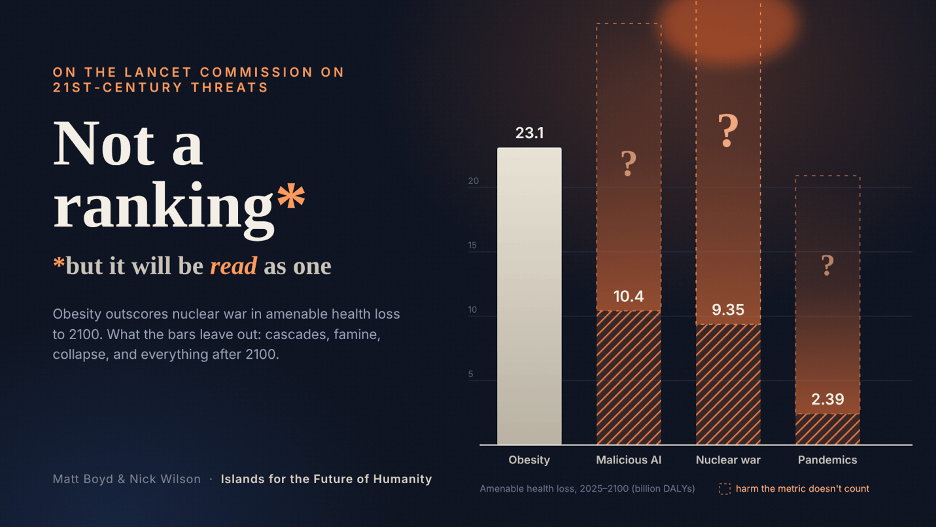
Figure credit: Anthropic Claude’s (Opus 5.5) interpretation of the blog below
TLDR/Summary
A new Lancet Commission Report quantifies the amendable health loss from 17 threats according to potential prevention policy spanning 2025 to 2100.
Obesity (with amenable health loss of 23.1 billion DALYs) beats nuclear war (9.35 billion), which ties with poor mental health. The authors say it is not a ranking, but it will be read as one.
The figures for nuclear war and malicious use of AI rest on subjective forecasts, yet sit on the same chart as estimates built from decades of data on threats such as obesity and smoking.
The metric is health only. Obesity does not destroy ports, power grids or trade, or harm the biosphere. Nuclear war would, and that harm would extend far beyond the blast zone to potentially the whole planet and beyond 2100.
Harms from pandemics, AI and nuclear war are all probably larger than the Commission suggests. Famine is barely treated as a health threat. Major volcanic eruptions (eg, Tambora in 1815 which caused famines) and solar storms are dismissed or missing.
Every scenario assumes business-as-usual to 2100. Yet if we take models such as Limits to Growth even slightly seriously, the next few decades look very different.
The Commission appropriately recommends threat-ready health systems, breakthrough innovation, and an annual Monitor of threats. But we also recommend that future Monitor reports show the strength of knowledge behind each estimate, report catastrophes’ probability and consequence separately from the other threats, stress-test failures of trade and energy, and add monetised harm.
Health research is mostly the study of disease: what makes people sick, and how to prevent and treat it. Our recent work sits elsewhere, in global catastrophic risk: nuclear war, extreme pandemics, volcanic winters, solar storms and artificial intelligence (AI). These could disrupt civilisation itself. The two fields rarely meet. The new Lancet Commission on 21st century global threats to health is innovative because it brings them together. It puts nuclear war and what it calls “malicious use of AI” on the same scale as obesity and smoking related harm. But the way it compares these very different risks could easily be misread, with consequences the authors clearly do not intend.
What the Lancet Commission did
The Commission, led by Christopher Murray (IHME) and Natalia Kanem (UNFPA), published its major Report in October 2026. It defines a “threat” broadly, as among the largest causes of future health loss that policy can change, so slowly developing harms like obesity count, not just sudden shocks.
For each threat it builds a plausible worst and a plausible best future, usually anchored in real experience. The worst case typically assumes a country follows the worst trajectory actually seen since 1990 among countries at a similar level of income and development. The best case assumes it follows the best. The gap between the two, summed from 2025 to 2100 and measured in disability-adjusted life years (DALYs), is the “amenable” burden: the health loss that policy could plausibly avert.
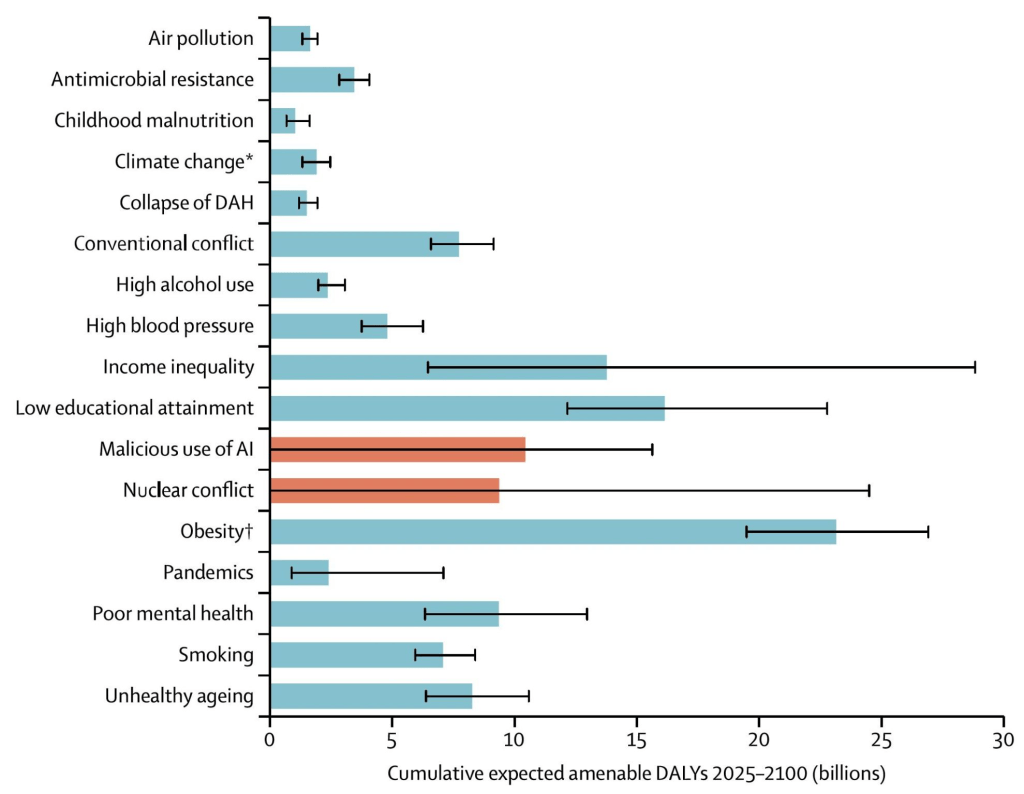
The headline results, in billions of amenable DALYs:
Malicious use of AI (including AI-enabled bioweapons, infrastructure failures and loss of control): 10.4
Nuclear war with nuclear famine: 9.35
Poor mental health: 9.35
Conventional conflict: 7.71
Pandemics: 2.39
Climate change: 1.89
Figure credit: Murray C, et al. The Lancet, 2026; 408, 1603-1661
For scale, Covid-19 caused about 0.5 billion DALYs. The Commission appropriately recommends threat-ready health systems, breakthrough innovation, and an annual Monitor of threats reporting to the G20 group of countries.
What it gets right
The Report puts catastrophic risk on the global health agenda and names “short-termism and localism” as obstacles to good risk governance. It is candid about its limits, and the Monitor is a sensible answer to cycles of panic and neglect.
Its cross-cutting “enablers” also overlap strongly with our own recent review of seven catastrophic risks, No place to hide? (Jehn et al, 2026):
Shared: good governance, reduce inequality, resilient food systems.
Only in the Commission: trust, health-system financing, universal health coverage, human rights.
Only in No place to hide: decentralisation and self-sufficiency (in energy, food and trade), and geographic isolation.
The missing factors in the Commission’s work are those that matter when global supply chains fail.
Comparing obesity with nuclear war: a risk-analysis problem
The authors stress that their summary bar chart “is not a ranking of policy priority”. But the axis displaying level of harm invites such ranking, and busy decision-makers will see bars, not caveats.
However, potential problems arise through method. Each threat is scored by expected value (probability multiplied by harm). That works for chronic disease, but for rare catastrophes it hides most of what matters.
The numbers are built differently. The estimates for nuclear war and malicious use of AI have no well-established statistical model behind them (in contrast to obesity etc). They come from a 2022 forecasting tournament, in which superforecasters and domain experts gave probabilities of global catastrophe and extinction by 2100. The nuclear worst case takes the 95th percentile of those forecasts. The AI worst case uses a different rule (the median plus three median absolute deviations). Both set the best case to zero. The uncertainty intervals for both run from zero upwards.
Strength of knowledge is largely invisible. Contemporary risk science describes risk as consequences plus uncertainty. Uncertainty includes how much we really know. Obesity’s estimate rests on data from 204 countries. Nuclear war’s rests on forecasters’ judgements about 2100, a horizon over which super-forecasting has never been tested. The chart presents both bars side-by-side (albeit they are colour coded and have error bars but these features might not be readily appreciated).
Tail risk is averaged away. The Commission considered giving extra weight to catastrophic outcomes and rejected it. It also rejected reporting probability and consequence separately, because users “might struggle” with two dimensions. That may underrate decision-makers and their officials. Insurers, engineers and defence planners treat rare, irreversible catastrophes differently, because they cascade and destroy the capacity to respond and recover.
Threat size is not urgency. The reverse also holds. A threat with a smaller burden can deserve urgent action if there are simple, obvious things to do now. Many equity, access and pricing problems (such as unaffordable but low-cost essential medicines, or tobacco and alcohol that are under-regulated) are easy to fix with tools we already have. Priority needs tractability, cost and timing, not just size.
Health is not the same as harm
The Commission measures health only: not wellbeing, future generations beyond 2100, economic loss, infrastructure damage, or harm to the biosphere. That is fair for a health report, but it tilts comparisons between threats.
Obesity does not sink ships, burn ports or bring down power grids. Nuclear war, severe solar storms and AI-enabled cyberattacks can. Those losses cause uncounted health harm: if trade in medicines collapses, people with heart disease or diabetes die far from any blast. Each threat is modelled alone, so these cascades never enter the numbers.
A companion comment by Stephen Morrison (CSIS) worries that the Report will struggle to reach finance ministers and heads of state. Our own recent work in progress suggests that harm, not just health, is the lens they need. In a comparative risk assessment for Australia (Graham et al, 2026)*, we put fatalities, asset losses and lost economic output into a single monetary measure. On that basis, AI catastrophe (AU$ 7.8 billion a year) and pandemics (AU$ 7.3 billion) each roughly matched all of Australia’s cyclones, bushfires and floods combined. In the worst 1% of years, catastrophic risks dominated: AU$ 5.8 trillion for AI and 1.6 trillion for nuclear war, against 118 billion for the worst traditional hazard.
Just as disease is not all of health, health is not all of potential human harm. A health-only lens misses the societal perspective, and risks steering resources towards what is easiest to count. An “amenable DALY” is also an “amenable financial harm”, and the Monitor will report to a G20 finance task force.
DALYs also only count harm to people who exist. About half of the amenable burden for low education comes from fewer births, not healthier lives. As another companion Review notes, minimising DALYs “favours an empty future”. Such a metric cannot weigh human survival.
Blind spots
Pandemics may be much worse. The Commission extrapolates 400 years of pandemic history, with pandemic size held fixed. Forward-looking work by Madhav et al estimates a 2–3% annual chance of a Covid-scale pandemic, and 2.5 million deaths a year on average from respiratory pandemics alone. They call that a lower bound. Yet engineered pandemics and bioterrorism appear only inside the Commission’s malicious-use-of-AI estimate.
AI harms may also be larger, and broader. Despite its name, the Commission’s “malicious use of AI” covers three pathways: AI-designed bioweapons, failures of or attacks on AI-dependent infrastructure, and loss of control of advanced AI. But only two extreme outcomes are counted: catastrophe (at least 10% of humanity dies) and extinction, using forecasts made in 2022, before recent rapid gains in capability. Lesser but still huge potential harms, such as cyberattacks on health systems or mass economic disruption with a rise in inequality, are not counted. The authors concede that treating loss of control as amenable to policy may exaggerate their estimate. On balance, we think the omissions matter more.
Nuclear war is a cascade, not a casualty count. Physical modelling by Xia et al (2022) suggests a large US–Russia war could kill over 5 billion people through nuclear winter induced famine, assuming food trade stops. The Commission suggests resilient foods as a partial remedy. That could help survivors outside the attacked areas, but mitigation also has to cover trade, fuel, fertiliser, electricity and medicines. The nuclear figure counts deaths in forecasters’ broad outcome categories, but none of the knock-on effects on other threats, so it too probably understates the harm. Some of these arguments also apply to the Commission’s conventional conflict category – given how such conflict can cascade into multiple other problems (eg, disruptions to basic services in Ukraine and malnutrition in Gaza).
Famine barely counts as a health threat. The climate analysis includes heat stress deaths (its largest pathway), air pollution, floods, storms, malaria and dengue. Crop failure enters only indirectly. Drought, migration and famine are excluded, because “famine is a sociopolitical phenomenon”. Famine is not a threat in its own right anywhere in the Report: childhood malnutrition is chronic undernutrition, and famine appears only after nuclear war.
Yet famine is amenable to policy whatever its cause. Our new analysis of 38 major volcanic eruptions (preprint pending) reveals that famine rates have historically risen by about 60–70% after them, with more famine after bigger eruptions. Eruptions act together with weak reserves, inadequate relief efforts, conflict and trade restrictions, which are exactly what policy can change.
Volcanoes and the sun. The Commission dismisses supervolcanoes as too rare to mitigate. But Cassidy and Mani (2022) estimate a one-in-six chance of at least a Tambora-scale eruption this century, and the same resilient foods that would help after nuclear war would help after a volcanic winter. Severe solar storms are not mentioned at all.
Business-as-usual to 2100?
The Commission’s biggest assumption goes unstated: that the world carries on. Because “plausible” is defined by what countries have experienced since 1990, the method cannot produce a discontinuity. Growth, energy, trade and medicine supply all continue, and life expectancy rises every year to 2100.
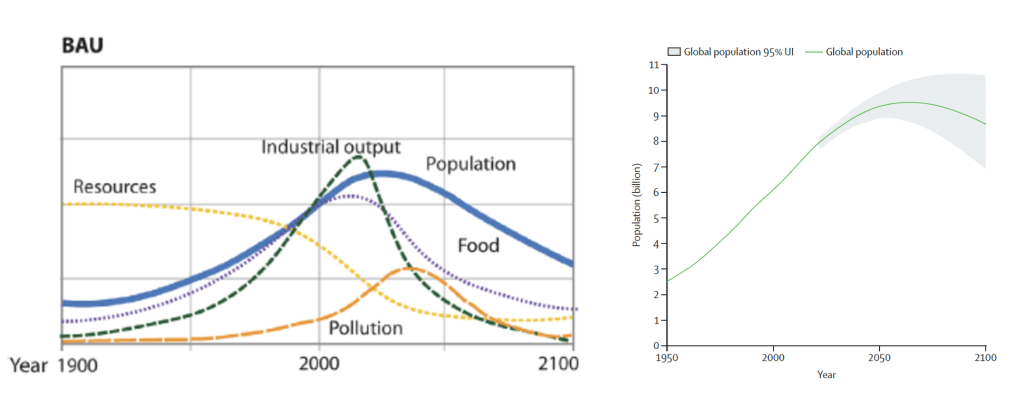
The seminal Limits to Growth (Meadows et al, 1972) suggested otherwise. Recent comparisons with real data by Herrington (2021) and Nebel et al (2023) found the world tracking its business-as-usual run, with a turning point around 2024–2030 and sharp declines in energy availability, material production and life expectancy.
The Lancet’s global population model (below right) peaks at about 9 billion mid-century and pulls back to 8 billion by 2100. The Limits to Growth model (below left) peaks today, and halves by 2100. Such scenarios and assumptions make a big difference to health priorities.
Figure: Global population models through to 2100; Limits to Growth (left) and Lancet Commission (right).
If resource limits, trade disruption or a major shock arrive in the next few decades, health priorities likely change dramatically. Medicine and vaccine supply chains, food security, primary care, infection control and local manufacturing all move up the priority list. Catastrophe preparedness pays dividends twice, buffering slower decline too.
There is an additional argument we are sceptical of, for an AI-fuelled techno-utopia which inverses the limits to growth trajectories. This scenario would likewise reframe the Commission’s model, in substantially different ways.
Where the Commission meets the Global Catastrophic Risks and Effective Altruism worlds
Comparing very different causes on an amendable health loss scale is not new. Health economists do it (eg, Pharmac, and New Zealand’s BODE3 programme), and so does Effective Altruism (EA).
EA asks how to do the most good with limited resources, and its organisations (eg, GiveWell, Open Philanthropy and 80,000 Hours) rank causes on three factors:
Importance: how much harm the problem causes or could cause;
Tractability: how much progress extra effort would buy;
Neglectedness: how few resources already go to it.
EA’s priorities are global health and development, animal welfare, and catastrophic risks. 80,000 Hours currently puts AI, engineered pandemics and great power conflict (including nuclear war) near the top.
The Commission measures mainly importance. Its “amenable” gap is a rough proxy for tractability, but without costs. It uses neglectedness only informally: heart disease and some cancers were left off the list because they are already well funded.
Who is getting it off course? Probably both, in opposite directions.
The Commission likely underestimates catastrophic risk. It ignores future generations (beyond 2100), non-health harm and cascades, harm to the biosphere and other living beings, and averages away the tail.
EA likely underweights the vast, slow burdens the Commission highlights: obesity, low education, inequality and mental health. EAs would say these are not neglected or tractable priorities per dollar, which is now testable.
Both largely assume business-as-usual, with AI as the only major source of discontinuity and a major uncertainty at that.
The two world views already overlap: the Commission’s companion Review draws on population ethics and was part-funded by Open Philanthropy. Yet we could find no discussion of the Report on the EA Forum by 1 Nov 2026. We think practice communities such as EA and catastrophic-risk researchers should formally engage with it.
Conclusions: how to read the Commission’s Report
The Commission’s work is serious, ambitious and welcome. Our worry is that reports travel without their caveats. If it is read as “obesity is a bigger threat than nuclear war”, it could pull attention away from the catastrophic risks that probably matter most in the coming decades.
The Commission’s work is an estimate of the health loss that policy could avert by 2100, in a world that carries on roughly as it has since 1990. It is grounded in data for chronic threats and in judgement for nuclear war and AI.
But it is not a ranking of priorities across all these threats or a guide to the cost-effectiveness of threat reduction. Nor is it a measure of economic, social or harm to the biosphere, or of harm to future generations, and it does not test for collapse or cascades.
Future Monitor reports could show the strength of knowledge behind each estimate, report catastrophes’ probability and consequence separately from the other threats (like obesity), stress-test failures of trade and energy, and add monetised harm. There are real risk-science lessons here for everyone.
* The linked preprint is an old version that does not yet include the AI results, we can share the latest version with anyone interested.