
The Reality of Food working group asks the next government to make someone responsible for feeding New Zealand
TLDR/Summary
- We have released a new briefing to the incoming government on national food security. It comes from the Reality of Food working group, part of the Reality of Everything collaboration (read the media release)
- The core problem is complacency. New Zealand exports food, so it is assumed to be food secure. But no minister or agency is responsible for national food security, and no one monitors it.
- Food is critical, but critically dependent. National production rests on imported diesel, fertiliser, agrichemicals, seed and machine parts, and on fragile distribution and payment systems.
- Our closest partners treat food as national security. The UK has assessed ecosystem collapse as a threat to its food system and has told households to stock food ahead of a record El Niño and the threat of cyberattacks.
- New Zealand could feed itself through even a severe global catastrophe, but only with prior planning (see the NZCat Report). We recommend a National Food Vulnerability Assessment, a National Food Security Strategy and a minister accountable for both.
A briefing for the incoming government
The Reality of Food has released National Food Security: A Briefing to the Incoming Government. A media release accompanies it. The briefing is addressed to the incoming ministers for agriculture, environment, emergency management, energy and economic growth, climate change, health, social development, Māori development and finance. That list is itself the point. Food security cuts across at least nine portfolios, and no single one is accountable for it.
The timing is deliberate. Coalition negotiations after the 7 November election are still under way. A new government sets its priorities in its first months, and this is the moment to put national food security on the list.
Where the briefing comes from
The briefing was prepared by the Reality of Food working group, a spin-off of the Reality of Everything collaboration. Its symposium in Wellington in June brought policymakers, politicians, researchers, business and community groups together to take stock of climate, biodiversity, energy, water, food, the economy and health. We reported on it here, and offered a field guide to its key terms: global catastrophic risk, systemic risk, polycrisis and metacrisis.
The working group brings together several New Zealand organisations working on global risk and resilience. The briefing is supported by Reality of Everything, Wise Response, Islands for the Future of Humanity and Adapt Research. Internationally, the Alliance to Feed the Earth in Disasters (ALLFED) has done much of the foundational work on feeding people through global catastrophes. It was not part of this briefing, but its research runs through the field.
Special thanks go to Dr Catherine Knight, convenor of the Reality of Everything symposium. Catherine’s energy and persistence got both the symposium and the food working group off the ground, and she has been making the case for national food security for years, including on her Substack, An Uncommon Land.
Complacency in a destabilising world
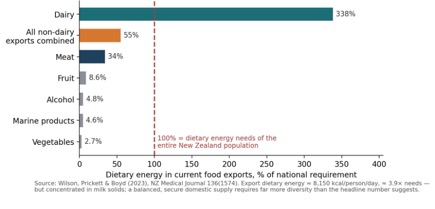
New Zealand often claims that it “feeds 40 million people”. That figure is a theoretical maximum. It needs uninterrupted imports and unrealistic crop choices, and in practice our surplus is almost entirely milk solids. Bread wheat, rice, sugar and edible oils are largely imported, mostly from one or two countries.
Meanwhile, for many households, food emergency is already everyday life. In the year to July 2025, 21.4% of children lived in households where food ran out often or sometimes, rising to 32.3% of Māori and 44.3% of Pasifika children.
Food prices are rising faster than general inflation.
Unusually among comparable nations, New Zealand produces no regular report on the state of its food security.
Food is critical, and critically dependent
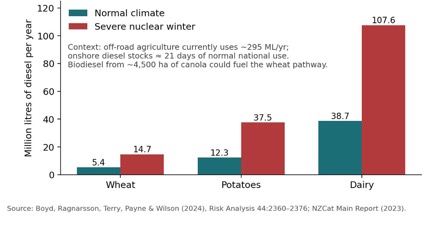
Food is the most basic of needs, but it is not a self-contained system. It depends on almost everything else. Our farms run on imported diesel, about 300 million litres a year for off-road agricultural uses alone, and statutory onshore stocks equate to about 21 days of normal national use.
Yields depend on imported nitrogen and phosphate fertiliser, agrichemicals, seed and machinery parts. Food reaches households through a handful of distribution centres, by road, and through payment systems that depend on offshore data infrastructure. Lose any of these inputs and the surplus does not survive.
This is the systemic risk lens we apply to all our work. In 2026 the Strait of Hormuz disruptions squeezed the diesel and fertiliser that New Zealand’s food system cannot do without, and a record El Niño now threatens yields worldwide. As I described at the National Lifeline Utilities Forum two weeks ago, islands are at severe risk in trade isolation scenarios.
The global context: our partners treat food as security
The briefing draws on the United Kingdom’s recent assessments. In January the UK published Global biodiversity loss, ecosystem collapse and national security, a Joint Intelligence Committee and Defra assessment that warns ecosystem collapse threatens UK food security.
That UK report had been withheld and was released only after a Freedom of Information request, abridged to remove some of the most severe risks, including food system collapse. Rupert Read has documented the story. The UK also reports to Parliament on food security every three years, a statutory duty since the Agriculture Act 2020. Its latest Food Security Report describes compounding shocks behind its worst food inflation in 45 years.
In September, the UK Environment Secretary urged households to stock up on food ahead of what forecasters are calling an unprecedented El Niño, after the National Audit Office found the government had done too little to strengthen food system resilience. Cyber risks to the food system have been on display recently with attacks on refrigeration in Europe.
The US Global Catastrophic Risk Management Act of 2022 likewise treats food as a core part of protecting the population in a major crisis. New Zealand has no equivalent.
New Zealand could feed itself, but only with planning
Our own research gives grounds for hope, on a condition. The Aotearoa NZ Catastrophe Resilience Project (NZCat) and associated papers found that even a severe nuclear winter, cutting domestic yields by 61%, would leave diverted export production at about 150% of national dietary energy needs. Our 2026 review, No Place to Hide, confirms New Zealand and Australia as the countries most resilient across the widest range of catastrophe pathways. It also concludes that resilience is a policy choice, not geographic fate.
But this surplus may not survive unplanned isolation. Without imported fertiliser alone, yields fall by 20–40%. But the fixes are cheap. As we set out in an earlier post, crop choice matters. Feeding the population with wheat grown in optimal locations needs about 5.4 million litres of diesel a year, against 38.7 million litres for dairy. Biodiesel from about 4,500 hectares of canola could fuel the wheat pathway entirely. Frost-resistant crops can be optimised for nuclear winter. And in a Palmerston North case study, urban and near-urban agriculture could feed the whole city with minimal imported fuel, a strong argument for protecting versatile soils near our cities. What is needed is a sufficiency analysis for food security.
What the briefing recommends
The briefing sets out five actions that could be completed within one to two years:
- Commission a National Food Vulnerability Assessment. Stress-test imported staples, inputs, processing, distribution, workforce and energy dependencies against zero-trade, no-imported-fuel and climate-shock scenarios, and publish the results. This is consistent with our recommended approach to national risk generally.
- Develop a National Food Security Strategy. Aim for secure, nutritious, affordable food for everyone, in ordinary times and in disruption, with a statutory three-yearly food security report as in the UK.
- Make a minister accountable for food security, including catastrophe response. Alongside this, establish a commissioner or similar office for catastrophic risk across food, fuel, fertiliser, energy and communications.
- Protect sovereignty over critical food-system infrastructure. Oversee processing, seed, milling, cool chains and shipping. Extend the National Fuel Plan to a no-import scenario that prioritises food, and build minimal biodiesel capability.
- Enable household and local resilience from the centre. Run a national campaign for 10–14 days of household food and water, with support for those on low incomes, and back community food initiatives, local markets and healthy fisheries as a food resource.
Most of these measures pay off in ordinary shocks such as storms, shipping disruption and price spikes, well before any catastrophe. As our 2025 survey found, most New Zealanders want the government to plan for global catastrophe. This briefing shows where that planning should start.
Closing
Few nations could be a food refuge for their people in humanity’s worst moments. New Zealand can be, but only if a government chooses to plan for it. We hope the incoming one does.

